Choreographer impresses once again at Dublin Theatre Festival following success of Loch na hEala
[rating]4[/rating]
After thrilling with Loch na hEala, choreographer Michael Keegan-Dolan again impresses with MÁM at Dublin Theatre Festival, writes
Michael Keegan-Dolan’s Teac Damsa returns to the Dublin Theatre Festival three years after Loch na hEala, a sensational work that was many people’s highlight then, and continues to tour now, having only recently played in Cork as part of the Sounds From a Safe Harbour festival.
Loch na hEala is from a well-established strain of Keegan-Dolan’s work that embraces narrative, weaving the old story of Swan Lake with the Children of Lir to tell a story about the dark sides of Irish life, public and private.
This time, there’s nothing so literal. No speaking parts. Just musicians and dancers. Just? Perhaps that’s the wrong word. With such imagination, such thrilling, thunderous physicality, such beauty and evocative power, what more could anyone want?
There is continuity with the previous Teac Damsa show in a couple of senses, however. Firstly, it’s another step in Keegan-Dolan’s deepening engagement with Irish musical tradition.
Secondly, it’s another example of his genius as a facilitator of surprising, enriching collaborations.
Mám, a word meaning mountain pass, and thus a place of potential meeting, here brings together the concertina maestro Cormac Begley and a host of international dancers and musicians.
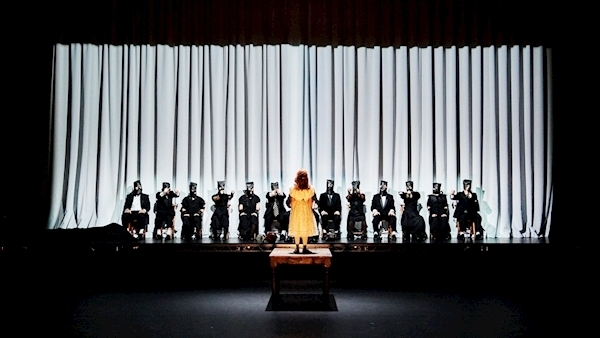
We open with symbols of Irishness: a child in Communion dress, eating Taytos as Begley, wearing a ram’s head mask, looks on. He plays a selection of familiar airs, most prominently O’Neill’s March, which becomes something of a motif.
This is a show of layers, each revealed not by a curtain up, but, in a flourish from designer Sabine Dargent, a curtain fall.

The rail tilted, the curtain itself slides off it, piling swiftly on the floor at one side until, with a thump, a new element is revealed. The first time this happens, it’s to bring in the dancers, seated, masked and all in black.
The second, it’s to introduce the stargaze ensemble, via an opening violin sonata, bringing a sound world evoking Bach and Vivaldi. That soon broadens out into a range of more contemporary sounds, at first jolting the dancers, as if out of another headspace.
It all comes together soon enough, of course, in keeping with Keegan-Dolan’s humanist vision, which emphasises the local and the rooted only to remind us of what we all have in common.
It’s uplifting: a cross pollination from the centre of European musical tradition to the periphery, the western edge of Europe, which both Belgey and, now, Teac Damsa, call home.
This is a choreographer at the top of his game, working with some superb artists to create something special.














