The high cost of just staying alive
If you want to survive, you better be in a position where you can raise funds pronto, writes Michael Clifford.

The high cost of just staying alive

If you want to survive, you better be in a position where you can raise funds pronto, writes Michael Clifford.

Christmas festivities were still in swing when John Holmes was presented with the limits of his mortality.

He’d had a persistent cough, but, like most men, had done nothing about it until his wife, Edel, had pushed him to see a GP.

The doctor spotted something, didn’t think it was sinister, but had some tests done anyway. Then, on December 29, 2012, John got a call from him.

“He said the results were in and would I go see an ENT [ear, nose, and throat] guy in Dublin,” John relates. “I said ‘when?’, thinking he would suggest not to leave it too long and he said at 2.30pm that very day. It floored me. Came out of the blue.”

John was diagnosed with a rare form of throat cancer. He had neuroendocrine of the larynx. He was 47, married, with two children who were just emerging from their teens. Life had been good, and then, out of the blue, the future was swiped away.

There followed a journey that is familiar to anybody who has had a cancer diagnosis. And now John is reaching for what could be genuine hope.

Pembro is the best-known of a new generation of cancer drugs.

John has been screened and deemed appropriate to try it. The problem is that the drug is only available through the HSE for those who suffer from cervical cancer.

That dispensation came after some Trojan lobbying by Vicky Phelan. But what of people like John?

“Are we supposed to die, while others who have been given access to the drug might live?” he asks.

The only option open to those in his predicament is to pay for the drug themselves. John is not wealthy, but he is blessed with friendships that have accumulated over a life in his native Kilkenny city.

And some of those friends, of their own volition, have stepped into the breach and set up a fundraising campaign to give John the best chance of life.

Is this what we have come to, in terms of a health service? If you want to live, you better be in a position where you can raise funds pronto?

John hasn’t been too bad for the last few months. That’s largely down to the fact that he hasn’t been receiving chemo. Neither has he had surgery for over a year.

Both forms of treatment have run their course, as far as John’s cancer is concerned.

It’s certainly a bonus to John’s wellbeing that he is neither sick nor weak at the moment, after six years of constant treatment. But it also signals that his avenues of rescue from the disease have narrowed.

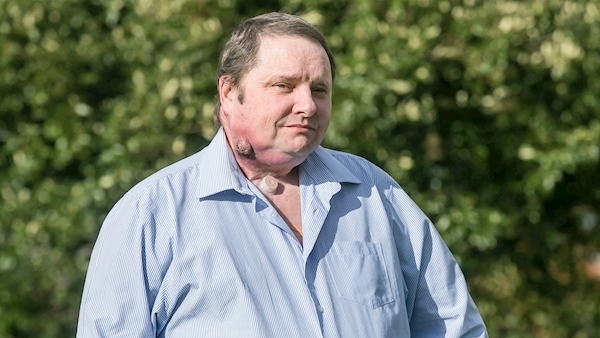
Today, the condition is evident in a large growth on his neck. He says he also has one on his back.

“They’re appearing on the outside, which is good,” he says. “The doctors have told me that if this had been happening on the inside, I would be gone by now.”

John is a native of Kilkenny. His life has been woven into the fabric of the city, through his lifelong involvement in business and sport.

After the diagnosis, the first attempts at fighting the condition involved non-invasive laser treatment. The discovery that the cancer hadn’t spread from his throat meant there was a good chance of killing it. That didn’t happen, however.

There followed a series of surgeries in St James’s Hospital in Dublin. John can’t remember how many, but there were three major surgeries. Again, the results were not as hoped for. In the end, they said they couldn’t keep opening him up.

“No further intervention was what was advised,” he says. “At that stage, I went back to my GP to try to find alternatives. I was looking at seeing could I go to England, or whatever. Then, the GP said there was one other possibility, this guy in Dublin, John Crown.”

This wasn’t just any old guy in Dublin. Professor John Crown is known for his vocation to fight cancer by any means necessary. Once upon a time, he was a fixture on national media. There followed a stint in the Seanad, where he was one of the vocal independents who bring an outsider’s perspective to the insider’s game.

He didn’t put his name forward for re-election in 2016 and has been largely below the radar since then. The public square’s loss has been a further gain for cancer sufferers, as Prof Crown invests all his energy into fighting the disease.

John was impressed by the message the professor gave him on their first meeting.

“He said ‘we’re not going to let you die’, which was very reassuring, after being sent home from James and told there wasn’t much more that they could do.”

The aggressive chemo started soon after. Much of it required stays in hospital in Dublin.

He suffered some severe effects. His friend, Kieran Conway, put it blunty.

“It was awful,” he recalls. “At one stage, John looked like a lab rat.”

This went on for two and a half years. The treatment appears to have slowed down the cancer, but it was still there. And then, one day, John read about this new drug. He looked further into it and found out that Pembro was originally designed to treat small-cell lung cancer, a form of the disease that was similar to what he had.

“I found out that you can get tested to see if you are suitable for the drug,” he says. “So I did that with an independent laboratory, which came back with the result that I had one of the five markers that suggest your tumour could respond to Pembro.”

He shared the news with Prof Crown, who suggested trying one more dose of chemo, before heading down a route that could prove financially ruinous.

The chemo still didn’t do the job, so John set about acquiring the drug.

John and Edel considered selling their home, but, ultimately, ruled against it. That’s the kind of choice with which people in their position are faced.

He raided the family savings, but that was barely enough to get things going. For instance, the recommendation John received was that he would need three doses, each administered in ten separate phases, three weeks apart.

The cost of the full treatment is €150,000.

That was the dilemma John and Edel faced last November. They decided to begin and use whatever money they had.

Even in that regard, there was a sting.

After organising for the first phase of the first treatment, which he was told would cost €4,000, he was told, at the last minute, that he’d also have to pay the VAT, for a total of €5,111.

Around that time, his friends stepped in. Kieran put together a fund-raising committee.

“It was a diverse group of John’s friends that came together,” says Kieran.

“People from business, others who were in school with him, played sport, all different areas of his life. We set out an aim of raising around €5,000 every three weeks, so that he could get what he needs.”

Since then, the committee, aptly called John Needs Pembro, has been organising various activities, including quizzes, business breakfasts, music events, and calling on the people of Kilkenny to support one of their own.

The members have also engaged in lobbying. One target was the drug company, Merc Sharp and Dome (MSD), to see if there was even a chance of a break on the price.

“MSD had a conference call with us and, in the end, told us that any issues we had with price was with the HSE and not them. They said the sector was so heavily regulated that a break on the price would get them into trouble.”

They also lobbied politicians to see if there was a chance of doing something about the Vat. So far, no luck.

The meat and drink of the fundraising, however, has borne results. They have now exceeded the €50,000 required for the whole of the first treatment.

Twice as much will now have to be raised in the coming months.

John and those around him are aware that while fate has dealt him a horrible blow, he is lucky to be surrounded by people in a position to do what they can.

“What about the people who don’t have friends to call on, like John has?” says Kieran. “Bad and all as John’s situation is, theirs is even worse.”

On the other hand, John can point to a health policy that denies him access, through the HSE, to this drug, while others are granted it.

“Pembro was initially developed for small-cell lung cancer and what I have is similar to that, yet I’m denied it,” he says.

“Others are given it and good luck to them, but it should be there for anybody for whom it is deemed suitable.”

Pembro for some cancer patients — but not others

On January 23, the Minister for Health, Simon Harris, announced that immunotherapy drug Pembrolizumab would be made available to all women with cervical cancer, once their doctors recommended it.

The move ended an inequity in which the 221 women caught up in the CervicialCheck controversy had access to the drug, while others did not.

However, it also highlighted another inequity. Others who have cancer, and are deemed on medical or scientific opinion to be suitable for treatment with the drug, do not receive it through the state.

That was the dilemma faced by John Holmes — and many others — when they sought to get the drug.

Last month, the case of Philomena Canning was highlighted on these pages. Ms Canning, a midwife of considerable repute, was suing the HSE for wrongful suspension dating from 2014. She had refused a settlement because she wanted the issues attached to her case aired in public court. However, after receiving a terminal diagnosis for ovarian cancer, she went public with her case in order to receive a settlement so she could pay for Pembro.

Again, if she had cervical cancer or another strain of the disease that is covered by the HSE scheme, she would not have been put in that position.

Currently, there are three principal forms of cancer for which the HSE has approved reimbursement for Pembro.

These include forms of melanoma in adults (approved June 2016), forms of metastatic non-small cell lung carcinoma in adults (approved April 2018) and some forms of Hodgkin lymphoma (approved November 2018).

According to the HSE, the drug company Merc Sharp Dome (MSD) has applied for reimbursement of Pembro for small cell lung cancer and bladder cancer and “these applications are being considered in line with agreed procedures and the reimbursement process is ongoing”.

The only exception to the process of determining what cancers should qualify is cervical cancer.

“Pembrolizumab is available for use in the treatment of cervical cancer outside this process as directed by Government,” the HSE stated in response to queries from the Irish Examiner.

For those who believe, or are advised, that the drug could benefit them, they must pay the considerable amount of money at issue.

“The decision to facilitate the treatment of patients who wish to self-fund treatment is taken by each hospital,” the HSE statement says.

x

More in this section

Cookie Policy Privacy Policy Brand Safety FAQ Help Contact Us Terms and Conditions

© Examiner Echo Group Limited













