Ask John Paul: Men who share the Pope’s name on the big changes during their lifetime
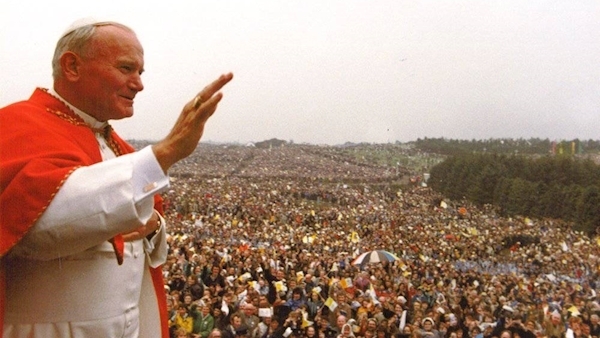
40 Years after the visit of Pope John Paul II to Ireland, Pat Fitzpatrick looks back at that era and asks men who share the Pope’s name what they think of the big changes during their lifetime

Ask John Paul: Men who share the Pope’s name on the big changes during their lifetime

40 Years after the visit of Pope John Paul II to Ireland, Pat Fitzpatrick looks back at that era and asks men who share the Pope’s name what they think of the big changes during their lifetime

IRELAND, 1979. Women looked like Joanna Lumley in the New Avengers; men looked like they had slept in a hedge.

Around 40,000 married couples had six or more children. Drink-driving ads were telling us ‘just two will do,’ or 22, if you know someone in the guards. Brendan Shine’s, ‘Do You Want Your Oul Lobby Washed Down,’ spent five weeks at number one.

A month before Pope John Paul II’s visit, 18 British soldiers were killed in Warrenpoint, on the same day Lord Louis Mountbatten was one of three killed by an IRA bomb in Sligo.

The Pope’s public appearances attracted an audience of 2.5m (out of a population of 3.3m). There was a baby-boom exactly nine months after his visit. (Don’t think about that too much; it’s completely disgusting.) The Pope’s support acts included Fr Michael Cleary and Bishop Eamonn Casey (throw in a ‘Golden Cleric’ award, and you could have been looking at an episode of Father Ted).

One in 10 baby boys born in 1980 were named John Paul. It’s fair to say they’ve seen a lot of changes.

John Paul Feeley, born in 1981, is a solicitor and Fianna Fail councillor on Cavan County Council. His home, in Blacklion, is on the border with Northern Ireland, and because of that he has been him invited on Al Jazeera and Sky News to talk about Brexit. So it isn’t a surprise when I ask him about the biggest change in his area since 1979.

John Paul Feeley
John Paul Feeley

“It’s the peace process. The big change was north of the border, where the security forces were particularly intimidating. That going was the biggest change, and something our community took for granted, were it not for the fact that our neighbours north of the border are causing us trouble again.”

What does he think about recent referenda? “I opposed the introduction of abortion. I think we should be fair: a third of the people who voted, voted against it. There was well-organised conditioning, leading up to them [the referenda] and a lot of people didn’t think too deeply about them and followed the popular position.”

John Paul O’Shea, from Lombardstown, near Kanturk, is a Fine Gael councillor on Cork County Council.

A practising Catholic, this John Paul doesn’t hesitate when I ask what has changed most since he was born in 1983.

The biggest change is people’s involvement in the Church; 35 years after I was born, there are a lot more ethnic groups and religions in Ireland, and the Church doesn’t have as significant a role as it had in 1979.

While rural broadband remains an issue for his community, O’Shea acknowledges the advances in technology. “I remember when the neighbour across the road got a phone and we used to use it: someone would ring at half-six and we’d have to be over outside the gate when the phone rang, and the neighbour would answer, but she had a cross dog, so she had to come out and leave us in.

John Paul O’Shea
John Paul O’Shea

“Technology has reduced the need to go out, to call to the local church, shop, or the pub,” says O’Shea.

“A lot of people stay at home and watch the Sunday Mass on RTÉ. Our local church doesn’t have a Sunday morning mass any more, because it doesn’t have the priests, so the Mass now is on a Saturday night.”

You might be surprised to hear there were John Pauls in Ireland before the papal visit. John Paul Calnan, from Cork, tells me he’s over 40, when I contact him on Facebook, and adds: “I’m not named after the pope, I’m glad to say.”

But unlike some other John Pauls, he can remember Ireland in 1979. “I was 16. I didn’t go to see the Pope. I knew I was gay, at that stage, but couldn’t talk to anyone at the time, I didn’t come out until I was 21.”

Did he find that his sexuality held him back, in 1980s Ireland?

“Not really. Once I came out, my life was transformed. I went from thinking I was the only gay in the village, and then realising that I wasn’t and found a sense of community around me. From then on, it was all fine.”

John Paul Calnan
John Paul Calnan

When does he feel that Ireland started to change its attitudes? “I came out in 1985. David Norris had already started down the road of getting the laws changed around homosexuality. It took the government until 1993 to decriminalise, but I felt that things were about to change. I never thought I’d get married, but did so in 2008.”

Does he think life in the 1980s Ireland was all bad? “I knew a lot of people, not just gay people, who left because they didn’t fit in, that Ireland didn’t accept them for what they were. But I also know quite a lot of people who have come back, not because of prosperity and the Celtic Tiger, but because they were ready to come back and recognised that Ireland is a much more accepting place.”

Ireland in 2019 is more colourful in every sense. That’s got to be a good thing, as long as people don’t use it as an excuse to bring back two-tone anoraks. (What were we thinking?)

x

More in this section

Cookie Policy Privacy Policy Brand Safety FAQ Help Contact Us Terms and Conditions

© Examiner Echo Group Limited













