Screened out: What happens when a parent is distracted by technology?
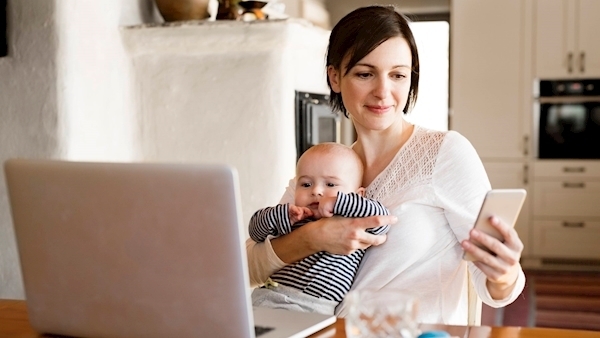
It’s easy to miss out on what your baby is doing because you’re distracted by your phone. Striking the right balance between screen time and time with your child is essential, writes
MÁIRE Toomey from Cabinteely, Co Dublin, didn’t realise she had a problem until her husband told her to put down her phone. “He told me that one of our children had been trying to talk to me and I hadn’t heard them because I was so engrossed in the screen,” she says. “I immediately felt terrible.”
Toomey is a mother of three who works from home, which is why she had got into the habit of always having her phone to hand. “I would respond to everything straightaway,” she says. “Emails, texts, social media; as soon as I heard a ping, the phone was out of my pocket.”
She is far from the only parent to be distracted by technology. Now that 90% of the Irish population has smartphones, most of us are subject to an endless barrage of notifications and it’s all too tempting to open each one as it arrives.
Experts are now warning that parents who pay too much attention to technology risk affecting their child’s development in a negative way.
Child psychiatrist John Bowlby did seminal work on attachment theory in the 1950s which is still central to our understanding of child development. One of its key principles is the importance of eye contact.
“Children develop their sense of self by seeing themselves reflected in their parents’ eyes,” says Joanna Fortune, psychotherapist and author of 15 Minute Parenting.
“Up to four months old, they don’t see themselves as separate to their mothers. So, when their parent looks at them with love, they don’t see the parent but rather that they are loveable. How a parent looks at their child in those early years lays the foundation for all future child development.”
She mentions a Facebook post that went viral in 2014. “A Californian called Brandie Wood watched her two-year-old twin sons playing. She counted 28 occasions when they looked up to catch her gaze, to see if she was noticing them and was present with them in the moment.”
This mother realised that she would have missed those glances if she had been working on her laptop, as she would usually have been. She ended her post with a plea to parents to put down their technology and pay more attention to their children. That post was shared more than 42,000 times in three days.
“This shows how digitally distracted parenting is a growing problem in today’s society,” says Fortune.
Chris Calland, a child behaviour expert and adviser to parents, schools, and nurseries, has already seen the consequences of this problem.
“Teachers are noticing that parents are too focused on their phones at pick-up and drop-off times,” she says.
“There is a lack of important interaction with their children.
“The early years are when you build your understanding of the world and where you fit in it. You learn social skills and empathy and you do this by communicating through eye contact, touch and conversation with your caregivers.”
She gives the example of a child walking home from school with a parent who is on their phone. “The message that child is getting is that they are second best,” she says. “They learn that there is no point in trying to communicate or alternatively, they act up in unhelpful ways, thinking that negative attention is better than no attention at all.”
Such acting up can make the situation much worse. According to a study published in the Paediatric Research Journal last year, it is common for parents who are stressed by their children’s behaviour to retreat into technology. This leads to worse behaviour from the child and further withdrawal by the parent; a vicious cycle that helps no one, least of all the child.
Parents being distracted by their phones may also be having an impact on children’s language skills. “The evidence is anecdotal at the moment, but children are arriving at school without the skills that are expected of them at age four or five,” says Calland.
This doesn’t surprise Catriona Lysaght, a senior speech and language therapist at the Speech Centre.
“When people think of learning to speak, they often think of first words like mama and dada,” she says. “But a baby will only start to use words if they know they will be listened to. Otherwise, they lose interest. It’s the parent’s response to the baby’s early attempts that guide development and help language to grow.”
Children who don’t get enough of a response can suffer delay in development. “Small children experiment with language all the time and need our responses to be able to tell what they got right and what they need to try again,” says Lysaght.
“If we fail to respond, they aren’t getting the feedback they need. This could mean that language development takes more time or that errors get embedded because they go unnoticed.”
A 2017 study in US journal Developmental Psychology showed the effect parental distraction can have. Mothers were asked to teach their two-year-olds two new words, one at a time. One of the teaching periods was interrupted by a phone call. The result was that the children learned the new word when the teaching was not interrupted but didn’t when it was.

A lack of parental attention can even affect how well children perform on the sports field. In a 2016 study, children between the ages of three and 12 ran around a field as fast as they could. Parents of half the children looked at their phones while the other half had no phones and were fully engaged.
Sports and exercise psychologist Nollaig O’Sullivan is not surprised children in the second group were 17% less likely to trip or make a false start and that they ran three seconds faster.
“Research shows that when asked what makes sport enjoyable for young people, a frequent answer is having positive parental involvement,” she says.
“This involvement has many psychological benefits such as building children’s confidence and coping skills. However, this involvement is being interrupted by technology.
“As a parent, if you were more involved in your phone than you were in your child’s game, how can you provide them with the feedback and emotional support they require to cope with things like failure and stress?”
In many ways, the odds are stacked against parents. “Smartphones are designed to be addictive and parents are as susceptible to this as anyone else,” says Calland.
“Then there’s the pressure that lots of working parents are under to be contactable 24/7.”
There are even gadgets to enable them to always have their phones to hand. These include phone holders that clip on to prams and even a ‘swipe and feed’ accessory that attaches to a baby’s bottle. “We have to admit that phones can be a force for good too,” says Calland.
“It gives parents a tool to communicate with others when they are isolated at home.”
There are plenty of parents who will testify to the sanity-saving powers of having access to Twitter in the middle of the night or who find Instagram a pleasant distraction from the relentlessness of life with a small child.
Finding a balance is key. “The wonderful thing about modern technology is that it provides us with a community through social media and WhatsApp groups,” says Toomey.
“But there’s a tipping point. There have been moments where I’ve looked up from my phone and wondered where the toddler was. I’d never
forgive
myself if he fell down the stairs but it’s only luck that has prevented that from happening because there have definitely been moments when I’ve been distracted. Now, when I’m with the kids, I turn my phone on silent and leave it on the microwave in the kitchen. They are only small once and they need my attention. I try my best to give it to them.”
What is the solution?
Here’s how we can balance our enjoyment of technology with giving our children the attention they need to thrive:
1: Pay attention to the amount of time you are spending on your devices. There are lots of apps that can help with this.
2: Have a family discussion about what is appropriate when it comes to screen time and agree on some ground rules. Common ones include no phones or devices at mealtimes or in bedrooms.
3: Have a conversation with work colleagues about what’s acceptable when it comes to receiving calls, texts, emails, and other notifications outside of work hours.
4: Consider telling people that you’re not available at certain times, whether that’s after 7pm weekdays or all day Saturdays.
5: Provide alternative family activities. Chris Calland recommends asking everyone to write down their favourite things to do on pieces of paper, putting all of the pieces of paper in a jar and taking one out every weekend. If you’re cycling, swimming, or baking, you’ll be too busy to look at your phone.
6: Calland also recommends 10 to 15 minutes of what she calls ‘bubble time’ every day. This is uninterrupted time that you spend actively playing with your child. It gives you the opportunity to talk and notice how they’re feeling.
7: Try not to resort to keeping everyone entertained with screens on car journeys. Play games such as 20 Questions or I spy instead.
8: Talk to other parents about how they manage. Often, it helps to know that others are struggling too, and you may also find that they have some helpful tips to share.

CONNECT WITH US TODAY



Be the first to know the latest news and updates

















