Café with appetite for change at UCC
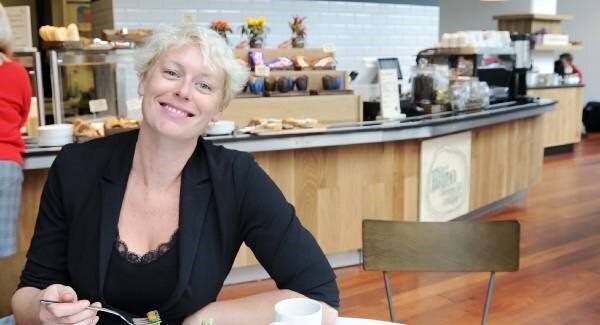
Ellie O’Byrne has lunch at UCC’s Bio Green Café, where there are no single-use plastic utensils or plastic packaging.

Café with appetite for change at UCC

Ellie O’Byrne has lunch at UCC’s Bio Green Café, where there are no single-use plastic utensils or plastic packaging.

It looks like a normal, deli-style café, with its pastries, salads, soups and rolls, coffee machine, and drinks fridge.

But Bio Green Café is part of a revolution. The café, in UCC’s Biosciences Institute, is a plastic-free zone. A progressive pilot project for catering company KSG, the café has no single-use plastic, either in the kitchen or on offer to customers.

Everything from bread to cooked meats to salad leaves arrives from local suppliers in re-usable containers. There are no drinks in plastic bottles and no crisp packets, and the disposable, takeaway

containers or coffee cups are made from compostables and come with a surcharge.

Thanks in part to a growing number of NGOs and social media awareness campaigns, consumers are cottoning on to single-use plastic as a lethal problem, not only for our local environment, but also for our planet.

Annually, 8m metric tonnes of plastic waste end up in the ocean.

And we can’t rest on our laurels just because we’ve rinsed out our yoghurt cartons and put them in the green bin. Recycling shifts the onus onto individual consumers, which is a smokescreen for global multinationals, who still profit from their packaging.

In any case, many single-use plastics aren’t recyclable. In Ireland, only 36% of plastic packaging was recycled in 2016, according to Repak. Globally, of the 6.3bn metric tonnes of plastic waste produced since the 1950s, just 9% has been recycled. The rest has gone to landfill, incinerator plumes, and our oceans.

We will to have to stop making plastic and some businesses are waking up to the increasing customer demand to eliminate plastics.

Having written about the issue of single-use plastics — my family didn’t buy any plastic for a month — I’m excited to stop by Bio Green Café for lunch.

The lunch-rush is about to kick in as I arrive: students and teaching staff alike are chatting at tables, as I head to the serve-over counter.

I’m one of those annoying people who thinks the food pyramid begins and ends with salad, so I come away with mixed leaves and other veg, topped with croutons and black olives and dressed in balsamic vinaigrette, for €5.50.

I opted for the build-your-own salad, but there are popular menu options, including chicken Caesar salad, also for €5.50.

For those after a heartier lunch, there’s a range of wraps, rolls and sandwiches, starting from €3.50, and there’s soup on the menu, too. Snacks are limited: there are no crisps or nuts, and the only chocolate bars come in the traditional foil-and-paper packaging.

An Americano, for €2.20, brings the bill to an affordable €7.70. That’s great: Plastic-free options are often more expensive than their eco-unfriendly counterparts, but real choice only comes when there’s a price equivalence, especially for cash-strapped students.

First-year students Caitlin Buckley, Jasmin Curran, and Ruth Herlihy agree.

Finishing up their lunch, Caitlin and Jasmin tell me they’re studying commerce and German, while Ruth is studying business information systems. It’s their first time in the café.

“We saw the café and it looked nice and we were on our way home,” Jasmin says.

“It’s cheap: in other places it’s probably €3.99 for a wrap.”

On campus, UCC’s sustainability officer, Maria Kinnane, and its Green Forum are making inroads into the university’s waste habits. Takeaway coffee cups and plastic water bottles are an enormous part of their waste stream.

Last year, the Boole Library banned disposable cups. Across the campus, coffee is now €2.30, with a 10c discount for using your own cup.

This year, enrolling students have been given a keep-cup to incentivise a shift away from disposables.

“We’re trying to use them and not use plastic,” Caitlin says.

UCC are very proactive in trying to get everyone to change their habits, at the moment.

Also at Bio Green is Ms Kinnane. The sustainability office worked closely with KSG on the pilot scheme, which Ms Kinnane would like to see rolled out campus-wide.

“Our aim is to be a single-use-plastic-free campus,” Ms Kinnane says.

“We’re discussing the timeline for that, and it’s high on the Green Forum’s agenda to achieve it over the next five years.”

For Maria, there’s a delicate balance between promoting changes in consumer behaviour — like kicking the coffee-to-go habit — and getting businesses to play their role. She has nothing but praise for KSG for coming on board (it has 115 outlets and is Ireland’s fastest-growing catering service provider).

The behind-the-scenes elimination of plastics from food prep and production is most impressive, Maria Kinnane says. “It’s really important for businesses like KSG to talk to suppliers and say ‘look, we don’t want this’,” she says.

“Hopefully, that message will get carried up the production line that people don’t want plastic anymore, and the big companies will start finding alternatives.”

The café has a rinsing station for reusable water bottles, and a waste disposal unit with five compartments.

Glass, aluminium and compostables are all taken care of and KSG will be weighing the contents of the residual waste bin, which only takes a fraction of the usual amount.

KSG chief execute, Michael Gleeson, says they’ve noticed a huge difference already. He eagerly awaits a six-month report into their waste streams at the pilot project: can a saving in the overall waste-disposal bill offset some of the costs of sourcing more expensive local produce for the project?

The pilot has been a challenge and a learning curve for the company, he says.

We probably thought it wouldn’t be that difficult, but when you start looking at it, plastic comes up everywhere in our industry. Both behind the scenes and from a customer perspective, if you go right the way through a deli café, plastic is everywhere.

So, the tough question: will KSG roll out some of the practices they’ve developed in Bio Green to the rest of their nationwide network of catering businesses?

“We went nuclear here in UCC, but we’re still a customer-facing business,” he says.

“We’re being asked by clients to limit the amount of plastic, especially bottles, on a more frequent basis: that’s industry-evident over the last year.

“But some people still seem to like the convenience factor, with things like bringing plastic bottles into meetings.

“We’ll respond to feedback,” Mr Gleeson says.

More in this section

Cookie Policy Privacy Policy Brand Safety FAQ Help Contact Us Terms and Conditions

© Examiner Echo Group Limited













