Appliance of Science: Why do bees makes hexagonal honeycombs?
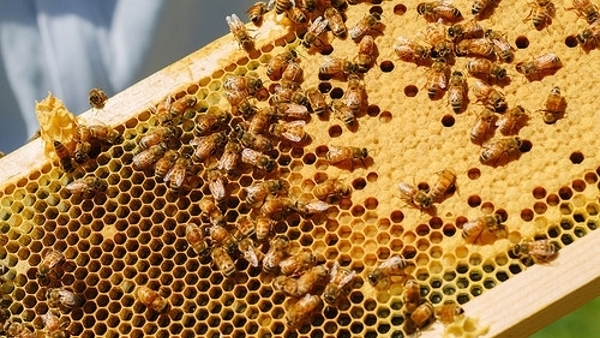
My husband's family have gone a bit bee crazy, there are hives popping up all over the place and we get to benefit from the delicious honey.
When my sister in law recently sent me some honeycomb from an old hive I couldn’t help but marvel at the architecture of it all and wonder why and how the bees make hexagonal honeycombs.
The hive of the honeybee needs to be a safe place for the bees to live and to store nectar, honey and eggs. They need maximum storage using minimum space and resources. Bees don’t have a wide range of materials at their disposal when it comes to constructing these hives, but they can make wax. Combining wax and mathematics they create these engineering wonders.
Although bees can make wax to build their own homes, it is a very precious material as they must consume about eight ounces of honey to produce just one ounce of wax. How do bees get the maximum amount of construction space out of the least amount of raw material? This is a mathematical puzzle that has been considered for thousands of years.
The Roman scholar Marcus Terentius Varro proposed the first solution as far back as 36BC. He suggested that the hexagonal shape used in the honeycomb was the most efficient shape to allow maximum storage using the minimum amount of wax. His proposal became known as the honeycomb conjecture and puzzled many mathematicians for a couple of thousand years.
Charles Darwin even contributed to the debate stating… the honeycomb is absolutely perfect in economizing labour and wax.
So why do bees choose a hexagon over other shapes? Firstly, the number of choices are actually quite limited. If the honeycomb was made of repeating cylindrical chambers there would be a lot of gaps between each one, a lot of wasted space.
In fact the bees really only have three shapes to choose from. For maximum efficiency the honeycomb should be made of repeating equilateral triangles, squares or hexagons. These shapes fit together without any gaps or wasted space.
In 1999 the mathematics caught up with the bees and an American scientist, Thomas Yale produced the mathematical proof that the hexagon, with its 120 degree angles and its six sides, does indeed provide maximum space for minimum wax.
The mathematicians were happy, but the bees didn’t seem to notice, they have been using hexagons all along. Every honey bee uses hexagonal shapes in their hives.
As is the often the way, answering one question just leads to many more. Now that we know why the bees use a hexagonal shape we wonder how they achieve such accuracy and precision.
Each chamber of the honeycomb is exactly the same as the one beside it, with only a very small margin of error. Are the bees able to measure as they build? Research suggests this is indeed the case. The width of each chamber in a honeycomb appears to be within the same size range of the antennae of the bees that construct it. So basically, the bees are using their own body parts as rulers.
How do they know to go with the hexagon in the first place? This point is still up for debate. Some scientist believe that they start off making cylindrical chambers and it is the laws of physics acting on shared walls that create the hexagon. However, the bees will keep us guessing for a while longer.


CONNECT WITH US TODAY



Be the first to know the latest news and updates









