Baby steps: Get your fitness back on track after birth
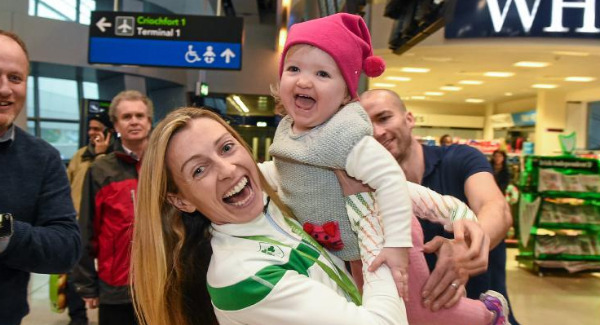
Top female athletes prove you can be stronger than ever after giving birth, but it’s important to take exercise easy at first, says
Professional sportswomen do maternity leave differently to the rest of us. Tennis player Serena Williams was back on the court six months after giving birth to her daughter Olympia last March.
Jessica Ennis-Hill won gold at the 2015 World Athletics Championships 13 months after the birth of her son Reggie.
Even more incredibly, British Olympic cyclist Laura Kenny was back on her bike a mere six weeks after her son Albert was born last August.
Irish Olympic marathon runner Lizzie Lee is one of these wonder women. The 38-year-old mother of two (Alison, aged one, and Lucy, soon to be four) made sure she got her body back on track as soon as possible after both her pregnancies.
With the help of her coach Joe O’Connor of Coachpact.com, she set a new personal best in the World Half Marathon Championships in Valencia in March. She is now preparing to compete in the European Athletics Championships in Berlin in August.
While few women will reach Lee’s level of fitness, there are lessons we can learn from her training regimen. These lessons could help us to lose our baby weight and recover from pregnancy to become even fitter and stronger than before.
The first lesson is to take things easy during the first weeks after giving birth.
“I didn’t take one step for six weeks on doctor’s orders,” says Lee.
“When could I have done exercise anyway? I was breastfeeding a new-born and getting no sleep. If I’d had any free time, I’d have gone for a nap, not a run.”
Experts agree that a woman’s body requires a period of rest after pregnancy and birth.
The American College of Obstetricians and Gynaecologists recommends that women get a doctor or midwife’s approval before resuming exercise. This is usually given six weeks after a vaginal delivery and 12 weeks after a C-section.
“We don’t call it labour for nothing,” says Dr Ciara Losty, a lecturer in applied sport at the Waterford Institute of Technology.
“Your body needs time to recover afterwards. Starting an exercise plan too soon can affect mood and energy levels, as well as milk supply.”
It can hinder healing, too, which Stephanie Sinnott, the founder of Baby Body Fit — a pre- and post-natal exercise company —learned to her cost.
“You’ll only go backwards if you push yourself too hard,” she says. “That’s what I did after my second baby.”
Despite suffering from pelvic girdle pain (which also causes instability and limitation of mobility and functioning in the pelvic joints) during her pregnancy, Sinnott was back running three weeks after giving birth.
“For some reason, I thought people were expecting me to bounce back, because I was a fitness instructor,” she says.
I pushed too hard and, as a result, the pain didn’t go away for eight months. Even now, three-and-a-half years later, I still get the odd twinge.
Terezia Foott, of Per4orm Exercise and Wellbeing in Cork, specialises in advanced postnatal exercise and recovery. She also made mistakes when she returned to exercise after the birth of her daughter four years ago.
“A running group passed my house when she was six months old,” she says. “I joined in the next time they passed.”
She kept up with the group in terms of fitness, but her body couldn’t cope in other ways. “I couldn’t run very far without stopping, as I thought I was going to leak.
“From then on, whenever I went running, I’d go to the toilet immediately beforehand and again afterwards and even then, I’d still take frequent breaks during my run, just to make sure there was no leakage.”
What Foott didn’t realise was that her pelvic floor muscles had been significantly impacted by her forceps delivery.
“I’ve since trained in postpartum fitness and now know what I should and shouldn’t do,” she says. “Running was the wrong thing for me at that time.”
There are several reasons why high-impact exercise should be avoided in the first months after pregnancy.
“The high levels of hormones, such as relaxin, in the body after pregnancy and childbirth cause ligaments to be more stretchy and elastic,” says Dr Paula Fitzpatrick, a lecturer in sports science at Carlow Institute of Technology and captain of the Irish women’s rugby team.
“Because the function of ligaments is to maintain stability in every joint in the body, laxity can lead to instability, which can lead to injury during high-impact and high-intensity exercise.”
Separation of the stomach muscles is another common issue for women. “About two-thirds of pregnant women have it,” says Fitzpatrick.
“Pregnancy puts so much pressure on the belly that sometimes the muscles in front can’t keep their shape. It’s also known as diastasis recti. Diastasis means separation and recti refers to the ab muscles which are called the rectus abdominis.”

This can have serious repercussions.
“When the muscles move aside like this, the uterus, bowels and other organs have only a thin band of connective tissue to hold them in place,” says Fitzpatrick.
“This can cause lower back pain, constipation and urine leaking. It can even make it harder to breathe and move normally. In extreme cases, the tissue may tear and organs may poke out of the opening. That’s called a hernia.”
Foott has seen many women suffer with such problems.
“I carried out a random test on 10 women in my fitness class one day,” she says.
“Four had separated stomach muscles. They were at fitness class to lose their belly after pregnancy but how could it not stick out if there were no muscles to hold it in place?”
Foott’s random test is backed up by research. A 2016 study by the Norwegian School of Sports Sciences found that 32.6% of the 300 women it followed suffered from separation of stomach muscles one year on from having a baby.
With such potential problems to consider, it’s vital that women work with fitness instructors who have trained in postnatal fitness.
“If you go into a gym, you’ll probably be asked generic fitness questions and be treated the same as everyone else,” says Foott.
“You won’t be asked about your postnatal recovery issues, but your body has changed and every woman’s body changes in a different way. A trained instructor will assess your situation and design a programme for you, with a slow progression to get you to where you want to be.”
This is exactly what Coachpact.com did for Lizzie Lee. They started slowly.
“People say you’re back at square one, but you’re actually at square minus 10,” says Lee, who lives in Cork.
“I couldn’t even stand on one leg, but Joe and his colleague Tara Guerin devised a tailored programme for me. I started with simple pelvic floor exercises that I did in my pyjamas in my living room and I took it from there.”
O’Connor has seen many women rush back to exercise too hard and too fast.
“They do aggressive abdominal work too early,” he says.
They do stomach crunches before their stomach muscles have healed and heavy squatting before their pelvic floor is ready. This is because they don’t know what they’re doing and they aren’t working with a trainer who is qualified to work with postpartum women.
Coachpact.com offers a 12-week exercise plan. Each programme is customised to the woman’s circumstances and all exercises are sent as videos to the woman’s phone so she can do them at home in her own time.
The first four weeks focus on pelvic floor exercises that new mums should start prior to taking baby out in the buggy for the first time.
“Walking is great and it gets you out socialising, but if it’s up a hill, you’re going to put your body under a lot of pressure and you should make sure that you’ve started healing properly before you do that,” says Foott
The second four weeks of training increases the volume and variety of activities, followed by another four weeks of strengthening the body, so it’s ready for regular fitness classes.
“This can take longer or shorter depending on the woman, her pregnancy and how healthy and active she was beforehand,” says O’Connor.
“Generally, though, it’s all about doing a little and often rather than a lot all at once.”
Lee followed this approach and, by the time three months were up, she was running again. By the time five months had passed, she made the Irish team for the European Cross Country Championships. Since then, she has performed better than ever and says the biggest lesson women can learn about fitness post pregnancy is that the experience can make you stronger.
“The skin on my stomach is looser than before, but I’ve run personal bests since having Alison,” she says.
Pregnancy has made me a better athlete.
“A lot of endurance athletes plan pregnancies in advance of Olympics,” she says. “Look at Sonia O’Sullivan. She won her Olympic medal after having a baby.”
Paula Fitzpatrick backs her up on this.
“Many world-class athletes have not only returned to their previous competition levels after pregnancy, but exceeded them,” she says.
“Given the body adaptations during pregnancy in terms of blood volume and red blood cells, aerobic endurance performance can often be improved postpartum.”
In a time when women are coming under increasing pressure to follow the examples of celebrities on Instagram whose bodies seem to snap miraculously back into shape after pregnancy, more helpful messages need to be heard.
O’Connor urges women to accept their bodies have changed.
You can’t be the exact same as you were before pregnancy. You and your life are different.
Stephanie Sinnott tells her clients not to put themselves under pressure. “We wouldn’t tell our best friend that she should have lost her baby weight a few weeks or months after giving birth but that’s what we tell
ourselves,” she says.
“Instead, we should be giving ourselves the time we need to recover and focusing on making our bodies strong again.”
Lee speaks from the heart on the subject.
“I appreciate my body more now, because it grew two babies,” she says.
“I don’t care if it’s not perfect. It’s much better to take the time you need to heal and to enjoy being a mother. Don’t stress. You grew a human, enjoy it!”















