My father, the hero: Jack Mahony honoured for fighting in World War II
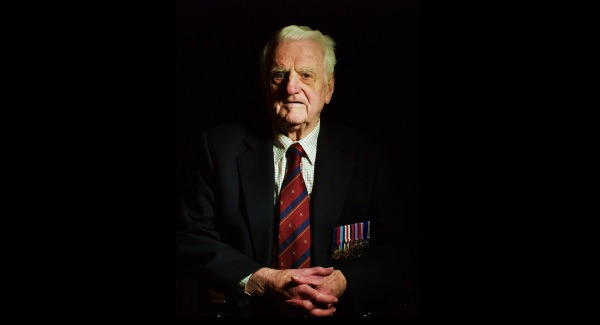
Most sons look up to their dads and think of them as heroes. As Father’s Day approaches talk to a real hero snd his son. Jack Mahony, 100, was honoured for fighting the Nazis in the Second World War
There was a great party atmosphere when Jack Mahony was honoured in the East Cork Golf Club on December 4, 2015, when he received the Legion d’Honneur for his role in the Liberation of France from the Nazis over 70 years ago.
“It was a great occasion,” says Jack’s son, Gerald. “I am very proud of my father who well served his adopted country in war and peace.”
Jack, who grew up in a small dairy farm at Laharn, near Killarney, Co Kerry, and is now living near Midleton, Co Cork, celebrated another great day this year, on April 3, when he reached his 100th birthday.
“It was a lovely day,” says Jack’s son, Gerald. “Dad was surrounded by his family, his friends, his neighbours, and his carers.”
What had the man himself to say about the great day three years ago, when he was presented with France’s highest honour by Philippe Ray, Deputy French Ambassador, First Counsellor from the French Embassy?
“Not many people get to attend their own wake! Jack commented. “I was delighted to receive this honour. Thank you one and all.”
“Dad was and is, an inspiration to my brother Steve and me,” says Gerald. “He guided us to do well for ourselves and he encouraged us in our educational efforts.
“Although he was strict; he was always fair and very supportive. He kept us on the straight and narrow.”
The death of his son Stephen and wife Mary death in recent years was a severe blow.
One of Jack’s favourite places was in the boglands of Connemara, Co. Galway.
“We also spent many happy holidays in the UK, going on day trips to the seaside and places of interest,” says Gerald.
Later on, Jack and Mary enjoyed holidays aboard cruise ships.
“But our summer holidays at, Mary’s family home in Galway, were very special,” says Gerald. “Those were our real holidays. In those days you got in the car and drove for hours often staying overnight. You kept at it until you got there.”
Jack loved those halcyon days in the West of Ireland.
“Dad loved footing the turf with Mike, Mary’s dad, in the wilds of Connemara,” says Gerald.
“His old Ford Popular and later his Volkswagen, travelled many miles to and from Ireland from our home in Woodford, East London. His greatestjoy was working side-by-side with Mike, stacking the turf on the bog, stopping occasionally for a mug of tea and a slice of brown soda bread.
“Dad and Mike were very close. Dad was up and out first thing after travelling almost two days in the car to Galway. Dad loved the clean air and the different pace of life in Oughterhard. People got up at 6am to walk 10 miles to church dressed in their Sunday best.
“The men had a drink in the pub after mass, the ladies gathered together for a chat. Then it was home for a wholesome lunch of potatoes and meat.”
Jack left his home at Laharn at age 17. With seven children in the family, it was difficult for all of them to make a living from farming. In early 1936, Jack caught a train from Killarney to Rosslare to catch a ferry for Wales. Like generations of Irish before him, Jack made his way to London where he worked for a firm which did contract work for Guinness Brewery at Park Royal.
Then, in 1938, Jack joined the Metropolitan Police and he was with the force when war broke out in 1939. Shortly after Jack and his wife Mary, had their first child, Gerald, Jack was given the option of staying in the police force, which was a protected job, or volunteering for the armed forces. He opted for the latter.
Jack sent Mary and Gerald back to Mary’s family in Galway after their home in Leyton was bombed during the Blitz. Jack decided to join up as he felt something had to be done to stop the Nazis who had no compunction about bombing and killing civilians in London.
“Jack says, “I think there was a need to do what we could, because they bombed my own bloody flat... they were hitting me in my own house’.” He was aware of the risks.
“But thousands of others had done the same,” he says.
“It appeared the right thing to do. I made no bones about it.”
The French embassy’s Mr Ray, paying tribute to Jack and his comrades for the part they played in liberating France from the Nazis over seven decades ago, said Jack’s story is a testimony to the courage of all men and women who refuse to give up and who uphold the principles they live by.
“Principles that we share, that together we defend, as we have always defended them,” said Mr Ray.
Mr Ray recalled how Jack and his unit landed at Normandy, then crossed the Seine at Rouen before helping to free Le Havre. And although twice wounded, Jack fought in the Netherlands to support airborne units near Arnhem before being captured by the Germans at Venlo in late autumn 1944.

Jack was held in Fallingbostel POW camp in Lower Saxony before being transferred to Lukenwald POW camp near Berlin where he ended up very malnourished. Jack and a number of inmates escaped, got hold of a few bikes, and cycled to the Elbe river.
“When we saw the American soldiers, (on the other side of the Elbe), we knew we were safe,” says Jack.
After demobilisation back in the UK, he re-joined the police force with whom he had a distinguished career as a detective including periods with the Flying Squad, until his retirement in the 1970s.
“In honouring you, we honour the bravery, the commitment and strength of all the Irish men and women who stood for liberty, equality and fraternity alongside France over time and continue to do so,” said Mr Ray.
Gerald is justifiably proud of his Dad. “Dad’s strength of will is tremendous and he is very principled. Coming from a very rural background in Killarney, he has gone on to achieve great success, of which I am very proud.”
What is Jack’s secret to longevity?
“Mum’s good cooking!” says Gerald. “Mary was a wonderful cook.
“But also the love and friendship of his wonderful carers and neighbours at Castlemartyr where Mary and Jack resided when they retired to Ireland. They were both good dancers and they enjoyed dancing. Dad liked the odd dram of scotch whiskey or a glass of the black stuff. He was always a very convivial man.
“Work was his life. He worked extremely hard. We are very proud of him.”
CONNECT WITH US TODAY



Be the first to know the latest news and updates

















