Life blood: People encouraged to join the 1,000 Polish people who donated blood in Ireland last year
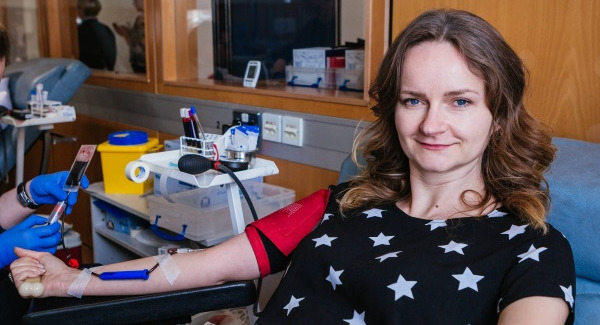
1,000 Polish people donated blood in Ireland last year and the transfusion service and the immigrant council have launched a campaign to encourage more to do so, to increase blood supply and promote cultural integration, says

AGA Daly has donated five litres of blood in Poland and six in Ireland. “I’ve replaced all my blood twice over; there are five to six litres in an adult’s body,” says Aga, 39, who has been a blood donor since she was a 21-year-old university student in Poland.
“When I first started doing it, it somehow played a part that my mum had got blood. She needed it, because she had low iron,” says Aga, who has one son, nine-year-old Mati, and lives in Skerries.
Aga donates blood every three months, when the mobile clinic visits Skerries. “Some people feel weak after donating. I always feel more energy. It’s such a buzz. If they use your blood, you’re sent a message, saying it has been used and in what hospital. Last time, mine was used in Drogheda.” Living in Ireland for the past 13 years, Aga says blood donation “makes me kind of emotional”. Every three months, when the clinic is due, she hopes her haemoglobin is above the minimum level to give blood. “I’m saying ‘oh, please be high’ and I’m eating goji berries and greens.” Aga is one of 1,000 Polish people who donated blood in Ireland last year, and hers is one of the stories that has inspired ‘Bloody Foreigners’, a campaign highlighting the contribution of Polish nationals to the Irish blood bank and encouraging more to give. It’s a joint effort by The Immigrant Council of Ireland, Irish Blood Transfusion Service, and Forum Polonia and will culminate in a ‘Bloody Foreigners’ day of action, at the end of July, when Polish people will be encouraged to donate on the same day.
Stephen Cousins, Irish Blood Transfusion Service (IBTS) national donor services manager, says the Polish are the largest group of donors after the Irish. “They’re very much part of the Irish communities they live in. They’ve put down roots in Ireland and take an active part of life [here]. Being a blood donor really demonstrates this community in action,” he says. Like Aga, Teresa Buczkowska, integration coordinator at Immigrant Council of Ireland, is passionate about being a blood donor. “In Poland, I couldn’t wait to turn 18, to give blood. I knew my neighbours and teachers gave blood. It’s a very important part of my identity,” she says. Also in Ireland 13 years, Teresa made her 10th donation here in April and received a commemorative pin from IBTS. Both she and Aga talk about a culture of blood donation in Poland.
“In Poland, you get a day off school or work to give blood. You get eight large bars of chocolate. You get a bus ticket to and from the clinic. Before I started donating, donors used to get a dinner voucher,” says Aga.
Teresa recalls a week-long campaign during her university days, when a mobile clinic would be on campus. She recounts a story told by her mother, who worked in a hospital newsagent’s in Communist-era Poland. “Blood donors would sell their bars of chocolate to my mum and she’d re-sell it in the kiosk to people who wouldn’t have access to such luxury items.” Soon after she started giving blood in Poland, Teresa joined a social club of blood donors in her home town. “It was a very collective sort of activity. They’d organise themselves to donate blood together. And, in emergency, if stocks of a particular blood type were down, whoever had that blood type would go, as a group, to donate it. They also got together for Christmas parties and summer barbeques,” Teresa says. The most common blood types differ somewhat between Poland and Ireland. Here, 47% of people are O+, whereas in Poland 31% of the population are O+. The combined percentage of people in Ireland who are A+ and B+ is 35%; in Poland, it’s 47%. There are also differences between the two countries’ blood-donation procedures. For example, you can donate blood every eight weeks in Poland and every 90 days in Ireland. In Poland, you have to eat a low-fat, light meal before donation; here, you have a substantial meal in the three hours beforehand. In Poland, you get a sick-leave cert and transport-cost reimbursement; here, you don’t.
Only three percent of the eligible Irish population are blood donors, providing for four million people. Each week, 3,000 blood donations are needed here. According to the IBTS, a car accident victim may require up to 30 units of blood, a bleeding ulcer could require between three and 30 units, or a coronary artery bypass may use between one and five units.
“In one way, giving blood is such an ordinary thing to do, but the impact on other people is tremendous. Put that way, it’s mind-blowing,” says Teresa.
Barnaba Dorda, chair of Forum Polonia, says the ‘Bloody Foreigners’ campaign has triggered him to give blood for the first time. “It’s one of those things. You might mean to do it, but never get around to it,” says the Portmarnock-based Siptu worker. “On a human level, it’s important to support others, to help others. It’s a thank-you for me being here [living in Ireland].” The campaign is also a way to challenge the negative stereotyping Polish people sometimes face in Ireland, say the organisers. It’s about finding commonality, says Teresa. “The Polish community is part of the community here now, sharing everything from living space to blood. How much more integrated can you be than to share blood, and receive blood, from others in the community?”














