Doctor’s orders: Dr Phil Kieran's prescription for health

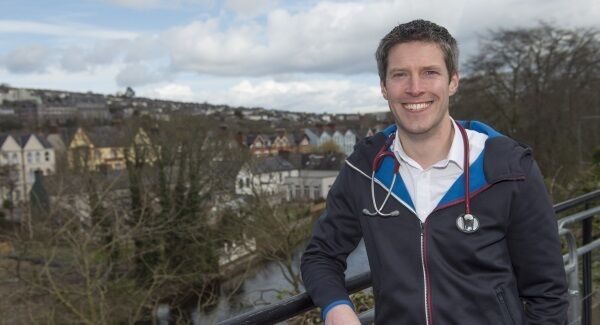
WHEN I arrive at Dr Phil Kieran’s surgery, he’s treating a patient — himself. He ushers me in, then flies off, announcing, “I need to bandage my thumb.” Back in two minutes, job done, he explains the injury was a result of not taking his own advice when stripping wire at home a few days earlier.
“I was too lazy to go to the shed to get my wire stripper so I used a kitchen knife. I recognise it was a bad idea. I stabbed myself in the thumb. I see a lot of injuries in trainee chefs who take chunks out of their hand. I always advise not to cut anything in the palm of the hand.”
When it comes to health, Dr Phil knows what to do. But when his wife, Claire, asked one day how he’d fix the health service if he had unlimited funds, he was hard pushed to answer. “The health service has so many moving parts. It’s like trying to rebuild an aeroplane in full flight with a full cargo.”
Some changes in action and perspective are obvious, says Dr Phil, who, alongside Dr Pixie McKenna, co-presents the
RTÉ series You Should Really See a Doctor.
First up, the health service needs to be de-politicised. “Health is one of the easiest things for politicians to campaign on. ‘I’ll extend your local hospital’ or ‘I’ll make sure the local A&E stays home permanently as a trauma unit’. It might be better for patients if it was closed overnight, resources allocated to a bigger hospital nearby, road network improved, and number of ambulances increased, so when you’re sick you can be brought quickly to the most appropriate place.”
His prescription: Remove the health service as a political bargaining chip, create a long-term fixed plan, and brave necessary unpopular decisions. The Government needs to decide whether it wants a cheap health service or a world-class one.
“If cheap they must be honest with the electorate and say that’s what they want. World class costs money. In the UK, investment in general practice is 10%-15% of total health spend — in Ireland, it’s about 3%.”
Working at Washington Street Medical Centre since 2014 — he became a partner last year — Dr Phil’s patients range from newborns to quite a few in their late 90s. “Our city-centre location gives us a mix of patients, from professionals working in the area to those living in quite severe poverty.”
He’s acutely aware general practice needs proper resourcing to allow GPs access vital services. “International studies show resourcing general practice saves the health service money and improves patient outcomes,” he says, adding that 80% of patient contact with the health service happens in primary care.
GPs are best placed to diagnose, monitor, manage, and treat many conditions. Our patients know us, they trust us. We can help them start treatment, remain compliant, and explain why they need to keep going with treatment, which improves health and saves lives long-term.
Yet, at a basic level, general practice is in the throes of a recruitment/retention crisis. “A large proportion of GPs are due to retire in the next five years. I have many colleagues who can’t take even a week’s holiday because they can’t get cover. Recent research shows 64% of all GP practices are closed to new patients — they’re over capacity.”
A big frustration is seeing his patients upset because — unless urgent — appointments can be booked out a week to 10 days in advance. And he finds it “incredibly frustrating” that he can only access many hospital services through A&E.
“Let’s say a patient with heart failure comes in very out of breath. They need diuretics to remove fluid. They need daily blood tests and review for seven to 10 days. It’d be nice if I could contact the hospital and get them admitted that day. But if I ring the hospital, I’m told there’s no access to beds from GP referral. So I’ve no option but to send them to A&E, where a work-up will be started again by another doctor even though I’ve already done it, and the patient waits to be admitted by the medical team.”
In another example, he cites the case of someone with recurring knee injury. “We need MRI to see what’s going on. My only option is refer him to an orthopaedic clinic where he’ll go on a long waiting list — because I can’t order MRI or ask him to pay €200 out of his own pocket. If he goes privately for MRI, I send the report to the orthopaedic clinic where he’ll go on the waiting list anyway — just we’re one step further along in planning his treatment.”
So are primary health care centres a solution? They were intended to be a one-stop-shop for all of a patient’s primary care needs — GP, physiotherapist, occupational therapist, counsellor. “I’ve never set foot in one,” says Dr Phil.
Personally, I don’t think primary health care centres are essential. I don’t think I need an x-ray machine or physiotherapist in the building with me. What I need is access to these services. I think primary health care centres are a fancy idea but there’s an element of reinventing the wheel.
Tongue in cheek, Dr Phil says becoming a medic was due to “lack of imagination”. He comes from a long line of doctors. His parents, Paddy and Mary, are both doctors, now retired. Paddy was an obstetrician and gynaecologist at Bon Secours Hospital, Mary worked in public health in north Cork. His older sister, Jennifer, is a consultant in general medicine and infectious disease. “I was 17th to qualify, between doctors and nurses, on my mum’s side. Growing up in that, you see it as a valid career choice.”
He opted for general practice over hospital work because in hospital you treat the patient’s episode of illness. “You diagnose the problem. You get them treated as rapidly as possible, turned around, and back home again. A GP gets to know the patient; rather than just treating pneumonia, you’re treating a person. You get to know their social context, which helps you treat the person. If I have a patient with pneumonia, weak and short of breath but not in imminent danger, I must decide should they be treated at home or in hospital. Knowing they’re 80 years old, living alone in a two-storey house with narrow, steep stairs, helps me decide.”
Dr Phil likes the continuity of patient care characteristic of general practice. “I’m able to help the same person through different stages — like with their anxiety when they’re doing the Leaving Cert and later when they’re having difficulty trying to conceive.”
He recalls an elderly man, newly discharged from hospital, phoning up for a house call. “I couldn’t figure out any medical reason why he needed a house call.” That evening after work he cycled to the man’s home. “I met him at the door. I asked ‘how are you?’ He said ‘fine, Doctor, not a bother on me’. I wondered what I was missing. I examined him and found nothing acutely wrong. We chatted over tea, I left and he was happy. It struck me: Maybe he hadn’t spoken to anyone since his discharge.”
Qualified from UCD in 2007, Dr Phil says he’d have been a happy engineer — engineering was his second choice on the CAO form.
If I won the Lotto, I’d be a permanent college student, doing degree after degree. I’d love to do arts, physics. But really, there’s nothing else I’d rather do enough to give up knowing how we [our bodies] work. And I never go home wondering is my job worthwhile — not everybody has that.
He has his own GP (“it’s a bad idea to self-medicate”), recommended by a colleague. “I haven’t been in over a year. A 35-year-old man has no reason to regularly see a GP if there’s nothing wrong.” He comes from a “pretty healthy family”, though he’ll need to watch cholesterol.
“I try to run 5k three times a week but I haven’t been running as frequently as I’d like. I don’t smoke. I eat a reasonably balanced diet, avoiding as much processed food as I can. If I have a run of bad eating — biscuits, Taytos — I try to catch myself quickly and go back to lower calorie, lower salt.”
Claire, a nurse, has been home full time since their second child, Max, 20 months, was born. His older brother Daragh is aged four. “Claire’s a massive support to me. I don’t think I could do the irregular hours without knowing someone is looking after the kids to the standard she does. I get fairly tunnel-visioned — I can lose sight of family events and obligations. To know she’s there, planning for us, is fantastic.”
Weekdays, he sees his kids for about half an hour a day. Knowing Claire’s witnessing those precious milestones — first step, first words — is tremendously reassuring. “She’s very good at not bursting my bubble. One weekend, when Daragh put a four-word sentence together, I ran all excited to pass on the news. I found out later he’d been doing it for three weeks. She was very good, she didn’t disabuse me of it immediately [that I’d been the first to spot it].”
In fact Claire often supplies him with practical solutions, even for playing with the kids. During the
recent snow, he spent 90 minutes trying to build an entrance to an igloo with Daragh. “She suggested I use plastic boxes to build snow bricks! We had the whole rest of the igloo built in an hour and Daragh and I spent the next hour playing in it. It’s all about working smarter, rather than harder.”
With three seasons of You Should Really See a Doctor behind him, long-term Dr Phil would love to split his time between media work and medicine. But his priority is his patients. Dr Pixie, he says, is a dream to work with, really funny, very genuine, “probably the most genuine person I’ve met in the media world”.
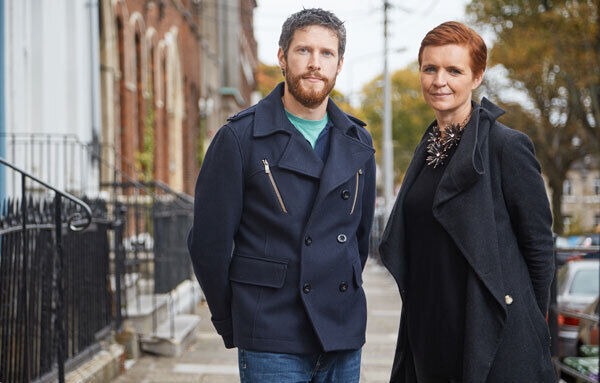
He did a pilot for Channel 4 — How to Stay Well — which televised last year. “It wasn’t commissioned,” he says.
“The second-last episode went out on the same day as the final of The Great British Bake Off. The last episode was the Monday after the Grenfell Tower tragedy — there were more important things to be watching on telly than our show. I thought it was a good show though, I was very happy with it.”
Naming his medical heroes as Louis Pasteur, a founder of microbiology, and all doctors who work with relief organisations like Médecins Sans Frontières (“I have a friend who worked in Africa during the most recent ebola outbreak — really that work’s astounding”), he admits to being teased about his moniker: ‘Dr Phil’.
“In college, I used to jokingly say I’d be Dr Phil, but that was after Dr Nick in The Simpsons — Dr Phil in the US wasn’t famous then. People usually only notice it when they say ‘you’re a doctor, Phil’ and then they exclaim ‘Dr Phil!’ And I say, ‘yes, I’m aware’.
“But you need people taking the mick out of you — it’s very important.”
Doctor on call...

“It’s very hard to avoid viral infections. Ensure you cover your mouth and nose when you cough and sneeze. If everyone did that, there’d be much less transmission of viruses. If you’re out and about and you shake hands with someone, wash your hands before eating. Take moderate exercise, get enough vitamins and fibre. You’re far more likely to catch colds and flu if you smoke — there’s almost nothing medically that smoking doesn’t make worse.”
It’s important people with young kids have a thermometer. But more than the actual number that the temperature gets to, it’s how the child is. Eyeball your child — if you think they’re OK, you’re probably right. If they have a bit of a temperature, give them something to bring it down. Trust your instincts.

“I feel massively strongly aboutvaccinating your child. Rates of measles and mumps have climbed in the last 10 years because of dropping vaccination levels. These are dangerous conditions. I feel strongly that every child should be vaccinated unless there are specific medical contraindications, of which there are incredibly few.”

“It’s something anyone sexually active should take responsibility for and get tested for STDs. In Ireland, we’re very embarrassed to discuss it with our doctor. A lot of patients will bring up an unrelated matter first — this puts them at ease but uses up time. You’re very unlikely to be the first person that day the doctor has spoken to about this. Everything you say in general practice is completely confidential. Particularly when family attend the same clinic, there can be concern that a partner might be told, but it’s confidential — doctors take this incredibly seriously.”
“If a cough or cold isn’t getting better after four or five days, you should see a doctor. Things you should never ignore include bleeding with bowel movements, unexplained weight loss, coughing up blood or new and severe headache.”
CONNECT WITH US TODAY



Be the first to know the latest news and updates

















