Capturing the sounds of nature: Attenborough's sound guy to speak at UCC
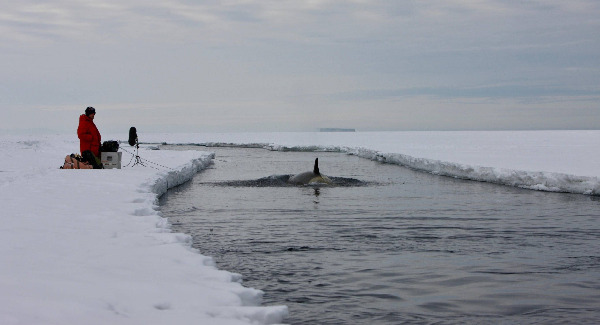
Attenborough’s sound recordist Chris Watson is one of the participants in a day-long event in UCC tomorrow, writes
COD sing duets when they’re courting, and it sounds like cats purring. Talking to sound recordist Chris Watson, it’s impossible not to pick up on his infectious sense of excitement about the wonders of the world of sound.
“It’s true,” Watson says. “Atlantic cod have drumming muscles that they can vibrate very quickly; they’re not singing, but when they vibrate these muscles, they produce these rhythmic sounds for mating displays.”
Watson, best known for his BAFTA-award-winning TV work on David Attenborough series like Life and Frozen Planet, has been listening to and recording everything from the groaning of glaciers to the love-songs of bearded seals for over 40 years.
In his teens, having begun experimenting with recording birdsong in his garden, Watson got his hands on a hydrophone, a microphone for recording underwater. “I dropped it into a rock pool, and I could hear everything: limpets grazing, the crackling noises of the shrimps,” he says. “A whole world opened up to me.”
A member of experimental Sheffield music group act Cabaret Voltaire in the 1970s, Watson started plying his trade in TV and radio in the early eighties and has travelled the planet recording ever since.
A perennial experimenter, he’s gone to great lengths to capture audio, famously, rigging a dead zebra with microphones inside its body cavity, the better to capture the sound of vultures ripping flesh from the carcass.
What has been his most memorable recording to date? It was in the Norwegian archipelago of Svalbard, he says. “I dropped a hydrophone through a hole in the ice; it was kind of like I was fishing for sound.”
An extraordinarily eerie and beautiful song reached Watson through his headphones.
“It was bearded seals,” he says. “I’ll never forget it: it was incredibly haunting and beautiful, and in a range very familiar to humans, almost operatic. A professor from the Norwegian polar institute told me the sounds of the seals were travelling from 20 kilometres away.”
Marine noise pollution is a real cause for concern for Watson, and he’s also a fervent advocate for reducing noise pollution in our human environments. The human ability to listen is, he believes, being lost against constant background noise.
“We’re actually really good listeners. Forty thousand years ago, our ancestors were the ones who heard the sounds of a tiger coming into their cave, and who escaped. So we evolved to listen. The problem nowadays is with all the distractions around us, and in remembering to listen. But when we do, we’re still pretty good at it.”
Watson uses phenomenally sensitive and high-tech microphones in his work, capturing detail like an ant’s individual footsteps. Does it ever bother him that his largest audiences hear his work through the rudimentary speakers of car radios and TVs?
“To be honest that doesn’t really bother me,” he says. “What gets my goat a little more is when Hans Zimmer comes along with a big, orchestral piece of music that he thinks describes the landscape and that gets put over the sound I’ve recorded: to me, there’s no better or more faithful way to represent a landscape than with the most accurate possible recording of it.”
Even so, live performances are still one of his favourite ways to bring all the intricacies of his recordings to an audience. “I record a lot in spatial sound, surround sound, which really puts the listener where the microphone was when I made the recordings.”
Watson has a long-standing relationship with Irish radio documentarians Kevin Brew and Luke Clancy; they made a series called Lighthouse Stories for RTÉ, charting the end of an era, as automation took over from human lighthouse keepers.
Many of Watson’s contributions to the series were recorded at the lighthouse in Galley Head in West Cork and he’s returning to Cork for a live performance of his lighthouse work at UCC.
“It was almost as if the lighthouse itself were a stylus sticking up into the sky,” he says. “You’re facing right out into the Atlantic, and the wind and weather were picked up right overhead. Amazing sounds: the sound of the sea around and the water on the rocks.”
“In a way, these are sounds that have passed into history, because the lighthouse keepers are gone, so when I was invited to Cork for the festival, I immediately said I wanted to make a performance of the Galley Head piece, which I’ve always wanted to do.”
UCC’s Sound Sound Day is on 11am - 10pm tomorrow (Saturday) in the Ó Riada Hall at St Vincent’s on Sunday’s Well Road, Cork. Free entry. Info: www.ucc.ie/en/music-theatre/music/news/














