Trinity students fight for rights
Trinity student Brian O’Flynn says the scholarships programme is from a bygone era and no longer fit for purpose

Trinity students fight for rights

Trinity student Brian O’Flynn says the scholarships programme is from a bygone era and no longer fit for purpose

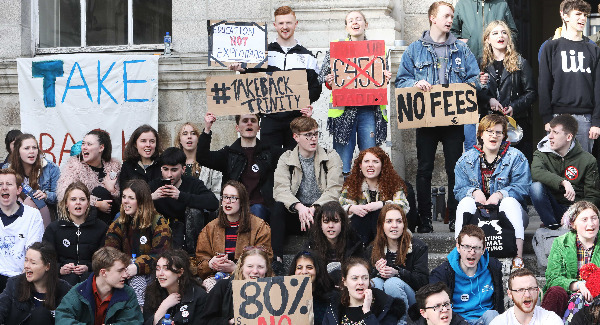
THREE weeks ago, hundreds of students took part in #TakeBackTrinity protests when the college introduced a €450 supplemental exam fee, only a month after students voted against the fees in a preferendum. After blockading the Book of Kells, students clogged Front Gate before occupying the Exam Hall and the Dining Hall, the palatial 18th century building where the Scholars of Trinity hold Commons.

As photos circulated of students clad in rainjackets and clutching thermos flasks huddled below the vaulted ceilings and sumptuous decoration of these old buildings, the contrast was almost comical to behold. The pictures were a window into an institution that still clings to its historic wealth while turning a blind eye to the reality of its own students’ lives. The students’ chants at the various #TakeBackTrinity rallies reflected this same critique: “Paddy in your ivory tower, this is called people power” they directed at the provost, Patrick Prendergast.

Today is known as Trinity Monday. It is the day when the provost will stand on the steps of the same exam hall that was so recently occupied to announce the names of the scholars for the upcoming year. These scholars will avail of free campus accommodation, free meals (Commons) in the dining hall, and free fees for up to five years. Trinity scholarships are awarded on the basis of voluntary exams, usually covering topics outside the remit of normal coursework.

I, like many other students, contemplated sitting these exams. The housing crisis in Dublin means that for working-class students like me, affording rent and living costs while studying full time is a constant, gnawing worry. The scholarship programme is surely a lifeline for students like me, one would think — except it’s not.

One Sunday in December, six hours into a 10-hour shift, on my third straight day of working, I thought abstractly about sitting the sociology scholarship exam. I thought about the essay I would write on the social determinants of health — working-class people, we were taught, have poorer diets and lower life expectancy. I thought about how little sleep I’d gotten that week in between working and studying, and the coffee and sugary snacks me and my co-workers survived on through our long shifts. I thought about how much harder I would have to push myself if I had any chance of getting a first in that sociology exam — how much less sleep I would get, how many more hours of minimum-wage work I would have to give up for study, when I was already writing desperate emails to the college begging them to waive the fees I couldn’t afford. I thought about the irony of it all, and had to laugh. I never sat the exams, unsurprisingly.

Because I am a member of the TAP programme for low-income families, Trinity did eventually waive my fees for one term, for which I’m grateful. This programme is one of the few in Trinity that acknowledges class exists at all — the scholarships programme erases it completely.

In Trinity’s annual equality report, no analysis is given on the overlap between TAP students and scholars. But if you attend Trinity, you don’t really need a report to know the socioeconomic profile of the scholars. Successful students are generally those who don’t work three days a week, who have strong networks that include former scholars who can pass down tips and notes, who live at home in nearby Dublin suburbs — in short, not struggling working class students.

In this way, scholars are less a lifeline, and more a vehicle for reproducing privilege. What is so infuriating about the programme is that it piles a glut of resources on a small handful of elite students, while other students are left protesting in the rain, terrified at the prospect of increased exam fees.

As student Neasa Candon wrote in an excellent critique for Trinity News, it is unclear why students who live on campus with access to cooking facilities also need to avail of daily free meals. To me, it is even more unclear why students with addresses in D4 need to avail of on-campus accommodation in the first place. The scholarships programme hails from a bygone era where all Trinity students were land-owning gentry and the college had money to burn — how the board has failed to revolutionise the programme through a recession and a housing crisis boggles the mind, especially when it’s resorting to hiking up exam fees to supplement its continuing deficit.

There are countless ways the programme could be overhauled to distribute resources more fairly. A class quota should be introduced, whereby a number of scholarship places each year are reserved for lower-income students, such as those who qualify for TAP or SUSI. This would acknowledge the additional hurdles working class students must overcome to achieve the same results as wealthier peers.

Many students who sit scholarships do so out of ambition, not need. Of course these students should be allowed to sit the exams, but if they’re only pursuing prestige, why offer them on-campus apartments while other desperate students work all hours and accrue debt to afford rent? Campus accommodation and scholarships should be dissociated completely, and an alternative scheme set up to offer these apartments at a low cost to the poorest students. Well-off students can enjoy the CV boost of scholarship without having two homes in Dublin to boot — are free meals and fees not already a large enough reward?

The Trinity website says: “Scholarship is awarded solely on the basis of the Foundation Scholarship examination performance — and no other factors are taken into account.” As if this wilful ignorance is something to be proud of. This is the same wilful ignorance that drove the board to introduce supplemental exam fees after students voted against it.

After the rage of #TakeBackTrinity, fees were withdrawn, but the college still sees this anger as isolated rather than part of a larger endemic problem that scholarship exemplifies. It’s time, Mr Prendergast, to take other factors into account.

More in this section

Cookie Policy Privacy Policy Brand Safety FAQ Help Contact Us Terms and Conditions

© Examiner Echo Group Limited











