Lots of laughs but also the big issues with 'Podfather' Richard Herring
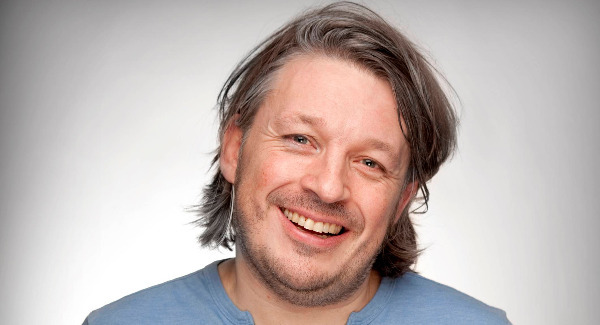
When Stephen Fry told Richard Herring about his suicide attempt, the podcast host had little idea that it would become such a big deal, writes Richard Fitzpatrick.

Lots of laughs but also the big issues with 'Podfather' Richard Herring

When Stephen Fry told Richard Herring about his suicide attempt, the podcast host had little idea that it would become such a big deal, writes Richard Fitzpatrick.

The English comedian Richard Herring has been dubbed ‘Podfather’ for his prowess as a podcast host.

He’s interviewed many big entertainment stars, including Eddie Izzard and Steve Coogan, but it was a revelation during his live interview with Stephen Fry at London’s Leicester Square Theatre in 2013 that caused ripples around the world.

Towards the end of their 90-minute interview, which was also filmed, Herring read out an innocuous question from a Welsh student, “What is it like being Stephen Fry?”

Fry described how on one hand he leads a gilded life, full of travel and invitations to sit in Wimbledon royal boxes; on the other hand, he said, he is “the victim of his own moods”, a condition that requires him to take medication and which, he confided, caused him to attempt suicide a year beforehand.

Fry described the suicide attempt in vivid detail. He had been filming a BBC documentary TV series overseas when he took a “huge number” of pills and vodka. His body convulsed so much he broke four ribs. A producer from the programme found him unconscious in his hotel room and he was taken back to England to recover.

It’s a gripping piece of interview. Fry speaks freely, admitting that it is an image of “the expression on my mother and father’s faces” that stops him from killing himself sometimes.

“I was just feeling upset and sorry for Stephen at the time,” says Herring about what was going through his head as Fry made these admissions.

It didn’t really strike me at all that it would be a big deal. Nobody in the room tweeted about it. The podcast came out three days later and that was when the press were interested.

There was no, ‘oh, this will get some views or publicity’. I could never have predicated a stupid little podcast would reverberate around the world, as it did with that particular incident.”

Fry is one of the great raconteurs. His description to Herring and their podcast audience of his unscripted, live one-man show at the Sydney Opera House is bone tickling. He makes for a brilliant interview.

Herring notes that the important thing for him in his position, in order to facilitate a good interview with someone like Fry is just to stay out of the interviewee’s way.

“It was an amazing podcast in terms of Fry’s skill at directing the conversation the way he wanted it to go,” says Herring.

The theatre of the night was very funny. He was able to improvise around whatever you were asking him. There was such a warmth and admiration from the audience in the room he felt he was in a comfortable space. I wanted to give him the opportunity to say what he wanted to say and I knew I should shut up and let him say it.

“The skill of a podcast is knowing when to talk and when not to talk. Some people really need guiding through. I had Brian Blessed on recently and I didn’t get much of a look in to direct that conversation!

"I love working with the comedians who do give a bit back and there’s a back and forth. With Stephen, there was a bit of that. I don’t always get it right. There’s an improvised hour and a half and I like to take chances and ask questions that can derail things.”

Herring — who came to prominence in the early 1990s as one half of a comedy-and-writing double act with his old Oxford University chum, Stewart Lee — sure ain’t afraid to derail things.

Herring once spent a year sporting a Hitler moustache as a kind of comedic social experiment. He wondered what reaction he would get in public to the set-up.

Herring explored his findings in his stage show, which he said became quite political and formed the basis for a DVD release in 2010. He wanted to highlight the importance of getting out to vote to stop the growth of far right ideology, as well as exploring why the toothbrush moustache, which was also popular with contemporaries of Adolf Hitler like Charlie Chaplin, became so maligned.

“There were unexpected consequences,” he says.

“Nothing bad happened to me, but I was always conscious that I could be attacked at any time. I didn’t get many comments, which was almost scarier, but I was aware that people were annoyed or scared by me. It gave me a window into being judged by your appearance, which never really happens to me as a white man living in the UK.

“It was an interesting experiment but I was very glad to get rid of it. Occasionally people would pass you by and go, ‘What the f**k? Is that guy wearing a Hitler moustache?’

Two or three times people challenged me about it to my face. Usually people would laugh at you, but not to your face, which was interesting because they were too scared. You could feel people were intimidated or else they dismissed me a lunatic or an idiot.

“The worst thing was one night around midnight a guy in a white van rolled down his window and said, ‘Well done, mate. You’re a man after my own heart.’ That was chilling. If he had been brave enough he would have proclaimed his Nazi sympathies by dressing like Hitler or wearing a Hitler moustache.”

Herring’s wife, who was his girlfriend at the time, had to put up with the ruse. They have two young children, a baby boy and a three-year-old girl. Being a late-stage dad is one of the themes he explores in his latest live show, having hit the half-century mark.

Entitled Oh Frig, I’m 50!, he brings it to Dublin next week. Wrestling with irrational fear is one of the great challenges of being a parent, he says, as the weirdest worries have popped into his brain like fretting about their heads twisting off, or falling off balconies .

Your brain starts thinking the worst possible things like what if this happened. It’s meant to be an evolutionary thing that gives you an advantage by picturing the worst possible scenario and, knowing how much it would hurt you, you avoid doing it.

"I’m perfectly capable of realising I shouldn’t put my son in the fire so it’s very upsetting that every time I make up a fire I have to think this horrible thing!”

Richard Herring is at the Sugar Club, Dublin on Wednesday and Thursday.

More in this section

Cookie Policy Privacy Policy Brand Safety FAQ Help Contact Us Terms and Conditions

© Examiner Echo Group Limited













