Ageing with attitude: Moving away from aches and pains
Hereâs a quote: âAgeing is inevitable â aches and pains are not. We get used to this idea that where we are physically as we age, is unchangeable â that we have bad backs, or knees, or sore feet, but this is not so,â says biomechanist Katy Bowman, who specialises in body movement.
âWhen it comes to adaptation to movement, we can become better movers at any age. The ship has not sailed; it sails every day. It sails 1,000 times a day â there are almost endless opportunities for you to move more,â she tells .
âJust move something, anything â differently and more than you did the day before â and you will reap the benefits. Start today! Start NOW!â
A best-selling author on the subject, Katy has a new book called Dynamic Ageing: Simple Exercises for Whole-Body Mobility, geared specifically towards a 50-plus readership. It has been co-authored with four âgoldenersâ (each over age 75), whose lives have changed over the past ten years, as a result of following her expert tuition.
Alongside her instructions in the book are the stories, experiences, and advice of four women whose programme focused specifically on their alignment, daily movement habits, and lifestyle.
The women, Joan Virginia Allen, Shelah M Wilgus, Lora Woods and Joyce Faber share how theyâve been able to avoid surgeries, have eliminated pain, and regained freedom of movement, that they had assumed was lost to normal ageing.
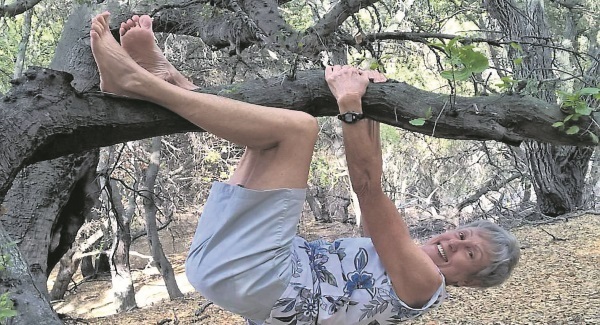
These septuagenarians are now backpacking through mountains, walking miles in their daily lives, climbing ladders â and even trees, as you can see here â with ease.
Joan, for instance, now 78, says: âI climb and hang from trees in our forest. At 70 I was scheduled for major surgery to address my pelvic organ collapse but the surgery has now not been necessary.â
Joyce, 79, who was debilitated by historic knee injuries, says she attended Katyâs movement classes ten years ago and now has regained her ability to walk without pain or impairment: âI learned that our health is influenced more by our habits â the way we use, load, and live in our bodies â than by our age.â
Katy, who is based in the west coast state of Washington, has an Irish connection: Sheâs married to Michael Curran, whose entire family live there, and they have travelled over with Finn, 6, and Roan, 4.
We have no excuse not to move our bodies in the beautiful countryside of Ireland, says Katy.
âHumans need green and blue spaces. I think our favourite rambling green space in Ireland was probably Glen of the Downs near Greystones.â
So whatâs stopping us being active? Blaming our ageing bones obviously canât be used any more. Trusting in our bodies â that we can transcend those old bad habits â is a start.
âOnce youâre outdoors and feeling stable, I recommend wandering over uneven terrain and hills,â says Katy.
âThis makes walking âharderâ but what these elements of nature do, is make more of your parts move, so âharderâ is just the feeling that comes with pursuing new strength and skill.â
Adapting to those challenges doesnât just get those limbs moving either; as we age, it has other benefits too, she points out: âMovement not only keeps your muscles and bones strong; itâs working on the cellular level also. Movement affects how your cells behave, including how they age.
âYou can have two people of the same chronological age, but if one exercises and the other doesnât, they can have different biological ages.
âSo, your biological age âhow old your body feels or works â can be affected by your movement.â
We asked Katy to give a few tips to get us flexing our bodies:
- Pick one place thatâs easily walkable and vow to not drive there. For me, thatâs the post office and my sisterâs house. Both are under a mile away, and by walking there, Iâve ended up adding three to four non-exercise miles to each week.
- Rearrange a few key items in your kitchen so everything isnât easily reachable. Move your tea to the top shelf so youâre reaching and stretching a few times a day. Put plates in a low cupboard so youâre adding bending and squatting.
- Pay attention to how you sit â including both how you get down and back up out of a chair. Avoid plopping and using your arms, to encourage better balance, stronger legs, and torso.
- Stand on one leg, balancing, every day (do both legs).
Dynamic Aging is published by Lotus and available at amazon.co.uk
Fighting dementia
A THIRD of dementia cases in the world could be prevented by being vigilant for nine risk factors throughout our lives, according to international experts.

They are: Staying in school until youâre at least over the age of 15; reducing hearing loss, obesity and high blood pressure in mid-life (ages 45 to 65), and reducing smoking, depression, physical inactivity, social isolation and diabetes in later life (65 and older).
The findings of the study, which were released by medical journal at the Alzheimerâs Association International Conference in London, suggest that controlling those risk factors could prevent 35% of dementia cases.
The three most influential risk factors were: staying in school (reducing dementia cases by 8%); reducing hearing loss in mid-life (9% fewer cases), and stopping smoking later in life (5% fewer dementia cases).
Rickshaw rolls
THERE have been an enthusiastic response from the public since the national launch in Dublin on June 13 of Cycling Without Age (CWA), the voluntary organisation that promotes making rickshaw bikes available for nursing home residents so they can get âthe wind in their hairâ outdoors.
âWe now want companies to come on board and offer to sponsor or co-sponsor bikes to help speed up getting rickshaws to nursing/care home residents,â says CWA promoter Clara Clark.
The rickshaw bike called âDaisyâ, bought by Clara and her husband Charles Mollan, pictured, for demonstration purposes, was brought to a summer party at Ailesbury Nursing Home in Dublin recently for residents, staff, and family members to try.












