Shandon Sweets reveal their 'secret mixture'
Under the shadow of Shandonâs steeple, in one of the oldest part of town, as the bells ring out the perfect sound of Cork, the morning air on John Redmond Street is filled with a warm, sweet smell from childhood.
At the doorway of Shandon Sweets, the sweetshop that time forgot, Danny Linehan welcomes visitors to the last remaining hand-made sweet factory in Ireland, the business started by Dannyâs father Jimmy back in the early 1920s, when it began as the Exchange Toffee Works.
All these years later, Danny says he just took a job in the sweet factory to help his dad for a while. In time, Dannyâs son Tony would do the same, filling in for what was only supposed to be a short time.
When you call to Shandon Sweets, you are greeted at the door by a sign explaining the shopâs history. It tells in loving detail the traditional process of sweet-making, describing the making of a batch of clove rocks.
âThe huge copper pans,â it reads, âThe moulding machines, even the recipe, are the same since Danâs father founded the factory. Today, the methods used in the manufacture of sweets (are) the same as back in the 1920s.
âThe secret mixture is boiled to a high temperature for three quarters of an hour. Then this hot, viscous liquid is poured onto a large metal table. Now the colours and flavours are added. From here begins the Shaping Process. As the mixture solidifies in about fifteen minutes, they have to be very fast and sure in their movements. The mixture is pulled and rolled into strips of about four feet (which) are then fed into a chopping machine.â
Reading that description is one thing, but to actually see the process is a different experience altogether.

It takes none of the magic from the âsecret mixtureâ when Tony reveals that itâs made up of water, sugar and glucose syrup. Eight pounds of sugar is mixed with eight pounds of glucose and added to perhaps three litres of water. The glucose gives the sweets a shelf-life they otherwise wouldnât have. The mixture is then boiled at three hundred degrees.
âWhat youâre doing,â says Tony, âis boiling off the water. What youâre left with is a caramel-coloured tar and thatâs when you work it.â âThatâs when it starts to get interesting,â says Danny.
Tony empties the mixture â âthe batchâ â out, spreading it onto the metal table, a gelatinous gloop already hardening as it cools, but Danny warns that itâs still extremely hot. âItâd take the fingerprints off you.â)
Back at the cooker, another pot is put on to boil as the process begins all over again, while Tony and Danny work the current batch. âOtherwise,â explains Danny, âyouâd be there all day, waiting for batch after batch after batch.â The batch, in its current state, is the basis of every sweet, before colouring and flavouring are added.
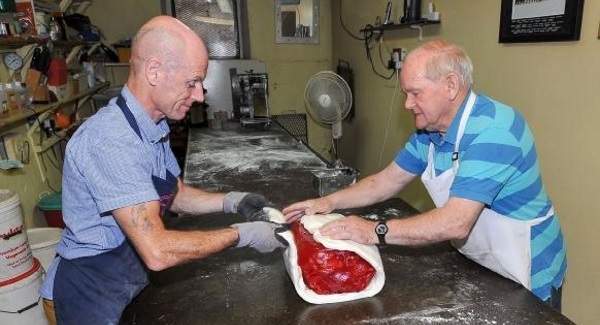
Today, the Linehans are making clove rocks. Using a large scissors, Tony cuts off approximately a quarter of the batch. To the remaining three-quarters, he adds a red food-colourant and the flavouring clove-oil, kneading it over and over. This gives it a rich, ruby colour and a strong, sweet smell.
Stretching out the other quarter of the batch, Tony loops it over a wall-hook and whips it quickly back and forth, in the manner of a boxer at a punch-bag. The secret ingredient here is air. Tony calls this his morning work-out, as he aerates the material, turning it a meringue shade of white. Back at the table, Danny rolls the white material out and wraps it around the red. The resulting package, deep red inside a thin jacket of white, looks for all the world like a giant leg of lamb.
This is then fed into a rolling machine, which returns long red and white pencils, to be in turn fed into the chopping machine.
This is when all that work translates into magic, as the chopping machine fires out a thousand of the best clove rock sweets youâll ever taste.
âThis is less a science,â says Tony, âand more an art. There isnât a place from here to Belfast doing this. Thereâs a sweet factory in the North but they work on a huge scale and itâd all be mechanised.â
In recognition of changing times, all of the sweets Danny and Tony make now are gluten-free. Another thing thatâs new, Danny says, is that kids today prefer sour sweets. âItâs not like kids long ago. Now itâs Apple, Acid, Pear Drops. Anything with a bit of a hit.â
In the shop at the front of the factory, business is brisk as tourists queue to buy bags of Bullseyes, Apple Drops, Butter Nuggets, Pear Drops, Acid Drops and Clove Rocks.
When Jimmy Linehan started the Exchange Toffee Works at the dawn of Irelandâs new state, sweet factories were ten a penny. Now, almost a century later, Danny and Tony hand-make sweets of a quality youâll find nowhere else in the land.
In uncertain times, Shandon Sweets â Irelandâs last traditional sweet factory â offers a direct link back to a time when no trip to the cinema, the dance or the show was complete without a bag of sweets.
Shandon Sweets remains a vital part of Corkâs living history.















