Smartphones have ushered in a golden age of personal eccentricity
I hate almost everything about my iPhone: What it does (distract me), what it cultivates (inattention), what it costs and how it looks (inert). But there is one capability for which I venerate this problematic rectangle.
My iPhone has alerted me to a fuller range of human weirdness than I could ever have imagined.
When I lie awake in bed at night, I do what many people do and let the Explore tab of Instagram whisk me away into a wonderland of bizarre self-expression and painstaking narcissism.
I explore fascistic dietary regimens and admire women who have squatted or implanted their butts into a condition that would give R. Crumb a heart attack. I encounter the possibility of owning a pet squirrel. I observe Indonesian death rituals, 3D latte “art”, and garden hedges that people have groomed into the shape of elephants.
In this way, a smartphone becomes the modern substitute for having an imagination. Most of us are seeking a specific feeling when we go on these idle internet journeys. The feeling varies from person to person and mood to mood. Sometimes we want to feel amazed (butts).
Sometimes we want to feel amused (squirrels). Sometimes we want to feel contemptuous (fascistic diets). Sometimes we want to feel horny (butts again). But occasionally we discover something that transcends momentary satisfaction.

Something compelling in its mystery. Something that provokes the investigative impulse to confirm whether or not the phenomenon is, as it were, “a thing”. The Explore tab is your gateway to such oddities.
To access this digital Narnia, you open up Instagram and tap the icon of a magnifying glass in your account. That leads you to an overwhelming grid of pictures and videos that renews endlessly by way of an algorithm that none of us will ever comprehend.
“Posts are selected automatically based on things like the people you follow or the posts you like,” says the Instagram help page, which does not explain how my Explore page became cluttered with hedges and ritually desiccated corpses.
But I’m not complaining! Unlike the algorithms used by Amazon (which are sneaky) or Facebook (which abetted the spread of fake news), Instagram’s Explore feature strikes me as refreshingly non-sinister.
It provides curated randomness — a category that can exist only in an era of algorithms. The distance between what I like and what Instagram thinks I might like is oceanic, preposterous, deranged.
And yet the algorithm is not wrong. I press the “like” button on a picture of my friend, and the Explore page shows me albino crocodiles. I comment on a cute dog, and the Explore page offers circus contortionists. Suddenly I like those things, too. Lurking inside my bland device is a fire hose of peculiarity that I can blast open whenever I choose.
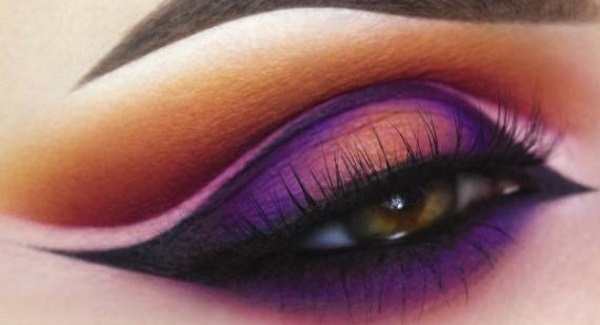
The fire hose introduced me, for example, to Giulianna Maria Bosco (@giuliannaa), a 19-year-old college sophomore with a hobby of applying trompe l’oeil makeup that appears to slice her face in half on a diagonal axis and flip one half upside down. What figment of the algorithm brought Bosco to my Explore page? I dunno.

But there she was one night, with a jagged line running across her face, splitting it in two, an eyebrow drawn on her left cheek, and an inverted nose and mouth rendered in eyeliner on her forehead.
Two faces were laid atop one, and both were looking back at me, saying something like: “There are so many ways to be yourself in the world. Here is one of them.” Using the same tools and creams I keep in my medicine cabinet, Bosco had retrofitted her face into an object with 180-degree rotational symmetry, which meant that it looked the same right side up as it did upside down. (Other items with this form of symmetry include parallelograms, the letter Z, and the New York Times crossword puzzle.)
The algorithm sensed my excitement. When I went back to the Explore page, it was populated with images of other young make-up artists who had executed the two-face look. (The look, it turns out, is a thing.)
It wasn’t merely the technical chops of the make-up artists that thrilled me, but the intensity and idiosyncrasy of their self-expression. Broadcasting the weird and obscure parts of your character has not historically been a favorite pastime of teenagers, but the internet has rendered that version of adolescence obsolete.
In Bosco’s world, trying too hard is not a sign of loserdom but a testament to focus. In this world, a person can spend seven hours alone in her room applying liquid latex over her eyebrows to a reception of 2,700 comments saying “Awesome!” in a variety of languages.
If I hadn’t landed on Bosco’s account, I would have never experienced the reality of a rotationally symmetrical teenage face. I’m aware this is not a huge deal, or even a deal of any size. But Bosco is symbolic.
Do-it-yourself broadcast mediums like Instagram have ushered in a golden age of personal eccentricity. In the history of humanity, the vast spectrum of private weirdness has never been so public. People use (and waste) their time in astonishing ways. It’s inspiring. If this new world order didn’t exist, a sci-fi novelist would have to invent it.

CONNECT WITH US TODAY



Be the first to know the latest news and updates

















