Can teenagers learn to be a parent in just a weekend?
BACK in the nineties we had Tamagotchis. Quirky digital pets that required nothing more arduous than adhering to certain virtual disciplines including feeds, playtime, cleaning up after a mess and preventing illness in order to keep them alive.
They were hugely popular and played by all ages.
Interesting fact — Tamagotchi’s were originally designed to give teenage girls an idea of what caring for a baby would be like.
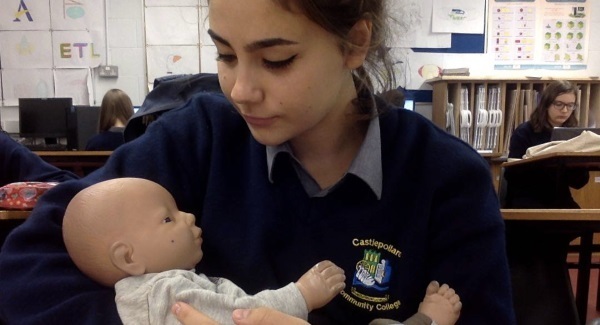
Times have changed and the Tamagotchi has been given a very realistic twenty-first century overhaul. Today they look remarkably like your average new born baby and behave in much the same way. But instead of enlisting their care to eight-year-olds, this time the job falls on transition year students who are presented with the lifelike dolls and required to care for them for a suggested 72 hours.
The dolls are part of an educational curriculum, run in conjunction with the TRUST senior cycle Relationships & Sexuality Education Curriculum. The concept behind which is to educate teens about the impact of pregnancy and parenthood.
The virtual parenting programme is a relatively new initiative for Ireland but countries such as America and Australia are no strangers to it. However, research recently published in The Lancet cites a result the opposite of what was intended from the module.
The study revealed that 36% of the 2,800 girls from 57 Western Australian schools who followed the “baby simulator” programme were more likely to become pregnant by the time they turned twenty.
Ireland has seen a 60% decline in teen pregnancies since 2001 according to figures released by the HSE. This drop in pregnancies was attributed to adequate RSE information (Relationships and Sexuality Education) yet according to another survey conducted by BMJ Open, an online journal of the British Medical Journal, the same Irish teenagers and their peers, labelled such talks in school as “out of touch” and inadequate.
Nicola Hayes is Transition Year Co-Ordinator with Castlepollard Community College, Co. Westmeath. The school is participating in the virtual parenting programme for the third consecutive year and Nicola feels the bigger purpose is about being responsible for oneself and others. “I would hope this programme enlightens students about the importance of self-respect, self-discipline and self-responsibility. Parents cannot be with their children every step of the way and the programme helps to develop a sense of responsibility and improve decision-making skills.”
From the get-go the doll is referred to as “the baby” as this encourages students to treat it as such and not a toy. The “babies” work via sensors, with students wearing their own individual sensor which they must scan to track consistency of care. The data is then downloaded to provide information on how the student got on. It also outlines when and what type of care was not given such as if the “baby” was handled roughly or incorrectly supported at the neck.
It is not compulsory that students participate and in the event “grandparents” feel an urge to help out, or stem the crying that is programmed to occur at varying intervals, they are unable to step in as the scanning system only allows the student to be the parent.
Trish Hurley, project worker with Teen Parents Support Programme, Paul Street, Co. Cork (www.teenparents.ie) says teenage pregnancy is multi-faceted and because of that it is important to appreciate the bigger picture.
“I feel it is better to come at the issue from a more positive viewpoint rather than creating an aversion situation such as having a crying doll to turn you off.” She says a more positive approach would be to include the young person in the process of building them up for the future but accepts, for parents and teachers alike, this is a challenging situation to recreate due to the sensitivity and diversity of the topic.
“The doll may or may not prevent a teenage pregnancy but I think it is worth exploring the effects of peer pressure, alcohol, drugs and the exposure to porn when it comes to the decisions some teens make. I also feel it is important to address the issue of sexually transmitted diseases.”
Unsurprisingly, according to both male and female participants in Castlepollard Community College, the most difficult part of caring for a baby was the middle of the night wake-ups. One “mum” found being stared at and talked about when she took her infant to sports training quite tough.
When asked if the programme made him think about teenage pregnancy and the ensuing responsibility, “Richard” had this to say. “It made me feel like I was a real parent. Trying everything when nothing seemed to work was very stressful. I thought it gave great insight into what parenting is about. There was a huge responsibility on me and I know I don’t want to go through that again for quite a while!”
“Donna” said it made her realise how challenging it would be to raise a child alone. “You have to completely alter your everyday life to fit in the needs of a child.” She felt the programme gave her good insight into the basics of parenting but at the same time, is still aware there is a lot more to it than nappies and feeds. “Having to be responsible for yourself is hard, never mind being responsible for an infant and having to juggle social life, education and your mental well-being on top of that.”
Contributing “grandparents” mentioned that they already had many conversations concerning contraception and childbirth with their teen and felt they had a good level of communication in this regard already. The general consensus was it is an effective programme with one saying, “there is nothing to beat practical experience to get a message across.” In the same way 16-year-olds aren’t given an instruction manual on how to drive a car much less the expectation that they be able to operate the vehicle after reading it, the students appear cognisant it is just a doll they are entrusted with. So how much can be expected to sink in?
Nicola believes it is worthwhile. “No, we don’t hand teenagers a book on how to drive a car but we do ask them to pass a theory test and sit lessons. Nothing will ever live up to the real thing, but we can prepare them. The majority of students realise they are definitely not ready for parenthood. They learn the effects an unplanned pregnancy can have. In turn, the programme gives the students a perspective of what their own parents do for them. Also the programme is not about preparing the students for parenthood per se but more about taking responsibility for oneself and one’s choices.”
When contacted for background information on the scheme, a HSE spokesperson issued this statement. “In light of the recently published research in the Lancet, the HSE is reviewing current practices in promoting and supporting Relationships and Sexuality Education (RSE) to ensure that the virtual infant dolls are not used as part of this work. The TRUST Resource was developed by the HSE in partnership with the Professional Development Service for Teachers (PDST) and does not include any reference to the virtual infant dolls.”
CONNECT WITH US TODAY



Be the first to know the latest news and updates














