Movie reviews: Doctor Strange, Train to Busan, Lo and Behold: Reveries of the Connected World
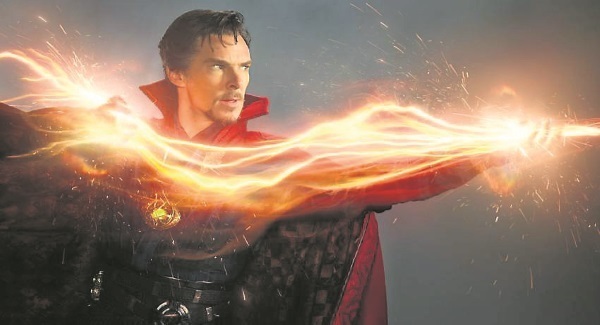
Doctor Strange 4/5

Movie reviews: Doctor Strange, Train to Busan, Lo and Behold: Reveries of the Connected World

Benedict Cumberbatch stars as Doctor Strange (12A), a brilliant New York-based neurologist who travels to Nepal in search of a miracle cure when his hands are destroyed in a car crash.

Tutored by the Ancient One (Tilda Swinton), Strange discovers there is more to this world than he believed and that he has a key role to play in the eternal struggle between humanity and the malign forces of the Dark Dimension.

Directed by Scott Derrickson, the latest comic book adaptation from Marvel/Disney is a superhero movie with a difference, not least of which is its intriguing blend of oriental mysticism and theoretical physics.

There is, of course, plenty by way of special powers conferred on our hero and fist-fight showdowns with the movie’s villain (Kaecilius, given a suavely sardonic reading by Mads Mikkelsen), but this tale has an unusually meaty backstory and Benedict Cumberbatch is in excellent form as Strange and is transformed from a supercilious surgeon into a reluctant hero of the metaphysical realms.

The visual effects, meanwhile, are reminiscent of the mind-blowing effects in Christopher Nolan’s Inception as the characters segue from one dimension to another and the sceptical Strange attempts to make sense of his awakening to a kaleidoscopic multiverse.

Origin tales can often overstay their welcome, but Scott Derrickson’s pacing ensures that Doctor Strange fairly flies by, its blend of fine cast (Chiwetel Ejiofor and Rachel McAdams give strong support to the leading trio) and intriguing premise resulting in one of the most satisfying superhero movies in years.

Writer-director Sang-ho Yeon’s Train to Busan (15A) opens in a minor key, with young Soo-an (Soo-an Kim) keen to visit her mother, who is separated from her father, fund manager Seok Woo (Yoo Gong).

It’s a straightforward one-hour train journey to Busan, and so Seok Woo reluctantly agrees to accompany his daughter, only to find himself fighting a desperate rear-guard action as the commuter-packed train becomes infected with a zombie virus.

Sang-ho Yeon offers a tongue-in-cheek metaphor for the rapacious selfishness of contemporary society in Train to Busan — the putative hero, fund manager Seok, is described as ‘a leech, a bloodsucker’, which makes him a less than ideal candidate to fend off the commuter hordes as they morph into ravening cannibals, especially as the zombie virus originated in an experimental laboratory managed by Seok’s firm.

Whether we’re supposed to take the social commentary seriously is a moot point: Train to Busan works best as a thrill-a- minute zombie flick, an expertly edited and brilliantly paced white-knuckle bullet-train ride to oblivion.

It’s not all action sequences and feeding frenzies, however: young Soo-an Kim is superb as civilisation’s conscience as her world degenerates into nihilism, and only those with a heart of stone won’t be moved by her relationship with her distant father, a role carried off with aplomb by South Korean superstar Yoo Gong.

The result is an inventive, nerve- shredding and unusually moving horror.

Lo and Behold: Reveries of the Connected World (PG) is a documentary from Werner Herzog that details the historical evolution of the internet and the world-wide web.

It opens in California with the origins of the internet, in what Herzog describes as ‘electronic pre-history’, at the dawn of ‘an unprecedented revolution in communication’.

The history lesson will likely prove fascinating to those who use the internet every day, but the film — divided into chapters — is far more interesting once Herzog moves onto discussing the web’s contemporary applications and begins musing on where the internet is likely to take us.

Narrated by Herzog himself, in doom-laden tones that suggest he is anticipating an imminent apocalypse, the film explores the positive ways in which the internet has been used — education, for example — and also the darker manifestations of the online world, and the way in which anonymity allows for a lack of accountability.

With a roster of contributors that includes innovators such as Elon Musk, Lucianne Walkowicz and Lawrence Krauss, Herzog also explores the internet’s potential, outlining how the web might allow for advances to assist in the development of life on Mars and self-driving cars; by the conclusion he even wanders into philosophy, asking if the internet dreams of itself, and whether it might ever develop a consciousness.

Informative and speculative by turns, Lo and Behold is an absorbing documentary from one of contemporary cinema’s most fertile and restless imaginations.

More in this section

Cookie Policy Privacy Policy Brand Safety FAQ Help Contact Us Terms and Conditions

© Examiner Echo Group Limited













