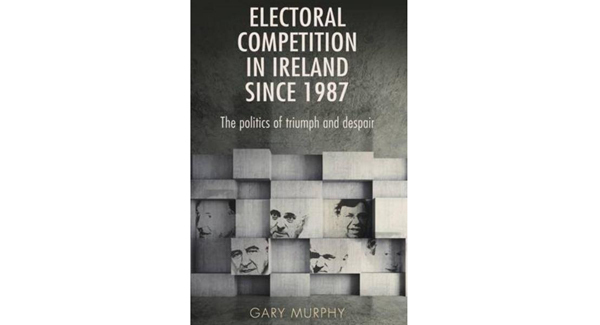
THE general election of 1989 was the first to produce a Fianna Fáil coalition government. 

Gary Murphy

Manchester University Press, £20

This form of administration would dominate over the following 22 years, leading the country up the hill to great prosperity, and dropping it from a great height into a pit of despair.

The 1989 election was notable in two other respects, according to Gary Murphy in his new book on politics in this state over the last 25 years.

The election was unwarranted, and unwanted by figures in Charlie Haughey’s minority administration, including Bertie Ahern. But there was no talking to Haughey, according to Ahern.

Haughey felt it a personal affront that he had to rely on the goodwill of the opposition.

Murphy, a professor of politics in DCU, points out that years later it was to emerge that during the election campaign, Haughey, his minister Ray Burke and Padráig Flynn all collected substantial donations during the campaign, some of which ended up being used for their own ends.

“This is unlikely to have been a reason in itself for Haughey’s decision to go to the country but it certainly adds an extra dimension to the calling of perhaps Ireland’s most pointless general election,” Murphy writes.

Fianna Fáil’s fortunes in coming to terms with governing in partnership and the fall-out from corruption perpetrated mainly, but not exclusively, by figures in that party are themes explored in detail by Murphy in his timely tome.

He sifts through the highs and lows of a political culture that initially saw the country enjoy great prosperity, followed by large dollops of hubris, before ending in disaster.

That disaster, Murphy concludes, was made all the worse because the system was unable to handle “a corrosion in intellectual thinking in Irish policy making” as a result of 20 years of social partnership where consensus was king.

But by far the most interesting element of the political culture over the last quarter century was the rise and fall of Fianna Fáil.

Haughey’s indignation at overseeing minority government in 1989 was followed a few years later by Albert Reynolds indignation at having to participate in a coalition government.

Such hubris was to torpedo Reynolds’ premiership not once, but twice, by attempting to belittle Des O’Malley first and then Labour’s Dick Spring.

Bertie Ahern’s great triumph was his capacity to park his ego and govern with others, leaving the rest to his own superlative negotiating skills.

His downfall, unlike those of his immediate predecessors, owed more to the smell the party could not rid itself of after enduring 50 years as the main party of government in the state.

The tribunals were supposed to neutralise the smell, but things didn’t work out that way.

The beef tribunal in the early 1990s was to show that “the government had an unparalled relationship with a private company” yet there was precious little accounting for such recklessness.

The two big beasts of Tribunal land, Moriarty into Haughey’s money and Michael Lowry, and Flood/Mahon into planning, both exposed how there was a dark confluence of interests at the interface of business and politics for which the citizen bore the cost.

Yet, at the ballot box, the citizen turned the other cheek, as Murphy writes of the 2002 general election.

“The Fianna Fáil/PD government became the first in over 30 years to be re-elected, and Fianna Fáil, despite being the most tainted with corruption and cronyism, came close to achieving an overall majority.”

That continued as the smell from the tribunals grew stronger. The public grew cynical through the exposure of corruption, but didn’t consider this in the polling booth.

“In contrast to the media coverage of the tribunals, which focused on the sleaze being uncovered, Fianna Fáil’s internal research findings showed that the public was in no way antagonistic to the party, and had, in fact, little interest in tribunal investigations,” Murphy writes.

As such, the author points a timely finger at the electorate. It was only when the economy crashed that voters reacted with fury, having failed theretofore to equate corruption, serious and petty, with mismanagement of the country.

Murphy explores much else about the political culture including the torturous yet intriguing trajectory of the abortion issue from 1983 to its current impasse.

Ultimately, though, the reader is left with one inescapable conclusion. We get the politicians we deserve.

x

More in this section

Cookie Policy Privacy Policy Brand Safety FAQ Help Contact Us Terms and Conditions

© Examiner Echo Group Limited













