Dan McCarthy's photos offer a snapshot of 1960s and 80s Ireland
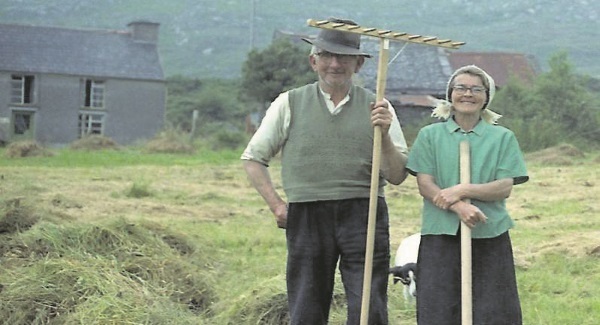
IT’S 10pm on a rainy night in Inchigeela in the 1980s. A knock on Dan McCarthy’s parents’ door. Outside, Con Joe Lucey with a pot of jam, come to see Dan off to America after a fortnight’s holiday at home. More than 30 years on — in his Canton, Massachusetts, home — McCarthy recalls Con Joe’s words that night: ‘I have some jam here, we’ll have a couple of sandwiches’.
The memory is sparked by a 1964 black and white photo of Con Joe. It is one of about 60 images that will feature in Iveleary, An Exhibition of Photographs of Uibh Laoire at the Town Hall Gallery, Macroom, from July 8-28. The photos were all taken by McCarthy on brief visits home to Inchigeela in the 1960s and ’80s. He had emigrated to America in 1960, having lived in England and Wales in the 1950s. He joined the US army in late 1962 and within 12 months was assigned to an army base in Germany — Erlangen in Northern Bavaria.
“The first thing I bought was a camera, the best I could afford — a Voigtlander Ultramatic, a German camera with a 50mm lens. It was like having a Cadillac. That’s what I used to take all my black and white photos with in the 1960s.”
Sean O’Sullivan, chairperson of Uibh Laoire Historical Society, notes in the brochure for this exhibition that a photo “is not the end of a story but the start of one”. McCarthy’s exhibition will spark myriad stories. There’s the 1964 photo of Garda Charles McCarthy — ‘Charlie the Guard’ — in front of McCarthy’s house at Graigue, about 1km west of Inchigeela Village.
“His main mission back in my schooldays was chasing truants. Later, when we’d all grown older, we’d stand around with him and talk about when he used to chase us back to school.”
McCarthy recalls developing the photo at his base in Germany. “My German instructor said, ‘Look at his head, at that bald spot and the sun shining off it — you’ve got to work on that, make it darker.’ When I got back to Ireland I told him.”

The people in McCarthy’s photos were his friends, his family, his neighbours. There’s a 1960s photo of his mother, Mary, getting water from the spring; another of her in 1983 with her 10-year-old grandson, Neil — McCarthy’s son — drinking water at St Gobnait’s Well, Ballyvourney. (He thinks his parents probably put his passion for photography down to his having become “a bit of a crazy American”).
And there’s a photo of a very young Bishop John Buckley with Fr Gerard Creedon, now a US-based priest in Virginia and a close friend of the Kennedy political dynasty — in McCarthy’s photo he’s a seminarian holding a hurley with a sliothar poised 6in above it.
“They were all friends of mine,” says McCarthy. And it shows in the photos, says his Inchigeela neighbour, Joe Creedon. “In the ’60s people were shy about being photographed and often averted their gaze. In these images the subjects obviously knew and trusted the photographer and smiled directly at him and his lens.”
Wandering around his home-place and its hinterland, McCarthy — 77 next month — recalls his words to these people he’d known since birth as he was about to capture them on film: ‘Hey fellas, I just want to take a photo of you – I have this camera here.’

In those days, when money was scarce and nobody could predict where technology would take us, they “didn’t know much about photography”, he says. “I wouldn’t have either, if I hadn’t gone away.”
Norah Norton, curator of the exhibition, says she fell in love with the photos the moment she opened the “email with attachments” she received from a US-based cousin. The first image she looked at was a “very boyish, relaxed-looking” Bishop Buckley. “Next was a bunch of children and teenagers standing on the village street and I began to recognise them as [now] very established middle-aged people. It reminded me of a time when people were a little bit different, when there was innocence and openness.”
Though she usually curates very different exhibitions — by contemporary visual artists — she showed McCarthy’s photos to Cork County Council Arts officer Ian McDonagh. “He said go for it.”
The photos, she says, bring her back to a time when everything felt more connected. There is, for example, a photo of Jimmy O’Sullivan — local postman for years — with his mailbag and bike. “He came in rain and snow. He’d bring you the latest news, from what was in the Cork Examiner to someone’s cow dying. At weekends, we played bowls with him. We pitched pennies on Sunday afternoons. It was a game of skill. I can just see Jimmy now. He was a massive penny-pitcher,” recalls McCarthy.
A photo of Dora O’Sullivan pouring petrol into a can made McCarthy smile even when he snapped it. “I thought it was funny. Petrol was rationed then, and here was someone pouring it into a one-gallon can.”

There’s a photo of Mary O’Riordan, named ‘Mary the Chair’, says McCarthy, because she used a wheelchair. “She was one of the first in Inchigeela to get a car [adapted].” And there’s one of Connie O’Riordan, who “had the shop right across from the church in Inchigeela”. McCarthy wanted a portrait photo. “I took it with a good camera, a Mamiya RB67 with a 90mm lens. I’m standing way back from him but I got a close-up.”
Over 20 years ago, a man named Michael Creedon contributed a photo of himself with a friend to a series of books published by Iveleary Historical Society. He later thanked the society for printing it because ‘people in the future will know we were there and won’t forget us’. McCarthy’s photos are from an age when the camera didn’t lie, when people stood up as they were, without artifice — a time long before we were saturated with selfies and numbed by the sameness of bland happy poses.
In these photos, McCarthy’s subjects look out with curiosity, interest, and innocence, with respect and roguishness, with humility — and a willingness to go along with this crazy American and local boy. And in doing so, they and McCarthy ensured people will know they were there and won’t forget them.















