Frank McGuinness and his first play The Factory Girls is set for Cork

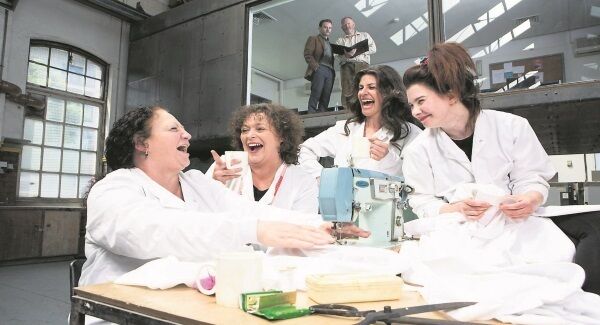
WIDELY regarded as one of Ireland’s greatest living playwrights, Frank McGuinness feels that his 1982 debut play, The Factory Girls, which is coming to Cork’s Everyman, is still relevant. “We’re not exactly out of recession now,” says McGuinness. Set during recessionary times, with industrial unrest at the core of the play, “it shows that you need to be able to stand on your own feet and take on whatever confronts you. Sometimes, you’d be as confronted from within as much as from without.”
The play, set in a shirt factory in Donegal, was inspired by McGuinness’s mother, aunts, and grandmother who all worked in a shirt factory in Buncrana, Co Donegal. “I grew up with a very powerful mother, listening to her stories about what happened in the factory. Looking back on it, it was probably inevitable that The Factory Girls would be my first play. The women working (in the factory) were extraordinarily skilled. They had their own language in which they talked about work and had a strong sense of communal identity as workers. They were protective of each other. The strength of that bond was important to me and it gave me a sense of what working life was like. I think they were very glad that they had jobs because it was very tight times. They weren’t particularly well treated. There was a desire for some form of change and for some kind of recognition that what they did was worthwhile.”
The Factory Girls is a must go to play in @EverymanCork July 13-july30th. #FunFunFun pic.twitter.com/kHGBc2T8Na
— Paul Byrne (@PaulByrne_1) June 30, 2016
McGuinness, who grew up in a council house with his two siblings, has a satisfying working life far removed from that which his parents experienced. His father drove a bread van but lost his job when McGuinness was in his teens.
As professor of creative writing at UCD and a prolific writer, McGuinness is all too aware of the economic difficulties of pursuing a creative career.
He acknowledges that there are currently a lot of talented writers in Ireland. “I think there always has been but finally, they’re getting a bit of recognition. That said, it’s savagely difficult to make a living as a writer, to be able to sustain yourself. I don’t know what can be done. I don’t think emigration is the answer. But it is a fierce battle just to get by. Aosdána helps some people to keep a roof over their heads, but not very many. I make no bones to my students that writing is a very hard life. You really need to be exceedingly committed to sustain a writing career. That counts for anything in the arts. You’re choosing a rough time. But if you want to do it, no one is going to stop you.”
Increasingly, creative writing degrees are being offered at Irish universities. Is it not folly to run such courses given the obstacles to carving out a career for even very talented writers? “What can I say? It’s inevitable that some will be better than others. I never let anybody forget that luck plays an enormous part in making your career. As a writer — or anything in the arts — you need a mixture of luck and stamina. If you can work out the combo for that, you might have some chance.”
For a while, McGuinness had “very tight and very hard times”. He had to make “two big decisions. Would I keep on teaching? I decided that I’d be a better writer if I was teaching rather than panicking about where the next ten bob was coming from. I felt teaching would enable me to sustain myself as a writer. In the 1990s, I had success in America and had to decide whether I was going to stay in Ireland or go abroad.”
McGuinness had “a very good agent” and there was interest in him writing for US television which, before the days of email, would have meant living in New York.
“It was a monumental decision. I don’t know if I would have liked doing television writing. It would have paid very well but I probably would not have been a happy bunny. I was young enough to be able to survive and do it but looking back now, I’m kind of glad I didn’t.”
He always prided himself on being able to work in Ireland.
McGuinness was in France recently where his play, Observe the Sons of Ulster Marching Towards the Somme, was performed on the Somme battlefield to mark the 100th anniversary of the First World War battle.
This Abbey Theatre and Headlong Theatre production is touring the UK and Ireland this year. McGuinness has a new play, Donegal, coming up at the Abbey Theatre.
“It’s a about country and western music and is very much about a mother and son. It’s a different style of writing for me. I have written lyrics for nine songs and, in true Donegal fashion, my cousin is doing the music.”
Although loath to be a “rent-a-gob”, McGuinness has his concerns about the way this country is going. “I feel we’re in a terrible danger of losing contact with something extraordinary, powerful, and illuminating. Our own spiritual self has gone through such a terrible conflagration in the last 20 years.
“We need to be on our guard against embracing a material culture that will be the death of us. There were appalling warnings in the years of the so-called Celtic Tiger of what could happen. We got badly scarred and I hope we’ve learned not to do that ever again.”
McGuinness is highly critical of the way the arts are treated in this country.
“Previous governments have failed the arts catastrophically. I’m not going to take the excuse of the collapse of the economy. The implementation of artistic policy in the light of the crash was so short-sighted and stupid, profoundly stupid. The economic plan for the arts is the workings of an idiot.”
But McGuinness won’t “vilify” politicians en masse. “There are plenty of decent politicians out there who know what must be done,” he says.
Who would be his ideal minister for the arts? “I think Leo Varadkar has a genuine imagination. He wouldn’t want the job, though. Joan Burton would be a good minister for arts but she has other things to do.”
CONNECT WITH US TODAY



Be the first to know the latest news and updates

















