Art: CIT Crawford College of Art and Design - Graduate Show
Highlights include Tomas Penc, whose mechanical instruments create hypnotic music; John Paul Verling’s vigorous paintings, a powerful installation by Jackie Nevin that reflects upon ‘the third phase of a woman’s life’; and Evgeniya Martirosyan, who uses water to create brilliant visual effects.
An interest in the overlap between physics and art is evident also in Isaac Stillwell’s Fractal Frequency, where loudspeakers generate complex patterns of visual imagery. Other memorable works include Linda Young’s video of slowly moving water, the paintings of Catherine Bacon, and Watermarks by Kim Roberts, an installation composed of found objects from Cork Harbour.
Found objects, in this case from the former Tax Office on Sullivan’s Quay, also form the basis for Alison Fogarty’s work, an installation that even includes a shop selling souvenirs.

There is plenty of conventional painting, much of it of good quality. A sense of distorted reality appears in the science fiction paintings of Kieran Murphy, while Gerard O’Callaghan’s realist views of industrial estates are quiet and atmospheric, as are Joseph Brickley’s paintings, inspired by images in Google Street View.
In a series of large black and white prints, Cathy Reddy documents rural landscapes formed by traditional farming methods. A sense of place also informs much of the lens-based work in the exhibition, particularly Pascal Ungerer’s Edge of Place, where the artist documents border posts and decommissioned army barracks in Europe, in video and photography.
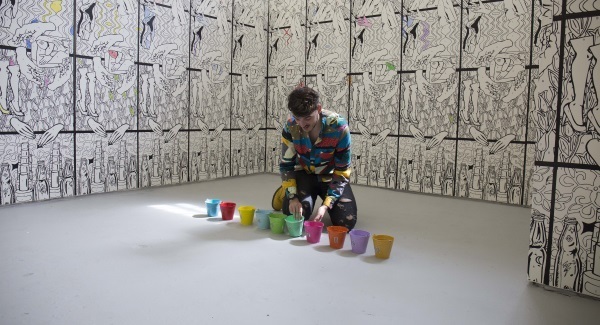
In sculpture, Ronan Bradbury adapts the physical apparatus of art transport and packing, to create an elegant mobile performative environment. Another ‘room’ by Aaron Bevan is lined with patterned wallpaper, combining the spirit of Pop Art with Arts and Crafts. Visitors are invited to colour in the wallpaper with crayons.

A circle motif features in several artists’ work. Olga Dorney’s plaster sculptures reproduce parts of the body, Nadia Rice creates delicate ink drawings of houses and landscapes, while Lisa Fleming maps viral and bacterial organisms that live in the body, all within the format of the circle. Human psychology is to the fore in Katarzyna Zalewska’s paintings of women experiencing emotional distress, in the dark etchings of Kayleigh NicGearailt, and in the installations of Nicole Flanagan and Aisling Browne. Issues of coming of age inform the work of Meghann Hales, in a series of sensitive photographic portraits of young people. An exhibition showing considerable achievement, albeit with little risk-taking, this year’s CCAD degree show is well worth seeing. The applied arts section, with work by Mary Burleigh and others working in textile and ceramic, should not be overlooked.















