Vintage View: The Vespa scooter
There are expected moments when travelling to the world’s great cities.
In New York, you expect to be cruelly told off at least once by a granite-faced waitress.
In Amsterdam, you expect to be trilled at by a grapefruit-sized bell as you wander into the lethal urban bike lanes.
In Rome, Florence, or Genoa, being mown into the sun-drenched cobbling by the Italian wasp — the Vespa, is again, expected.
It’s really part of the tense romance of the city.
Well, last month, the mayor of Genoa, attempted to ban all Vespas manufactured before 1999 from Genoa city, 7am-7pm, on the grounds of their potential polluting powers.
Over 20,000 of these wondrous vehicles are said to be affected.
The steed of legions of convent-educated, bobby-socked girls, billowing in net petticoats, pertly side-saddle, but wrapped tightly to the waist of their leather- flanked beloved — si tratta di una tragedia.
To make things worse, the entrepreneur who co-designed the Vespa was a native of Genoa.
Outrage roared across social media against the attack on the ancient bikes, crystallised in the operatic high C from the scooteristi (riders)— “Born in Genoa, Died in Genoa”.
Mayor, Marco Doria, has surrendered for now at least, postponing the action.
Piaggio, was an aircraft firm founded in 1884 in the independent principality of Pegli.
Starting off in ship fitting, it graduated as technologies changed, to the making of air and sea planes at their twin works in Tuscany.
Having been bombed flat as a prime target during WWII, the formerly thriving business found its means of manufacture curtailed by lack of money, clients and crucially, materials.
Enrico Piaggio, the son of the firm’s founder astutely weighing the needs of the times, set up an independent enterprise with former aeronautical engineers in an effort to design an affordable means of transport for the battered Italian public navigating shattered 1940s roads.
Its first efforts to deliver a scooter, the Paperino or Duckling, were lumpen at best. However the enclosed bodywork, unique splash-guard, handlebar-mounted controls and small wheels were innovative ingredients.
Enrico persisted, engaging plane and helicopter designer Corradino d’Ascanio, to develop a new bike along the engineering lines of his prototype.
D’Ascanio’s ‘stress skin’ in the new MP6 fused the body and spar frame of the bike together (this is known as monocoque and seen later in cars including the E-type Jaguar), and offered a handy step-through section with the engine mounted at the back.
Weird, eye-catching with no dirty drive chain to blot a guy’s pant leg, Enrico was delighted with the 98cc two-stroke scooter, exclaiming that it looked — “like a wasp (Vespa)”.
A neatly suited Italian man could get to work with little more than ruffled hair on this elegant mid-century wonder, his knife crease intact and grime from the road deflected away as he rode.
The bike was launched in the spring of 1947 with a press showing at Rome golf club and Enrico was confident enough to put 2,000, 98cc bikes straight into production.
Despite a slow start, by 1950, 60,000 Vespas had been sold, rising to an astonishing one million in 1956 when overseas manufacture was feeding healthy dealerships from American to India.
Vespa riding was immediately taken up as a social activity, the bikes flying the leafy lanes and city streets like a happy flock of birds.
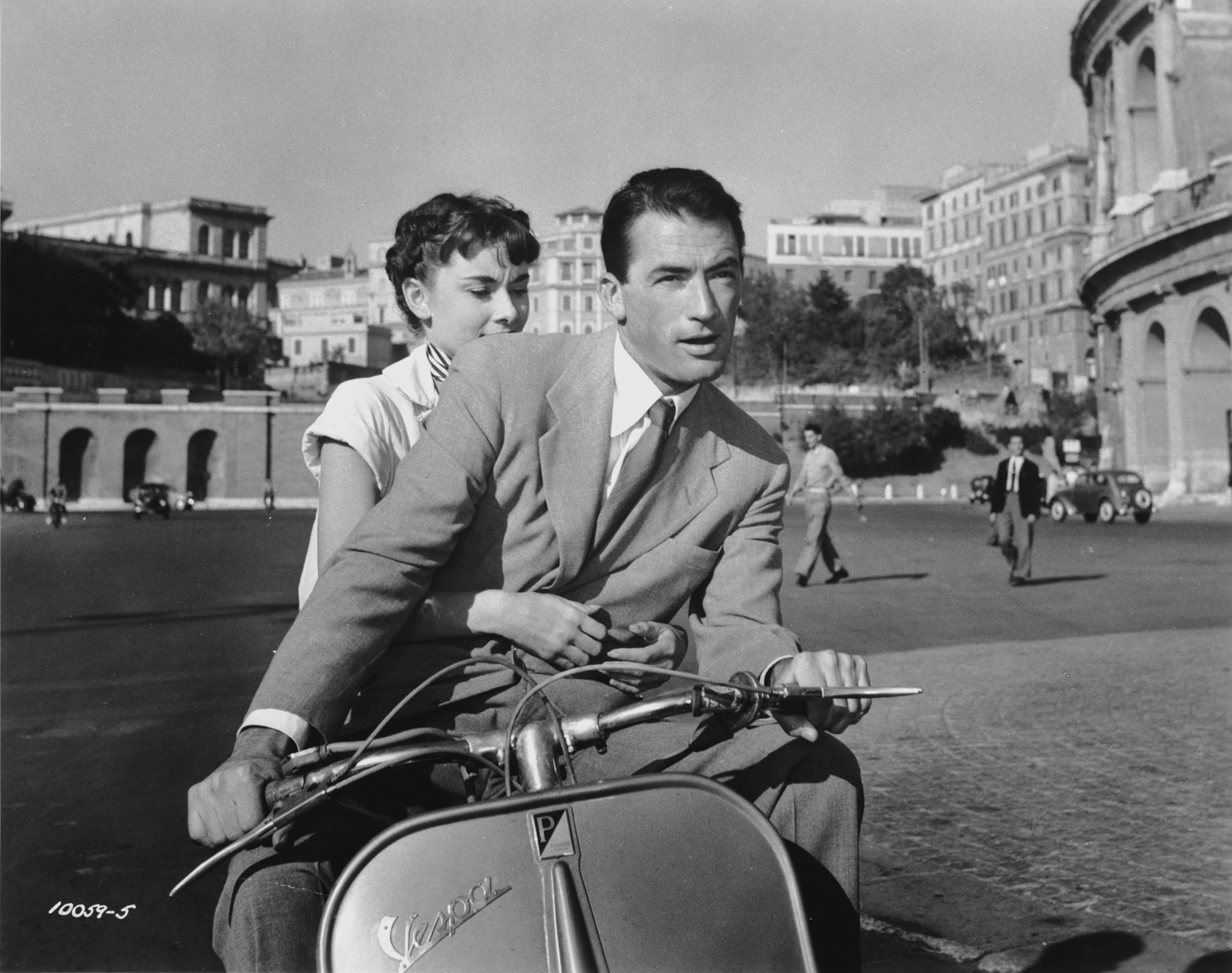
Its appearance in Roman Holiday (Paramount 1953), intensified its link to ideas of individual freedom, the young princess played by Audrey Hepburn swept away from her humdrum responsibilities on the back of a Vespa in Rome by love-struck journalist Gregory Peck.
Clubs were established worldwide, galvanising the Vespa’s position as a desirable, cult status object.
The bike was featured in daring expiations, and in 1952 Georges Monneret even crossed the English Channel on an amphibious bike.
There are three highly-feted models in vintage Vespas, although most owners are passionately loyal to their year and model of bike, and I feel their motors revving in anguish.
The Vespa 150 GS (for the engine size) 1955 which was first released in 1948 and then refined. The 1963 bike with a modest 50cc engine and the 1968, 125 Primavera.
The Vespa PX launched in 1977 marked the return to vintage models that have remained huge sellers for the brand.
The Design Museum in London in their Masterpieces of Modern Design (a must have — don’t think, just buy it), describes the Vespa as ‘the greatest symbol of post-war Italian reconstruction’.
Youngsters, ignorant of the interlace of industrial design and socio-economic progress, behold its dinky aesthetic, recognise the golden equation of its timeless look and instinctively sigh... ‘cool’.
Ross motorcycles is the Cork dealer for Vespa and you can find the Vespa World outlet, at Bikeworld, Longmile Road, Dublin.
CONNECT WITH US TODAY



Be the first to know the latest news and updates














