Book review: The Sermon on the Fall of Rome
This proves quite a challenge though, as over the following months a veritable plague of misfortune befalls the place, with the helm passing first to a big talker who turns it into a noisy techno-music joint for his own lewd gains.
Then to a couple whose overzealous demonstrations of both hatred and love keep the regulars at a careful distance; and finally to an apparently stable family who quickly fall into ruin when their patriarch, Bernard Gratas, succumbs to his inveterate gambling habit.
It is into this breach that long-time best friends Matthieu and Libero dare to step.
Freshly returned from Paris, having dropped out of their post-graduate philosophy studies, the two young men are determined to succeed against all the odds.
Libero, a bright, hard and somewhat disillusioned young man sprung from a big, impoverished local family, takes the lead.
The devoted and slightly doltish Matthieu is easily led and happy to go with the flow.
They hire five beautiful waitresses and a suave musician and, with their offering of late drink and almost communal decadence, establish their place as the island’s chief nightlife hot spot.
Matthieu is staked in this enterprise by his grandfather, Marcel, and it is through the old man that the novel’s second thread plays out: That of an intriguing, multi-generational family saga.
Having survived the war with barely a moment of combat, by the early 50s he has settled in to a comfortable civil administration post.
Due to an overzealous brotherly arrangement, he marries a beautiful and “almost angelically stupid” 17-year-old, and they set out for his new posting in French West Africa.
There, she quickly falls pregnant, but dies from infection barely a week after giving birth to their only son, Jacques.
Marcel’s sister, already the mother of an infant daughter, Claudie, agrees to take and rear the boy, and it is between these sibling-like first cousins that a forbidden but genuine love will form, one that eventually results in a life union and the births of both Matthieu and his archaeologist sister, Aurélie.
Horrified by what he views as an incestuous relationship, Marcel can’t bring himself to vent his anger on his son, niece, or granddaughter, but finds a natural target in Matthieu and makes no effort to hide his hatred for the boy.
All but the last of the novel’s seven chapters take as their titles quoted phrases from St Augustine’s 410 AD sermon on the Fall of Rome, and they serve well as a framing device, metaphorically paralleling the various collapses within the story: The crumbling of the French empire in Africa; the shift in Corsican traditions; the collapse of relationships both familial and romantic; and, in a spectacularly shocking finale, the explosive destruction of a hedonistic idyll that the two young friends have worked so hard to create.
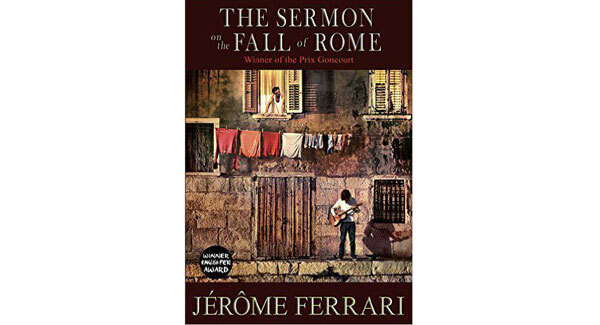
Jerome Ferrari’s second novel to cross into English (following the equally impressive Where I Left My Soul), The Sermon on the Fall of Rome won France’s most prestigious literary honour, the Prix Goncourt in 2012.
As with virtually all books that make the aesthetically successful leap between languages, credit must be paid to Strachan’s beautifully measured translation.
The result is a triumph of style and substance. Poignant, sensual and at times intense, it is ripe with long, languid, immaculately paced sentences, philosophical meditations, and essential questions of the heart.














