Vintage view: The history and character of old delft tiles in Amsterdam
Consider the same old round of furry- footed horses and snaggle-toothed milkmaids cluttering up your life day in, day out.
The most exciting thing to happen since 1595 had been the introduction of a flaming lantern on every 12th house to stop hapless idiots plunging into the growing networks of canals in the gloom.
Every Wednesday, the lepers came to town to beg for alms, waving their rattles and state-issued ‘dirty letter’ (vuilbrief) — a faint whiff of dangerous excitement.
Traders, merchants and naval adventurers in a relatively young city being dug from the slimy peat, the Netherlanders were hungry for new motifs, materials, even splinter-sized glimpses of the exotic lands ploughed by the East and West India Company (VOC and GWIC respectively).
If you visit Holland today — distinct as a region in the Kingdom of the Netherlands — everywhere you go, the main tourist bait is quaint blue and white delft pottery, much of it not made at Delft at all, but in the many surviving factories from all over the low countries.
With the exception of expensive, show-stopping chargers, contemporary delft is dreary, doll’s house stuff. It’s generally not even tin-glazed pottery, but porcelain.
Still, my sneering attitude towards delft was challenged last week on a long cultural tramp around Amsterdam.

The Rijksmuseum, the majestic national museum of the Netherlands, has a dimly lit gallery glittering with early polychrome delft including hilarious super-sized animals and magnificent dinner ware, with quality and invention enough to make anyone laugh out loud.
The exhibits include weighty sets of kast-stel jars that would have been used to brighten up, impress and serve family and guests in wealthy households.
Gorgeous tulip vases and stacked pyramids of as much as a metre high in polychrome colours of red, orange, blue and green, were intended to stage the obsessive interest of the Dutch with single rare blooms grown from bulbs from the east.
This vibrant passion survives down at the floating Flower Market /Bloemenmark established in 1862, if you are ever in town.
At the Rembrandt Museum (Het Rembrandthuis) on Jodenbreestraat, I really started to love the stuff, especially the tiles in delft.
Blue and white crazed tiles with late 16th century Spanish inspired decoration cover the walls in the kitchen and frame out the grand fireplaces where the master received his clients and flogged his work and that of his circle of close friends between 1639-1658.
Delft, a tin-glazed earthenware that crucially was waterproof enough for liquids and the splashes of a kitchen or washroom, was first produced in Antwerp in 1500.
Led by Italian and Spanish potters who settled in Antwerp, by the late 16th century production and finishing of delft had expanded to the north, many makers driven here or abroad by the pressures of the Eighty Years War.
For the next 150 years it was a crucial commodity and delightful form of domestic surfacing in every home that could afford it — and in the churches and aristocratic haunts of the Netherland’s trading partners.
The stunning painted decoration was a jealously guarded talent, overseen by the Guild of St Luke, a body to which every potter working on a monogrammed piece of delft pottery had to belong.
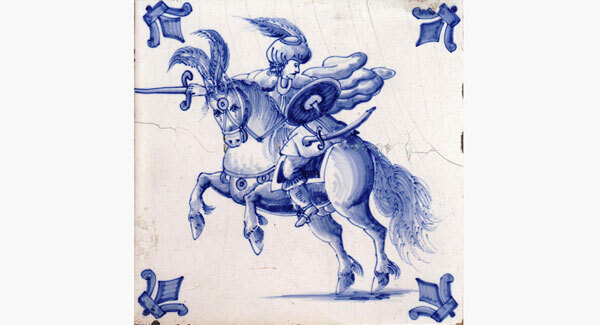
In the early 16th century a set of 4-16 glassy tiles would be laid to make up an entire pattern, but as time went on the Dutch started to favour tiles with individual motifs taken from the markets, the bible and daily life —a maid, a warrior, an animal or flower.
The corners were often decorated in the same abstract form so that you could connect them up into a wider pattern for walls and surrounds. The pictures might include new fruits, fauna and curiosities appearing in the harbours, art assembled on merchant’s tables — pomegranates, oranges, a lion or leopard, and not surprisingly — ships.
Blue and white (often termed Delft Blue) is the glaze most associated with delft ware today. This change can be traced to a thrilling event for the gentlefolk of Holland.
In 1602, slashed doublets strained in a polite frenzy of avarice, when the first Chinese porcelain arrived, pirated from Portuguese ships in the busy trading lanes.
New and garnered from the furthest reaches of the trading empire, porcelain was a social statement of taste, wealth and cultural guts.
Soon the VOC was doing big business in violently expensive Chinese porcelain, and where the best of taste went, the delft potters followed, introducing a purely blue and white palette.
Tiles with a white ground were ideal for not only providing a waterproof, scorch-proof, easily cleaned finish, but with their glossy character, they threw an uplifting light into dark smoky corners and dark minds. in a time where upheaval, contagion and death were always near.
During the 1600s the potters of Delft, Rotterdam, Harlingen and Makkum would add their decorative flourish in tiles and picture sets to palaces, town houses and country manors from England to Russia.
If you want to see the best of the best of delft tiles available to buy in Amsterdam, visit Kramer Kunst & Antiek, owned by Roeland and Sebastian Kramer on the Prinsengracht canal, a lovely stroll from the centre of the city, www.antiquetileshop.nl.
Random tiles appear at most antique shops in larger Dutch cities and towns, most genuinely dating from the 17th century in a variety of conditions from around €50 each.
Look for more intricate designs that would have originally been more expensive and which include an interesting subject matter.
The Rijksmuseum has some of its delft tile collection of 20,000 tiles on display in the delft earthenware galleries (€17.50 per adult for the entire museum/children free).















