Vintage View: The heroic life of Thomas Francis Meagher
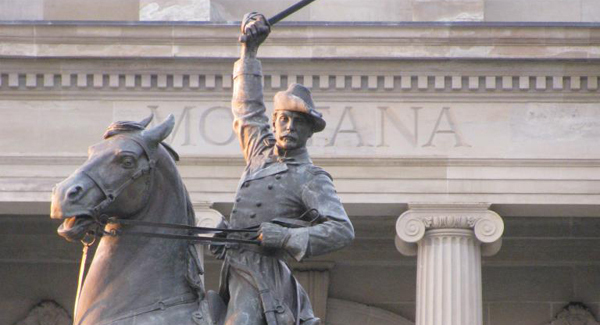
Kya deLongchamps celebrates the heroic and unlikely life of Thomas Francis Meagher (1823-1867) nearly 150 years since his mysterious disappearance.

Vintage View: The heroic life of Thomas Francis Meagher

WE WERE enjoying a tour of the Bishop’s Palace in Waterford. At least I was — my daughter was struggling to hide a series of elasticised yawns.

Eighteenth century tea-tables, the first Waterford Crystal ever made, and even the exploits of proud, bullock riding Thomas Wyse (1701-1770) had all failed to tickle her 11-year-old imagination.

She had perked up momentarily at the sight of a bright curl of Napoleon Bonaparte’s hair, when our narrator pointed to a magnificent painting of a dark, handsome officer in an inky American civil war uniform.

With gilded scrambled egg cresting his shoulders, sword swinging by his side and eyes on, he was clearly a cut above. Our guide was obviously relishing the moment. He moistened his lips — the story that followed woke us all up.

Thomas Francis Meagher (1823-1867) was born to Thomas Meagher Snr, (1763-1837) a wealthy Catholic merchant and twice mayor of the city of Waterford.

The family were already extraordinary. Thomas’ father was of Irish parents but born in Newfoundland, and established a thriving business in the only British colony (outside Ireland) where the Irish were in a majority.

Thomas Francis was educated by the Jesuits in Clongowes before finishing his formal education at the Jesuit stronghold of Stonyhurst College in Lancashire. With a first class academic start and a natural talent for oration, Meagher returned to Ireland in 1843 intent on a commission in the Austrian Army.

He was distracted by the opportunity to study for the bar and before long became involved in the Repeal Association and the Young Irelanders, writing for The Nation, and crowding out public halls with his rich prose and passionate voice.

Meagher’s distrust of the pacifying policies of the Whig government, wrangles with Daniel O’Connell and refusal to rule out the use of force to secure Irish Independence, led up to the incendiary ‘Sword Speech’ in Conciliation Hall in 1846, where he compared Ireland’s dilemma to that of other countries in Europe, like Belgium.

“Abhor the sword? Stigmatise the sword? No, my lord, for at its blow, and in the quivering of its crimson light, a giant nation sprang up from the waters of the Atlantic, and by its redeeming magic the fettered colony became a daring, free Republic.”

Aligning Ireland with other troublesome republics, and throwing around terms like ‘crimson light’ and ‘fettered colony’ this was seditious stuff.

With typical disregard to his personal safety, and ablaze with revolutionary optimism, Meagher took a moonlit flit to France with his companions John Mitchel, William Smith O’Brien and Thomas Devin Reilly, returning with a flag worked by Parisian seamstresses.

Aside from the order of the tricolour (the orange then was by the staff) and the presence of a Red Hand of Ulster in the white ground, it’s recognisable as the primer for our present flag.

This sensational invitation to instant arrest was flown by Meagher at the Wolfe Tone Confederate Club on March 1, 1848, during the Waterford by-election.

Following a high profile trial and a sentence of being hung, drawn and quartered (a barbaric medieval recipe unlikely to be tolerated in the mid-19th century), it was commuted to transportation for life to Van Diemen’s Land (now Tasmania).

Banishment to sweltering misery on the edge of nowhere might have made a lesser man a bit sulky — but not Meagher. He wed — his neglect of his first wife Katherine Bennett is the only flat gong against him — and by 1852 Thomas decided that trudging around the penal colony doing unpaid labour for the free settlers was a waste of his talents.

He wrote a gentlemanly letter to the authorities informing them that in 24 hours he was off — and caught a ship to New York.

Within two years he was practising law and editing a republican newspaper, The Irish News (alongside John Mitchel) and had married into the affluent Protestant family of the Townsends of Monroe County.

It was perhaps a little affected of Meagher to summon a panel of what he deemed his superiors to ‘court martial’ him for his escape from Van Diemen’s Land.

They naturally vindicated the popular public figure, now a pillar of respectability and author of many lively travel articles in Tatler magazine.

This is where even a ferociously brave, ambitious man might have hung up his sword, tended to his semi-professional, gentrified existence and virtually retired. However Meagher was a man of action, a political idealist.

Regardless of his familial failings, it’s hard not to love him for his genuine revulsion against slavery, which compelled him not only take up the cause of the Union in 1861, but to actively recruit from his Irish immigrant community to muscle up the legendary 69th Infantry Regiment (formerly the 69th NY State Militia).

By 1862 he was a Brigadier General and fought at the head of a purely Irish division, receiving iconic praise for their first outing — the Battle of Bull Run.

The 69th performed with bloody relish, a shamrock stitched into their caps. Gaines Mill was to be the highlight of Meagher’s chequered military career.

Together with the many contemporary paintings of Meagher, a spine tingling early photograph of him with his officers draped on a gun carriage, the dusty, exhausted Thomas looking right to camera, still exist in the Library of Congress. Armed with their Springfield buck ’n’ ball muskets (Meagher’s input), these were feared warriors.

Thomas Meagher led 1,200 men, most to their deaths, at the Battle of Fredericksburg and retired in May 1863, highly decorated, physically wounded and emotionally worn down.

He took up the governorship of Montana before drowning from a fall from a steam ship in the summer of 1867 in what conspiracy theorists describe as ‘mysterious circumstances’ but what was in all likelihood an evening stumble into the Missouri River brought on by a recent illness.

He was just 44. His exploits, intelligence, daring and commitment to his principles form part of not only the wider story of the flag that was raised over the GPO in Dublin in 1916, but across the World, to two continents in what was a tragically short but non-the-less diamond brilliant life.

You can see Thomas Meagher’s Union uniform, sword, portrait and much more at the architectural jewel, The Bishop’s Palace, The Mall, Waterford. waterfordtreasures.com/bishops-palace

x

More in this section

Cookie Policy Privacy Policy Brand Safety FAQ Help Contact Us Terms and Conditions

© Examiner Echo Group Limited













