Book review: The Negotiator: A Memoir
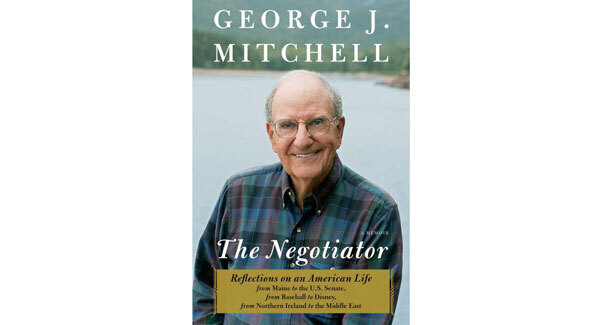
George J Mitchell
Simon & Schuster, €25.99; ebook, €20.28
GEORGE MITCHELL’S latest book, his fifth, is a sweeping memoir, in which he deals with the broad highlights, rather than the minute details of his eventful life.
The book provides some real insights into what made him tick, and why he was so successful.
He began public life as a federal judge and had the distinction of turning down a position on the US Supreme Court, because he wished to pursue a political career, in which he went on to enjoy phenomenal success.
After Edmund Muskie resigned from the US Senate following his appointment as Secretary of State, Mitchell was appointed to fill his seat for two years until the next election.
He was 36% behind his Republican opponent in the public opinion polls at the time, but Mitchell still went on to win the seat in his own right two years later with 61% of the vote.
He then went on to become Senate Majority leader after just one full term.
He actually won re-election to a second full term with a record 81% of the vote in Maine, a state that had traditionally voted for Republican candidates.
After serving two full terms he retired from the Senate and went on to distinguish himself in a variety of further political and business positions.
He served as President Clinton’s Special Envoy to Northern Ireland and was one of the main architects of the Good Friday Agreement.
With a name like Mitchell, he had Irish roots. His father was the son of Irish immigrants, but was orphaned as a child and never knew his parents.
Reared in a Boston orphanage until adopted by a non-Irish childless couple he grew up in the state of Maine. Mitchell’s father only had a primary school education and spent his life working as a school janitor.
George’s father married a neighbour, a young Lebanese woman who had immigrated to the United States as a teenager, and George was one of their five children.
His mother, who worked nights in a local textile plant, was the strongest influence on his life. She would be home to prepare the breakfast and get the children ready for school. The Mitchell’s story is the embodiment of the American dream.
George’s own secret of political success was learning “to spend less time talking and more time listening.” Learning to listen was the key to his success in the United States Senate, in Northern Ireland, and elsewhere.
“I’ve talked a lot in my life,” he wrote.
“As all those words flowed out of my mouth, the only certainty that I have is that I learned little while I was talking. Learning has come from listening, from reading, from observing, from doing.”
“As I listened more and better, I gained insight into the views of the senators with whom I was engaged,” he continued.
“Too many persons in positions of authority become accustomed to deference, develop excessive self-confidence, and are incapable of showing respect to others, especially those with whom they disagree.”
In addition to the British and Irish governments, the negotiations in Northern Ireland involved 10 different Northern parties.
People on the different sides had been shouting at each other, not just for years, or decades, but for centuries. Few, if any of them, had ever listened to each other.
“I’m a product of the United States Senate, which as you know, has a rule of unlimited debate,” Mitchell told the northern parties on the first day that he met them. He had listened to countless hours of debate in the Senate.
“I can and I will sit here and listen as long as you can talk,” he added. “I can take anything you throw at me.”
“In retrospect,” he admitted, “I went too far in my opening statement. Over and over and over again, for month after month, then year after year for what in the aggregate must have been hundreds of hours, the same people made the same speeches.
"It took every bit of patience I had and more to sit there and listen, but I did.”
Of course, it would take equal patience to read those details, so with the stroke of his pen, he has mercifully summarised what happened during those endless hours. Anyway he has already covered that material in his 2001 book, Making Peace.
Risk taking was the other key to Mitchell’s success.
“At several points in my life I took chances that seemed imprudent at the time,” he explained. During his early years as a federal judge, he honed his listening skills.
Judges are involved in disputes that others bring to them; they have virtually no independent authority to act on their own initiative. Elected officials, by contrast, can initiate action on any issue they deem important enough to address.
He enjoyed his time as a federal judge, but he took the chance of advancement by accepting the appointment to the United States Senate, and turning down President Jimmy Carter’s offer of a position on the U.S. Supreme Court.
Early public opinion polls seemed to indicate that he had little chance of election in his own right two years later, but he made the position his own.
It was another risk when he accepted the challenge of the British and Irish governments to chair the Northern Ireland peace negotiations.
“By far the greatest risk I took in the negotiations themselves was when I established the firm and final deadline of midnight on April 10, 1998.” It was he who set the Good Friday deadline.
“Without a final deadline,” he concluded, “the process was ultimately more likely to fail.”
One has to learn when to take one’s chances.
“We should anticipate chance without knowing how or when it will occur,” Mitchell advises.
“Chance can offer an escape from tedium, from a dead end, from failure; it can offer redemption from error; in some dramatic cases, it can offer a new life, as it did for me.”
He welcomed the opportunities that his Irish venture gave him to learn about his Irish heritage. He was clearly inspired by Claire Gallagher, a 15-year-old girl who lost both her eyes in the Omagh bombing.
“You have to bring this to an end,” she told him.
He was deeply moved, because despite her incredible tragedy, blinded for life, she was actually thinking of others.
The chance of success in Northern Ireland seemed remote. A week before the peace agreement a public opinion poll found that only seven per cent of the people thought a settlement possible, while 83% believed there would be no agreement.
Afterwards Mitchell kept in touch with Claire and saw her on a number of occasions. Now married with her own children, Claire Bowes is working at the Royal Institute for the Blind.
Mitchell first marriage ended in divorce, but he married again after retiring from the United States Senate, and he and his wife named their daughter Claire, after Claire Gallagher, the young Irish girl that inspired him.
In this book Mitchell does all the talking, but his story is a testament to the value of listening. If only more people would listen!

CONNECT WITH US TODAY



Be the first to know the latest news and updates

















