Vintage view: A Teddy Bears’ Picnic- Steiff
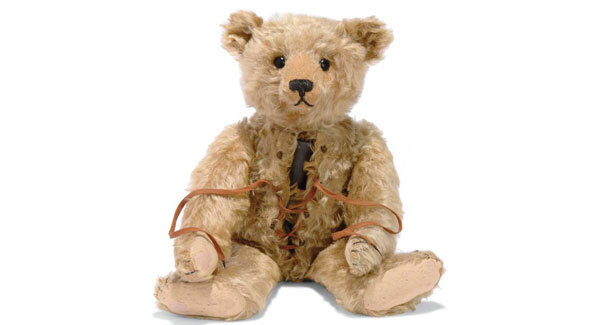
Kya deLongchamps says an old teddy bear or cuddly toy by German company Steiff can fetch thousands.

Vintage view: A Teddy Bears’ Picnic- Steiff

THE words ‘Ah, there’s the button in the ear’ thrill the ears of eager collectors worldwide, as they signal the work of one of the great soft-toy makers — Steiff, of Germany.

I’m amazed that the signature button survives attached to a well-cuddled, sucked and trampled teddy. We were clearly infant thugs, as that little golden bead would have been the first thing to be chewed, swallowed and reproduced at A&E.

Steiff was founded by a woman. Not only did she defeat the odds stacked against any 19th century female of ambition, she was also disabled, having had polio at the age of two.

Born in Giengen, on the Brenz, in 1847, Margarete Steiff was embraced by her community, taken to school propped in a hand cart and carried around by neighbours and her loving elder sisters, Pauline and Marie. Her sisters opened a tailor’s shop in 1862, where Margarete, a noted seamstress, developed a taste for business .

She saved up for a sewing machine and her father converted it for use on Margaret’s more able left side.

The family house served as an outlet for Margarete’s sewing and alternations. Her business slowly developed with the encouragement of her family, in particular her cousin’s husband, Alfred Glant.

When Pauline and Marie left home, Margarete established a felt clothing business in 1877.

This would have been counted as success beyond all expectations, but a tiny elephant would deftly seize Margarete’s future. It was a palm-size pin cushion, not even of her design, and it appeared in a popular magazine in pattern form.

Elephants were an exotic wonder, and not many people would have seen a living one, so the design was popular.

Margarete ran some prototypes on her machine (probably from remnants from her clothing commissions) and her brother, Fritz, took the pieces down to the Heidenheim market. They quickly sold out, and, between 1880 and 1886, she and her brother sold 5,000 elephants.

Now living in her own home, over her own shop, which was run by Fritz, Margarete had developed a charming zoo of small animal figures. Quality was a must from the start, and the first catalogue of Margarete Steiff’s felt-toy factory, Giengen/Brenz, declared ‘For children, only the best is good enough (‘Für Kinder ist nur das beste gut genug!).

Designed scrupulously from the study of live creatures and hand-built and finished to be safely played with by the youngest child, this determination for quality was to survive the rigours of two world wars, right to the present day.

By the early 1890s, Steiff engaged four full-time and ten home workers. Margarete’s nephew, Richard, introduced a design for a bear with movable arms, based on a bear he had sketched at Stuttgart Zoo.

Despite his aunt’s dislike of the use of mohair stuffed with lime wood for shaping, they entered the product in the Leipzig Toy Fair in 1902.

American commercial traders combing the showcase for products for retail clients were astonished by the posable, beautifully made bear, and Steiff secured an order for 3,000 Margarete Steiff bears.

When Clifford Berryman used the bear in his cartoons, surrounding the kindly hunting antics of President Theodore Roosevelt, the ‘teddy’ became a national icon. It might have taken 30 years in the making, but, by 1907, Steiff’s 400 employees and 1,800 home workers were producing 973,999 teddy bears and 1,700,000 toys.

Then, as now, it was difficult to visually trademark a product, and sewn toys were easily replicated. Franz Steiff, another useful nephew, saw the need for instant brand recognition and came up with the button-in-ear idea (knopf im ohr), embossing it with their first triumph, the figure of a small elephant.

If you find a genuine Steiff of any age, you should see the button (or in moth-eaten or played-with condition, then the hole left by it) and a fabric tag that carries the product number.

The most useful visual guide to button dates and tags I could find is at steiffnews.com, which shows buttons from the age of patent, in 1905, right through to the present day.

A Steiff from 1926 onwards may retains its rare card pendant, which was put around the animals’ necks when new. Generally, these were ripped off, leaving a small thread, which you might still detect deep in the fur. The early fabric tags carry a wealth of information.

The first number represents the position of the animal, the second digit states what material the animal is made of, and the third and fourth numbers identify the size of the toy.

Bears, animals and even small pieces of children’s furniture are now eagerly collected. Really old, rare bears, from 1905 to the 1930s, can achieve five-figure sums, even in rough condition with rubbed-out fur, missing eyes and repairs.

Pieces are available in alpaca, felt and mohair, and collectors’ editions for early bears have become sought-after in the second-hand market, especially in short runs. Mohair is long and shiny and, even when decades old, the fur can retain a surprising shine.

The most coveted pieces for most collectors are early examples of the Steiff Circus animals, mounted on wheels, and the legendary Harlequin Bear, c.1925, of which only one is known. It sold for €65,000 in 2010, at Christies in London.

For detailed information, a valuation service and insurance certification for collectable Steiffs, from around €50, go to steiffbears.org.

More in this section

Cookie Policy Privacy Policy Brand Safety FAQ Help Contact Us Terms and Conditions

© Examiner Echo Group Limited













