Kari Rosvall: "I was a child of Hitler’s Aryan race programme"
WHEN Kari Rovall was 64, and happily livingin Ireland, she was sent a photograph of herself as a baby — the first she had ever seen.
With it was a letter providing details about her birth. After a lifetime of wondering about her origins, she learned that she was one of Hitler’s Lebensborn children: his ‘Spring of Life’ programme which encouraged Nazi soldiers to have children with Scandinavian women to create an Aryan master race.
Horrifying though this was for her, it made sense of everything: the lack of official papers; her adoptive parents’ ignorance of her background and her birth mother’s coldness and reticence. And it led to further discovery.
Kari’s life had swung between darkness and light. Her first memory was of being three years old in an orphanage in Sweden.
“My parents had come to choose which child they wanted. We were standing in a row, then they opened a door, put one child through and closed it again. You were supposed to go around, but I didn’t. The man, Simon, had nice eyes, and I ran straight up to him and was put on his lap. It was love at first sight. He said: ‘I won’t go home without this little girl. She is mine’,” Kari says.
Having arrived from Germany, along with other Lebensborn children her Swedish adoption proved a success. If Kari’s mother never accepted her, her father and grandmother loved her dearly. Her rural childhood was happy, but something nagged at Kari.
“I was different. I didn’t have official papers. I kept asking Simon about my real mother, but he said he knew nothing.”
So, at 20, working as an auxiliary nurse, Kari took the matter into her own hands. She wrote to the Red Cross, and was surprised when they rang her, to say: “We know who your mother is. She is Norwegian and your father is German. You can meet her in a fortnight. We are organising train tickets for you.” “I was so scared,” says Kari. “I didn’t know what to expect.”
The meeting was not a success. Kari stayed with her mother for a few days, but she was cold, and told Kari little about her past. “When I asked her about my father, she said, ‘he wasn’t a very nice man’. She told me she’d had a child before me, a son, whose father was killed in the war, andwho lived with relatives.”
Kari’s mother wrote occasionally after that, and, years later, when Kari was next in Norway, she called on her mother. She wasn’t well-received. Her mother said they had now met, and that was enough. There was no point in further contact. Now that Kari knows the circumstances of her birth, she understand this better.
“My mother had TB in her hip as a child. She had a normal birth and I was a big weight. She was allowed to keep me for ten days, then suddenly I was taken away,” Kari says.
Kari was examined, and her head measured, to check that she was of good Aryan stock. She was packed into a crate and carted off to an orphanage in Germany. Kari and her husband, Sven, have visited this home, Hohehorst, which is now a museum. She learned what happened to her, and the other children, once the Germans were defeated.
“We had been branded pure blood and perfect. Himmler would visit, and any child born on his birthday became his godchild. But now we were the outcasts; the debris from the war. From being fed well, and looked after kindly, we were put in the attic until we were rescued from there by the Red Cross,” Kari says.
Reading Norwegian newspaper reports of the time, Kari has learned just how unwanted she and the other Lebensborn children were. In 1945, The Norwegian ministry of social affairs said that “to believe these children will become decent citizens is to believe rats in the cellar will become house pets”.
In adulthood, Kari has had joy, but much sorrow. Her first marriage, to Daniel, which was so loving at the start, failed when he became ill. She also has had physical illnesses, and bouts of depression. But Roger, the son from her first marriage, is an endless source of happiness. He now works for the Japanese embassy in Stockholm, and the two have remained close.
Perhaps the greatest joy of her life was meeting Sven in 1993 and when, four years later, Sven was offered a job in Ireland, Kari’s happiness seemed complete.
“Though I had to look at an atlas to see where Ireland was,” the 70-year-old says with a grin. Settling in Balinteer, Kari felt instantly at home. “In Ireland, I could be myself for the first time ever. I am accepted. I never was in Sweden. A woman helped me off the bus the other day. I couldn’t believe it! I can relax here. It was never like that before.”
Kari’s mother had died before Kari discovered the truth about her background, but she has met her half-brother, some other relations, and the man with whom her mother spent the last 28 years of her life. None of them knew of her existence.
“Her partner didn’t know a thing about me, and that made him sad. He said, ‘why didn’t she tell me? Didn’t she trust me enough?’,” Kari says.
But Kari’s mother had confided in him about other things; he was able to tell Kari that her mother had been tortured by the Germans, and then rejected by her own country, and derided by her family for having been a collaborator.
“He knew all that, but not that she had had a child. I think my mother had shame. I think maybe she felt guilty, and perhaps she was afraid that if she told him she would lose him.”
Kari was never able to trace her father, but she has been told that he was a foot soldier — rather than a high-ranking member of the SS. Kari has met other Lebensborn children, and many of them have not coped as well as she has.
She realises there have been moments of luck — and that had she not run to Simon, when she was that little girl, her story could have been much darker. When Kari got an apology, by letter, from the Norwegian Government, and compensation, she knew how she wanted to spend the money. “I became an Irish citizen,” she says.
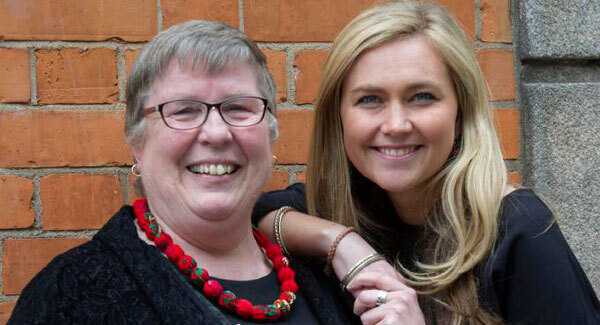
With the assistance of a young journalist, Naomi Linehan, Kari has written her story, Nowhere’s Child. Naomi came along for this interview, too, and she told me how she and Kari met. “I was working as a reporter for the Pat Kenny Show, so I was always on the lookout for good stories. Kari gave a talk to the Irish Countrywoman’s Association, and my mother and aunt attended. They said, ‘you would not believe this woman’s story’.
“I met Kari. We did the piece, and people texted into the programme, saying, ‘is there a book?’ The two of us looked at each other and said, ‘shall we try?’ And I quit my job, so that I could concentrate on the book completely.”
Kari is eternally grateful to Naomi for giving voice to her story.
“She has been able to pick up what I didn’t say,” she says. “To read between the lines. I hope that people will find that my book is full of hope. There is darkness, but there is light at the end of the tunnel. Things can change.”

CONNECT WITH US TODAY



Be the first to know the latest news and updates









