Book review: How Corrupt is Britain?
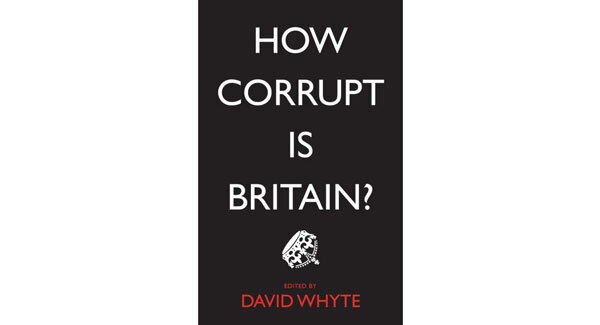
He asserts that corruption in Britain is “actually routine practice that is used for maintaining and extending the power of corporations, government and public institutions.”
Key to this analysis is the definition of corruption that David Beetham teases out in the first chapter of the book.
He begins with the World Bank’s narrow definition, which states that “corruption is the abuse of public office for private gain” and argues that this should be broadened to include “the distortion and subversion of the public realm in the service of private interests”.
As the collection develops, it becomes clear that it is the distortion created by neo-liberal capitalism which Whyte and his colleagues have in their sights. David Miller is most upfront about this.
He states: “The United Kingdom is institutionally corrupt and that corruption was introduced with the aid of neo-liberal theories of economics and politics, most notably public choice theory, which seeks to reform government by opening it up to the market”.
The election of Margaret Thatcher, in 1979, is thus presented as a political nadir, in terms of the evolution of corrupt practices in the UK.
Although I have considerable sympathy with those who criticise neo-liberalism for its capacity to generate inequality, the contributors to this collection never convince as to why this approach to economies and states is corrupt per se.
The case is considerably weakened by the absence of any chapter on corruption that preceded Thatcher’s election or, indeed, any discussion of the weaknesses of the James Callaghan government of the late 1970s, which aided her rise to power.
Following the early chapters on corruption and the economy, the next section of the book is devoted to corruption in policing, in the armed forces and in the security services, and these contributions are, by and large, more successful.
Phil Scraton outlines how accusations of corruption have dogged the British police since its inception in 1829. He traces this corruption through the founding of the Special Branch, after the Fenian bombings of 1883, through to the 20th century.
Here, the inter-class warfare that is implied in the earlier chapters on neo-liberalism is considered with more realism and depth.
Sheila Coleman, an activist from the Hillsborough football stadium campaign, makes a pithy contribution and her definition of corruption is handled with more panache.
The distinction between police officers who act corruptly out of personal gain or prejudice is contrasted with those who do so to protect ‘the Job’, which is undoubtedly the more problematic aspect of police corruption.
For those of us watching debates about police reform in Ireland, Joanna Gilmore and Waqas Tufall’s chapter on the killings of Mark Duggan and Stephen Lawence has insights that demonstrate the weakness of the UK’s Independent Police Complaints Commission (IPCC) in tackling police corruption.
Indeed, the experiences of victims’ families lead them to conclude that “justice for the victims of police corruption is not something that will be handed down from above, but must be fought for from below”.
The outstanding chapter of the collection is the review of the Jimmy Saville scandal, by Chris Greer and Eugene McLaughlin.
It not only provides an excellent overview of corruption in a modern institution such as the BBC, but provides a neat framework for examining how levels of denial in a society change as evidence of corruption emerges into the public domain.
Their distinction between literal denial, interpretive denial, and implicatory denial could usefully be applied to revelations of institutional abuse by the Catholic Church in Ireland. It also highlights how these denials are connected to the broader culture of the society in which they occur.
Given the strength of this chapter, the absence of any detailed contribution on phone-hacking in the press in the UK is a striking omission.
One suspects that because the tabloid newspapers’ victims were celebrities and members of the Royal family, they did not fit as easily into Whyte’s conception of corruption as a tool for the oppression of ordinary citizens by Britain’s institutional elite.
The omission is unfortunate, as the phone-hacking highlighted that corruption is perhaps slightly messier than Whyte’s neat framework suggests.
The final section of the book returns to finance and big business, putting flesh on the bones of some of the earlier arguments about the injustices of neo-liberalism.
Mair and Jones consider the many opportunities for corrupt practices created by public-private partnership models, while Prem Sikka considers the role of the ‘big four’ accounting firms in enabling corruption, a theme which has yet to achieve sufficient attention in the context of the Irish banking crisis.
Overall, this is an uneven collection; the individual parts are greater than the sum. By adopting such a sweeping and ideologically driven interpretation in the opening chapters, the potential insights to be gained from using the term ‘corruption’ are diluted.
Like ‘democracy’ or ‘freedom’, if a term becomes too widely applied, it becomes too watery to be powerful. The book is crying out for a detailed concluding chapter that would outline specific reforms.
These could tackle the revolving door between government and corporate finance, a problem consistently highlighted in the chapters on the economy.
Britain emerges as a society that is corrupt, but also as a place where ordinary citizens succeed in challenging corruption from time to time. For Irish readers, jaundiced from years of tribunals and a banking enquiry that has yet to reveal major new insights, one chapter does give pause for thought.
Paul O’Connor’s short contribution describes how the British government withheld key evidence when Ireland took a case to the European Court of Human Rights in the mid-1970s, concerning the treatment of the 14 ‘hooded’ men, following internment without trial in 1971.
The court found that while the treatment of the men was inhumane, it did not constitute torture. He notes: “The Irish attorney general, Declan Costello, had no access to military or police witnesses, no ability to cross-examine and, crucially, had been denied sight of hundreds of documents which were extremely damaging to the British case.”
As a result, the court found that the five techniques used by the British (hooding, white noise, deprivation of sleep and food, and wall-standing in a stress position) did not do long-standing damage to the victims.
Hundreds of documents have since emerged, in the National Archives in London, which contradict this judgement.
Yet, the Ireland V. UK judgement has become a key pillar of case law on torture, having been cited by the Israeli General Security Service in the High Court of Israel to justify the treatment of Palestinian prisoners, and by the US Secretary General in justifying the treatment of prisoners in Afghanistan and Guantanamo Bay.
Following a High Court case by the ‘Hooded Men’, the Irish government has now asked the ECHR to re-examine the judgement.
The vital importance of this case is clearly evident, as it highlights how one corrupt act, one lie, one untruth can become a foundation stone for many other, subsequent institutional abuses that have consequences not only in Britain and Ireland, but around the world.
Niamh Hourigan is senior lecturer at the School of Sociology and Philosophy, University College Cork. Her new book, Rule-breakers: Why ‘being there’ trumps ‘being fair’ in Ireland, has just been published by Gill and Macmillan















