Some less than usual choices for home flooring
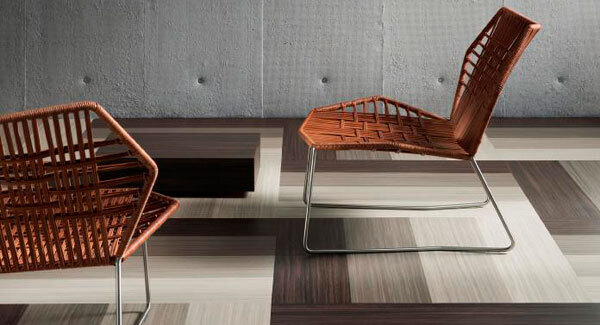
Kya deLongchamps is spoilt for choice when it comes to alternative flooring materials, from durable fabrics to luxuriantly silky carpets made with goat hair.

Some less than usual choices for home flooring

HOME flooring offers a wealth of possibilities. Be adventurous and explore the wider world beyond expected varieties of ceramic tile, carpet or wood plank. Ensure any non-standard choice of flooring is installed by a reputable a firm that fully understands the material and any specialist requirements.

Hair of the goat

Tretford is something of a surprise to me. It’s a unique product made in Waterford for over 40 years, and most of us have stood on a Tretford carpet at some point.

Tretford is favoured for commercial spaces such as banks, schools and libraries, but the company has a healthy following of architects and private residential customers in the US and Europe.

In a ribby flat finish, the flooring is made of 80% Mongolian goat hair, a by-product of the making of cashmere, with the addition of 15% nylon and 4% viscose.

Tretford Broadloom is an environmentally friendly, bleach and chemical free carpet. Offered with fusion-bonded jute backing it can be fixed directly to the floor or sit on a thick underlay.

It’s amazingly tough, anti-static, and surprisingly soft with an inherently anti-allergenic character mopping up nano-fibres and dust that would otherwise float around in the air.

The carpeting comes in a large variety of colours, and with every order bespoke, can be tailored ro banded stripes or designs of searing colour. It can be wall mounted to create acoustic insulation too. Ask about Acousticord in 36 colours.

For swatches go to Tretford.com (Waterford) where you can read more about the long-standing relationship between this Irish company and the goat farmers from whom they buy their product. Price (installed) from €40 per metre². Sales contact: Dave Melia.

Natural weave

Coir, sisal and seagrass come in a range of colours, rustic weave patterns and even printed finishes. Environmental features aside, the more determined feel of these materials plus the fascinating visual textures make them a real contender.

Coir (coconut husk) is tough, economical and has a prickly but robust touch. It cannot be dyed so choose from a natural greenish hay shade or a paler bleach. Prices from €28 per metre².

Seagrass (in woven cords) delivers a luxuriantly silky caress underfoot, and makes delicious carpeting or rugs. It’s not suited to stairs, where its polish will prove slippy. From €40 per metre².

Sisal is a wonderful alternative to traditional wool, with a refined, tweedy finish. In fine cords or larger ropes, it takes a dye beautifully, so look for new choices in white, silver and pewter and block edging for rugs, runners and full carpets.

John Keegan at the Natural Flooring Company (naturalflooring.ie) emphasises that ‘sisal and coir are only as good as their installation.’ The rolls must be acclimatised to the environment in which they are being laid, and seams on boucles and basket weaves must be carefully matched and edged to prevent fraying.

Mounted on natural latex backing natural Sisal can take heavy domestic abuse, but any open weave will require regular vacuuming to fight the build up of dust. Prices from €40-€80 per metre² (ex-installation).

Concrete choice

A darling of architects including Frank Lloyd Wright, for its versatile applications and honest good looks, polished concrete surfaces are enjoying something of a renaissance.

If you love the industrial look, a concrete floor is probably a tenderly held dream. A diamond in the rough, its blank face reveals little before the grinding and polishing process.

This is a creative, dynamic enterprise, and the degree of grinding before polishing will reveal more aggregate (chips) in the complete floor.

Concrete once laid is down for good unless mechanically removed, a disruptive, expensive nightmare best avoided by careful forward planning, between your architect, contractor and the supplier of any decorative inclusions in the mix.

If you want more than a subtle grey, companies such as Renobuild (renobuild.ie), can come up with a recipe to include anything from copper coins to coloured glass in four surface finishes.

Less expensive, a thin micro-topping of concrete over an existing concrete floor can be polished up to the shine of marble or left with a more matt, natural lustre.

Installation costs have many variables including the existing floor, the inclusion of under- floor heating and so on but reckon on a least €50 per metre² installed.

Lino’ lovelies

If you love vinyl flooring but want something with a high degree of natural ingredient and a soft touch, then Marmoleum might be for you.

As a material this resinous blend of wood flour, jute, rosin (pine resin), and linseed oil, pressed together into sheets has been around for over a century. It is produced today by Forbo, represented here in Ireland.

Together with their solid colours in traditional seamless floors, there are two clever domestic tile choices.

Available in solid colours or with strong of subtle marbling, Marmoleum Modular is a new collection and comes as a tile in four sizes ranging from extra-large (75 x 50cm) to small (25 x 25cm) and in between sizing medium format square and rectangular tiles (50 x 50cm and 50 x 25cm respectively).

You can shuffle them up into a unique pattern. Colours include greys, ideal for creating a polished concrete style floor with some individuality thrown in. €38.95m2 installed plus VAT.

For DIY installation as a floating floor try Marmoleum Click, with a top layer of Marmoleum, set on a layer of water repellent HDF (high density fibre board) with a back layer of cork. The system locks together with no glue or drying times for a seamless finish.

For a luxury choice, take a look at Forbo’s continuous, embossed Marmoleum flooring in a leather look Crocodile Black or Red. Forbo-flooring.ie

Traditional tips: Carpet

* For the most durable carpet looking for a high wool mix (80:20) or pure wool if you can afford it. Scotchguard or other stain- resistance treatments will further protect your investment.

* Pricey but gorgeous, a woven carpet in pure wool with the yard and the backing woven together could last up to 30 years. Axminster and Wilton are both woven rather than tufted carpets. Ulster Carpets, in Craigavon, is among the most famous makers of Axminster carpets.

* Carpeting is not in itself an allergen. The faeces of dust mites, a major allergen are largely airborne but can be harboured in dirty, neglected carpets their fibres matted with dirt and grit.

* The greater the traffic, the tougher your carpet needs to be. In a bedroom, you can get away with a lower density pile, even a shag or shorter cut-pile saxony.

* The look of the tufted or woven carpet is a personal matter, but a short velvet pile will be formal set against the slight length variations of a deeper loop. Cut pile is generally more durable.

* The old adage to pick colours and patterns to ‘hide the dirt’ might seem primitive to our immaculate 21st century notions, but darker colours and the visual play of a design will keep the dust and dirt out of sight between regular vacuuming.

* A good underlay will extend the life of a carpet by up to 40%, so don’t be cheap in its consideration and don’t reuse old underlay already weary with years of compression.

Wooden heart

* If you want solid wood through and through, lay it in rooms with a constant temperature and employ a professional team to get the fit completely right. Treated well, solid hardwood (generally oak and walnut) is the ultimate investment floor.

* Solid wood flooring can twist and lift in damp even under a heavy lacquer. For kitchens use an engineered floor of at least 14mm with a thick real wood veneer and multi-ply base. Engineered wood planks are 75% more stable than solid wood in humid situations.

* Laminate pretenders in a compressed fibreboard plank come in convincing pattern repeats that can fool the eye. This floor cannot be sanded like an engineered or solid wood floor. Guarantees of around 10 to 12 years of use are standard and prices start from as little as €10 per square metre.

* Click-lock style flooring is a lot easier to handle DIY than T&G boards which must be carefully knocked together and requires gluing too. Click-lock also comes apart more easily if you have to access your sub-floor or take the whole lot out.

* Choose laminates with a fibreboard base rather than a cheaper chipboard which can swell when wet. Budget for a waterproof membrane beneath click-lock styles and choose the more convincing beveled edge board for an authentic, real-wood look.

* Solid wood and engineered planks are best acclimatized in the room they are to be laid in for seven to 14 days with the heating in the house running normally.

x

More in this section

Cookie Policy Privacy Policy Brand Safety FAQ Help Contact Us Terms and Conditions

© Examiner Echo Group Limited













