If you go blind, you don’t have to lose sight of how to live well
FIVE people go blind every week in Ireland. For some, like Midleton man, John Shanahan, it happens suddenly. Nine years ago, when he was 38 years of age, the former construction worker was driving home from work when his sight disintegrated. “It was like a bad picture on the TV; a foggy haze,” he says.
An examination at Cork University Hospital’s eye clinic revealed that he had Leber’s optic atrophy, a genetic condition that impacts on the optic nerve. He lost 99% of his vision in four months, unable to see anything other than light and shadow.
While he had the support of his wife and six children, professional help was needed. “Initially, I felt in desperate need of that, and I got it from the NCBI (National Council of the Blind) and Irish Guide Dogs for the Blind,” he says. “They dug me out of a pit.”
Before his blindness, John says he “couldn’t turn on, let alone use a computer.” Now he uses blind-friendly technology for social media, email, Skype, and for the news.
Neither has blindness stopped him from going to his sons’ hurling games. “All of my sons are great hurlers, and while I go to their matches, I can’t see the play, but I don’t miss out, as my little son, Oisin (7), is like Mícheál Ó Muircheartaigh, in the way he delivers the full lowdown on what’s happening on the pitch,” he says.
For big matches, John relies on himself: “I tune my phone to Radio One or 96FM and stick an ear phone in one ear, so I can listen to the commentary. With the other ear, I take in the atmosphere at the stadium.”
But everyday tasks are more challenging: “Cooking is tough, as is making a toasted sandwich or a cup of tea without burning the hand off myself. Showering and shaving aren’t easy. Sometimes, my wife takes a look at my shaved face and says: ‘My God! You’ve cut yourself!’
There are other challenges: “Some people can be ignorant towards blind people and that’s scandalous. I’ve walked Cork’s Patrick Street and met selfish dummies, who simply wouldn’t move out of the way and who were less than polite when I apologised for accidentally tipping their feet with my cane.”
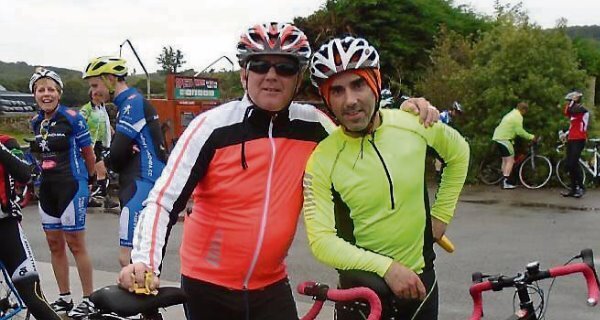
It’s different when he walks with his guide-dog. “He keeps me 100% safe even on uneven paths,” he says. “He avoids potholes and dirt and does a wonderful job.”John’s no slouch himself. Not only did he organise the East Cork Triangle sponsored cycle for the NCBI last weekend, but he took part, even though he hadn’t been on a bike for 30 years. “I rode on the back of a tandem,” he says. “My friend, Gary Neff, was the pilot. It was scary for me at the beginning,but with training we built up to 130km on the day.”
Not every blind person has John’s independence. When Dublin pensioner, Francis Crookes (84), crashed his car, his son, Peter, was concerned about Francis’s sight. He took him to a hospital, where he was told his father would go blind. But Peter took him to the NCBI for a second opinion and learned that while his father couldn’t see straight ahead, he wouldn’t be categorised as blind. “He was crying a little before we went,” says Peter. “But we were so relieved by what we were told that, for the first time since his sight went, I felt okay about his future.”

Francis was diagnosed with age-related macular degeneration (AMD), the most common form of sight loss in the over 50s in Ireland. While he is able to dress himself, it takes a toll in other ways. “His sight loss is a big issue,” says Peter, “one about which he gets depressed and upset. He tells us he could go into an old people’s home, but I reassure him that we’ll take care of him at home.”
“He doesn’t have enough vision to make himself tea or breakfast or see what’s on television. Nor can he read a newspaper; something he loved to do. He’d like to be able to do things for himself, but worries when he goes outside with his stick, in case he mightn’t notice obstacles in his way.”
Peter accompanies him when he’s out but it’s still difficult. “My dad was someone who liked to wash the dishes for my mum.Now when he tries, they don’t get cleaned properly. Also, when he washes himself, he leaves water everywhere. I clean up after him, help him shave and clean out his electric razor as he can’t see the trapped hairs. It takes time to adjust.”
Fionnuala Murphy, communications manager at the NCBI, says it’s not common to go blind suddenly. “It can be happening without you recognising it, so even if you don’t wear glasses, it’s important, from the age of 40, to get your eyes tested every two years, as early detection may prevent sight loss.”
A 2014 Deloitte report recorded 220,000 people with sight loss in Ireland and this is expected to rise to 264,000 by 2020. 13,845 people are blind, a devastating statistic given that in Ireland, 75-80% is preventable.
- May 1 is Guide Dog Day. Anyone interested in street collecting can contact guidedogs.ie
Whats it’s like to go blind?
Most blind people have some vision; perhaps just enough to tell the difference between light and dark.
It’s a myth that blind people have superhearing. It’s because they rely more on their other senses, they get better at using them.
Many blind people play sport. Blind golf and blind football are popular.
Technology is becoming increasingly accessible to the blind, with text-magnification and a voiceover that reads text aloud changing the lives of many.
Braille terminal attachments for mobiles are also making it possible to communicate privately, when audio messages would be inappropriate. Phone screens can be set to blank, thereby preventing others from reading private messages.
Many people are confused when they see someone with a cane counting change on a bus. But canes don’t necessarily imply there’s no vision. There may be side or central vision, but still difficulty in recognising faces, reading, watching TV and travelling independently. Sometimes, the only thing an individual can see on a computer screen is what’s around the edges.














