Cork-based artist embraces a broader palette with current exhibition
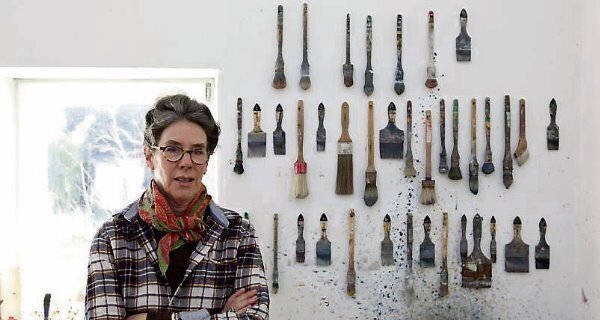
FOR her current exhibition at the Oliver Sears Gallery in Dublin, Cork-based artist Katherine Boucher Beug shows her trademark expressive paintings and assemblages; but for the first time, is also exhibiting purely sculptural work.
So what brought about the move into fully-fledged sculpture? âI had been putting little stages on paintings and wood on paintings, fabric on paintings for a long time,â the American-born Beug explains, âand finally, I broke through the voice that said âYou canât do itââ. The transition was liberating as despite the precision seen in the completed pieces, the artist relished the flexibility to move and change elements of the sculptures around while making them.
âI have a friend who is a physicist, who speaks about the âelegant equationâ and when you make a piece of work, it is like a beautiful equation,â says Beug, who has been working from her studio in Dunderrow, near Kinsale since 1971.
The analogy is apt and is used by Beug to explain the process of testing and re-testing what happens in the studio and how connections and relationships to other disciplines, such music and poetry, can exert influence upon her. âIt is in a sense similar to a poem, where every word has to count and if it doesnât count, you throw it out. And I feel very strongly about that in anything I do.â

One of the paintings in the exhibition, entitled âString Theoryâ, was created by merging collage and expressive paint techniques which distort perceptions of space and form â teetering between representation and pure abstraction. Is this interface a tangible theme for Beug?
She uses a quote from the mathematician Ian Stewart to illustrate this relationship: âEvolutionary systems are forced to poise themselves on the edge of chaosâ. âI think a good creative process is one that will survive and take you forward, only if it is always on the edge of chaos.â
Beugâs striking watercolors have clearly come through the other side of this chaos as demonstrated by the elegance of the imagery, including austere trees and mysterious cradle-like forms. While in the sculptural work, objects and animals interact in a playful, almost innocent fashion. So where does the imagery come from? âThe imagery emerges as part of whatever Iâm going through or something that is happening in the world. The content is constantly boiling around.â
Beug has a very strong affinity with the theory of colour, and has long-standing experience of teaching its rules and principles to fine art students. But can colour in painting ever be fully planned in advance?
âI think it is a great poverty not to understand the theory, as it enables you to see more clearly. I personally donât believe much in an intuitive use of colour.â The process of mixing colour is not however for the artist an entirely logical and methodical one, stating âyou put together a piece and paint over again until the precision brings the work to its conclusionâ.
She continues that âI know physiologically what is happening within my eyes. Itâs like listening to a certain rhythm in jazz, I know I canât really do it, but I can hear much better by carefully listening, that someone else can; so you become much more keenly attuned.â
For Beug then, the experience of colour is enriched by an ability to observe and articulate the influence of light and colour in the world around us. âYou know what is happening with the shadows in winterâ she muses with appropriately poetic poise, âyou get to see the turquoise shadows on the frost on the grass.â
Perhaps if just such an awareness of colour theory was more widespread, it might have put a stop to the recent internet meltdown over whether or not a dress looked blue or white. Oh, and by the way it was white.
- Equations is at Oliver Sears Gallery, Dublin, until April 2
Visit our dedicated 'Culture' section for more arts, books, film and TV news, views and reviews















