There is great power to Julianne Moore’s impressive dementia role in Still Alice
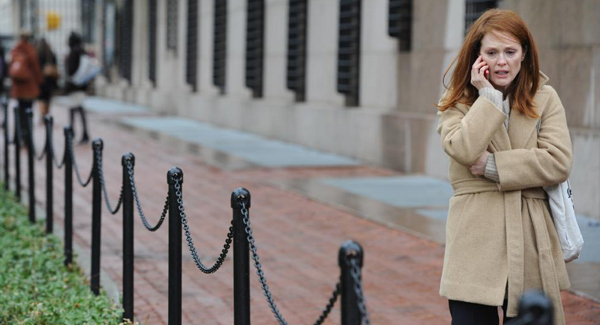
These include her first Oscar, for best actress, having been nominated four times previously.
Moore is just 54 and her moving portrayal of how linguistics professor, Alice, struggles to keep control of her life, and to cope with her gradual loss of independence, makes for powerful viewing.
But the North Carolina-born star says she had no expectations when she signed up for the “little” independent project.
Still Alice was made in just three-and-a-half weeks on a budget of $4m — that’s peanuts in Hollywood. Moore even joked in an awards speech how she had to pay for her own food and bras during the shoot.
But while the production was speedy, her research was more in depth.
“I spent about four months researching the disease and I met quite a few people who were diagnosed with early-onset, people at various stages of the disease,” she says. “They were incredibly generous and very forthcoming about their experiences. I based the character on that.”
Alzheimer’s, the most common form of dementia, causes symptoms such as memory loss, and difficulty with thinking and language.
It mostly affects older people, over-65s typically, but early-onset Alzheimer’s can develop in people in their 50s, and sometimes — though very rarely — in even younger age groups.
Alice, 50, is an accomplished academic living in New York, who travels the country giving lectures. When she is diagnosed, she is determined not to let the condition get the better of her.
“The interesting thing about the movie is it’s about a progression through a disease,” says Moore. “So it’s not like you go from zero to 100 all at once.”
But the film sees the independent and self- assured woman gradually regress to a helpless, almost child-like patient.
And despite all the awards and nominations, the actress says her greatest reward has been the response from people living with early-onset Alzheimer’s.
The movie is directed by married couple, Richard Glatzer and Wash Westmoreland. And as it happens, while it was being shot Glatzer was undergoing a battle of his own, having been diagnosed with ALS (amyotrophic lateral sclerosis), a progressive neuro-degenerative disease that affects nerve cells in the brain and spinal cord.
“When we were working on the film, he basically had lost function from the waist up and was no longer speaking. He was directing on an iPad,” Moore says.
“So what they were experiencing professionally and personally, as a couple, was mirroring what was happening in the movie. It was an extraordinary experience for all of us.”
And while red carpets and awards buzz are fun, now that the hoo-ha is over, Moore’s looking forward to a weekend of staying at home and chilling out.
“Every weekend during awards season, it’s like you’re going to your own wedding again,” she says.
“That’s what it’s like — it’s me, I’m the bride! Because you put on make-up and hair and stuff. So that element is fun, but odd.”
CONNECT WITH US TODAY



Be the first to know the latest news and updates

















