Julianne Moore finally gets the gong
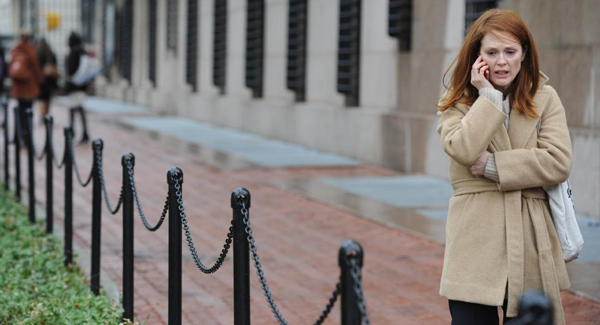
Will Lawrence says the 54-year old actress has finally won a best Oscar, playing a woman losing her identity to early Alzheimer’s. Moore herself, is utterly unchanged by fame and fortune, he finds.

Julianne Moore finally gets the gong

It’s fifth time lucky for Julianne Moore: one of the 54-year-old actress’s Academy Award nominations has finally blossomed into a win.

Last Sunday, she accepted the Oscar with typical grace and humour, saying she’d read that winning added five years to your life.

“If that’s true,” she said, “I’d really like to thank the Academy, because my husband is five years younger than me.”

Everyone laughed. Moore is one of the most likeable actresses in Hollywood. She is normal. She is not one for histrionics. She is not a diva.

“She is laidback and easy-going,” says Wash Westmoreland, her co-director on the film for which she won, Still Alice.

In her speech, Moore said there was no such thing as a ‘best actress’, but she’s doing herself a disservice. She is one of the most accomplished of actresses. Her win comes courtesy of a brilliant performance in a film with a difficult subject.

Based on the book by neuroscientist-turned-novelist, Lisa Genova, Still Alice tells the story of Alice Howland, a linguistics professor who is diagnosed with early-onset Alzheimer’s Disease. Her bid to stay connected to who she is plays out as frightening, heart-breaking and inspiring. The effect on the character’s family is devastating.

“I hadn’t read it, actually,” Moore says of the book.

“I had actually seen it in book stores. It’s one of those books that would be on a ‘favourites’ table, but I had never picked up.

“Yet when I read it, I was really struck by the story. It is very compelling, very readable, and so when the filmmakers said, ‘We have something; we want you to take a look at it — and would you be interested?’ I loved it.”

It is a role tailor-made for an actress of Moore’s brilliance, whose previous Oscar nominations — Boogie Nights (in 1998), The End of the Affair (1999), The Hours and Far From Heaven (both 2002) — highlight the diversity of her talent.

Moore has oscillated between blockbusters, like Jurassic Park 2, and the more recent Seventh Son and The Hunger Games, and small-scale indie productions, such as the critical hits The Kid are All Right or What Maisie Knew.

“Julianne could not only project the scintillating intelligence and complexity of a linguistics professor, but also the vulnerability and simplicity of the later stages of the disease,” says Westmoreland. “She’d master every beat of the character’s deterioration.”

Moore’s research into Alzheimer’s was extensive. “It was a tremendous amount of work. People were so incredibly helpful to me and one led me to the next. I started with The Alzheimer’s Association and they sent me to a hospital, where they gave me the memory tests and sent me to a support group for women who have just been diagnosed.

“I spoke with many women at various stages of the diagnosis,” she says. “Then, I went from there to a long-term care facility, so I basically talked to, and observed, people at every stage of the disease and watched a lot of documentaries and footage, because I wanted to make sure I understood as much as I possibly could, before embarking on it.”

The biggest challenges on screen were when she was doing relatively little.

“What is most interesting to me is that sometimes the scenes where the character is the most declined, I would be doing very little,” Moore says.

“She starts to lose her function, but that is what I found most exhausting. What I realised, in my observations and in talking to people who are declined, is that there is a tremendous amount of effort that goes into trying to control what you can control.

“If you can’t remember how to tie a shoe or the shoe doesn’t look the same to you, it is really challenging to put it on and it is exhausting,” she says.

“It’s a lot of work. So, those are the scenes sometimes that would leave me feeling the most depleted.”

The movie was especially poignant for the filmmakers, as Westmoreland’s co-director and partner, Richard Glatzer, had been diagnosed with ALS (amyotrophic lateral sclerosis, known here as motor neurone disease) the year of filming. The disease has similarities to Alzheimer’s.

“They are both terminal, incurable, and have the effect of isolating the patient from the world at large,” says Westmoreland. “Most crucially, both diseases eat away at the sense of identity and make it vitally important to hang on to yourself.”

Glatzer arrived a week before pre-production and his hands and arms were barely working. “He could no longer feed or dress himself and could type only at certain angles with one finger,” says his co-director.

“This infused the whole production with a sense of deeper purpose.

“Everyone felt that something special was going on and bore the long, hard hours with grace.”

Moore bears everything with good grace. Her 30 years in the business (she debuted in a TV mini-series in 1987) have given her a calm understanding. She is in it for the long haul and knows how to behave.

“Being in the business as long as I have, you see that there’s definitely a caste system in Hollywood and you see how people behave at different levels and who behaves well and not, or who could be nicer,” she says.

“But I don’t think success changes anybody. It just exacerbates who they are, so the people who behave badly when they are famous were usually pretty bad-behaved when they were not famous, though maybe not to that degree. And the people who are nice when they are not famous, usually are nice when they are famous.”

Moore is happy and confident enough to talk about any subject and is candid about her family, and her husband, filmmaker Bart Freundlich — who has directed her on The Myth of Fingerprints, World Traveler and Trust the Man — and their two children, Caleb and Liv.

Last year, she and her daughter appeared together in a photo-shoot for Vogue.

“She was so excited,” says Moore. “My daughter loves fashion and they didn’t put any make-up on her, which was great, because she looks like a real kid.

“We spend a lot of time with our kids and it’s a great thing that my 12-year-old girl likes to hang out with her mother and go shopping, and whatnot, so I feel pretty lucky.”

Liv now gives her mother fashion advice. “She will always tell me what she likes and what she doesn’t like,” says Moore. “She tends to be more colourful and takes more chances in her clothes than I do.

“We talk about that a lot, but now she is just about getting big enough to start wearing some of my things, especially my shoes!”

And does she think that Liv, or even Caleb, might follow in her footsteps and go into acting? “I can’t tell yet,” she says. “My son really loves basketball and music right now and my daughter loves fashion. I imagine it would be difficult for them to avoid a career in the arts, because of me and because of their father, but they’re still so young.

“I wouldn’t discourage it, though,” she says. “If possible, I feel like they should do something that they really love doing, because we spend an awful lot of time doing it.”

Moore clearly loves what she does. Audiences adore her too, and so does the Academy. Finally.

More in this section

Cookie Policy Privacy Policy Brand Safety FAQ Help Contact Us Terms and Conditions

© Examiner Echo Group Limited













