Fitting tribute to one of Ireland’s great art educators
AMPBELL BRUCE, who died in February last year, was a highly influential figure in the development of the visual arts in Ireland, holding the position of professor of fine arts at NCAD for 20 years from 1975.
Several generations of Irish artists benefitted from Bruce’s ability to draw in talents such as Nigel Rolfe, Joseph Beuys and Patrick Scott as teachers and assessors.
“It was a really good mix,” remembers his widow, the artist Jacqueline Stanley. “We had Seán Scully, too, who we’d met in New York. Bruce kept a very Irish basis. Those artists understood what the students were about.”
Students during Bruce’s years also benefitted from the freedom he gave students to express themselves. In this sense he was a liberating figure, in contrast to the art scene as it was when he and Stanley arrived from the UK. “It was very much rigid,” says Stanley, “ruled by a few people. On the one had, you had the modernists and they were very strict and absolutist. And on on the other hand, you had the academicians. There was not an open flow of what art can become.”
Bruce’s remarkable life began on the remote Atlantic island of St Helena, where he was born in 1927. He was sent to England to be educated, and there had to be evacuated from London during the Blitz. His father, sadly, died on St Helena in 1946, before he and his son could be reunited.
After his national service, Bruce trained at the Croydon School of Art and the Royal College of Art, thereafter teaching at various colleges in the UK, and exhibited widely as a painter himself. He was eventually elected to the Royal Hibernian Academy, in 2005. In this, and his approach to teaching, he was a figure who bridged the two former rival worlds or academic and modernist art.
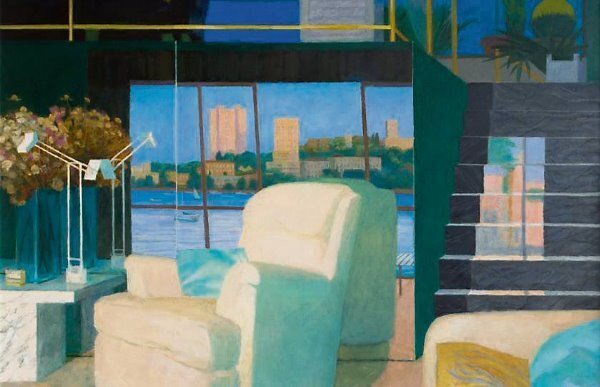
Stanley has spent the past several months curating a semi-retrospective of Bruce’s work for the Origin Gallery in Dublin. He painted portraits, still lifes, landscapes that evoke Dublin, West Cork, and the Mediterranean; seascape, interiors and more abstract works.
The selection covers all the periods of his work, says Stanley. “In England, when he thought at Canterbury, he painted abstract works. When he came over here got into landscapes. Most of those are in collections, so I’ve emphasised the other side, architectural and interior works.”
Bruce might be best remembered, as Stanley says, as a good teacher and administrator. But the work shows he was a fine painter in his own right. “He gave a lot, I think,” says Stanley. “His painting suffered a little bit because of that. He didn’t exhibit all that much, but he kept it up.”
Stanley and Bruce were a high- profile couple in Dublin’s arts scene. They settled in Sandymount, fully embracing their lives here, supporting young artists, and various ventures, including a fine art programme for NCAD. Yet a long-term stay was not the plan originally.
“We said we’d give it five years,” says Stanley. “But we’ve got interwoven into the arts here. We saw the job advertised when he was teaching at Canterbury. Margaret Thatcher was minister for education then and she was tightening up on anything to do with arts. There seemed to be a positive move here, to open the arts scene. That’s why he was employed.”
Stanley herself had been to Ireland long before that, exhibiting in the late 1960s.
“That was my first taste of Ireland,” she says, “and I was happy to come back and get stuck into the landscapes. That was the main basis of my work here. We had a house in West Cork in Schull. A great place, fantastic landscape. We got a lot of work out of going down there.”















