Character judged to perfection
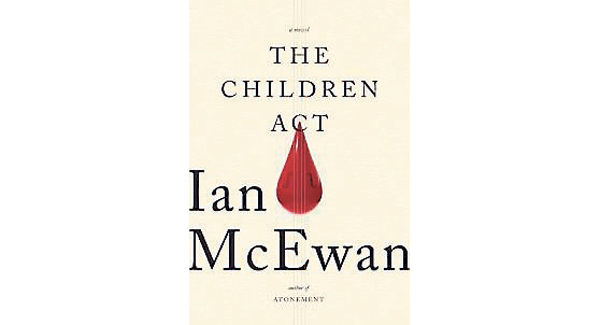
The Children Act
Ian McEwan
Jonathan Cape, €18.99;
ebook, €12.99
To the successful neurosurgeon of the divisive Saturday (2005) and the Nobel-winning physicist of the satirical Solar (2010), McEwan here adds Fiona Maye, a respected High Court judge with a reputation for bringing “reasonableness to hopeless situations”.
The childless, 59-year-old Fiona specialises in “vicious” disputes between husbands and wives as well as in contentious cases of custody and consent with regard to minors. On the night The Children Act is set, both collide for her in spectacular fashion.
Her husband Jack, a caricature rightly mocking ageing academics who see infidelity as an entitlement, has just announced his intention to pursue a “big, passionate affair”. Not to seek divorce, mind, merely to purchase his pleasure with his wife’s misery.
Fiona rightly throws him out of their Gray’s Inn home (“Jack, you’re 60! It’s pathetic, it’s banal”) but before she can begin to process what has happened she is called to adjudicate on a life-saving blood transfusion for a 17-year-old Jehovah’s Witness named Adam.
Caught between Adam’s rare form of leukaemia and the religious convictions of his parents, Fiona succumbs to the “sentimental whim” of visiting the hospital herself (pausing only to have the locks changed on her apartment). The boy is, after all, only three months shy of attaining majority and so “very nearly an adult”. Consequently, how much do his parents’ wishes matter?
McEwan’s title is thus more than a clever borrowing and The Children Act is not just a novel about the implications of the titular welfare legislation. It is an exploration of the generative act of bringing a child into the world, about the responsibilities and the limits of caring for that life.
It is also about the act — the performance — of wanting children, the “habitual theme” of social pressures. Fiona, even at the end of her 50s, is still haunted by the fact that she never became a mother while the reader, for their part, struggles with the way childlessness is regarded as a “failure”.
In Adam, Fiona finds a surrogate son of sorts. He is also the embodiment of her work, of the “strange differences, special pleading, intimate half-truths” and “exotic accusations” to which she has sacrificed her fertile years.
He himself is resistant to the transfusion; brainwashed by a “cult” as the hospital has it. Yet Fiona knows that “the duty of the court” is “to enable the children to come to adulthood and make their own decisions about the kind of life they wanted to lead”. It is an intricate dilemma from which McEwan does not shirk.
On one hand he offers the reader a masterful study of a mind devoted to fairness at, perhaps, the expense of being fair to herself, but, on the other, The Children Act is also a fascinating look inside the judicial process itself.
“As in all branches of law,” Fiona knows, “fine-grained particularities of circumstance needed to be assimilated at speed”.
Her decisions, and indeed her thinking, are precisely, even elegantly described by an author who has, as in Saturday and Solar, clearly absorbed the minutia of his protagonist’s vocation.
Conveyed in crisp and considered prose, this attention to detail on McEwan’s part elevates the moral conundrums of The Children Act beyond the sensationalism which lesser authors might have pursued in such a subject. It is, in all respects, a novel which is carefully judged.















