Inside Beatles’ minds
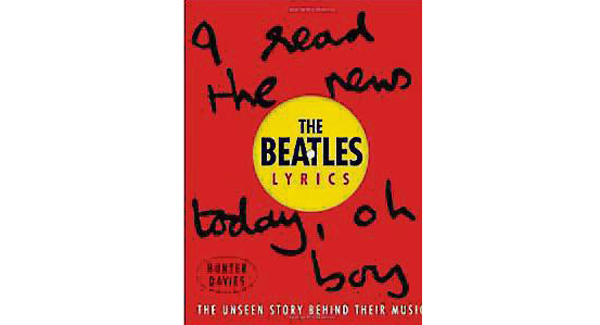
I Read The News Today, Oh Boy The Beatles Lyrics
Hunter Davies
WeidenFeld & Nicholson, ā¬29.99; ebook, ā¬15.99
YOU MAY never read a more comprehensive, unpretentious account of the creative processes behind a bandās body of lyrics. It seems fitting that band should be The Beatles.
Author of the bandās only authorised biography (The Beatles, published in 1968), Hunter Davies had unique access to this unique group. Now the author of more than 40 books, in the 1960s Davies was also the first Sunday Times journalist to be given freedom to write extensively on popular music, a cultural shift in the newspaper, seemingly brought on by Beatlemania.
This book features illustrations of handwritten lyrics for 100 of the 182 original songs written by the band and released from 1963-70. Seeing these scribbled notes now, on 50-year-old scraps of paper, is deeply intriguing.
Even moreso when you add Daviesās unique relationship with the band. Many of these first drafts come from his own collection, discarded pieces of paper which he scooped up while visiting The Beatles in their rehearsal rooms or on visits to their homes.
Of course, these manuscripts are now worth a lot of money. John Lennonās handwritten lyrics for āA Day In The Lifeā sold for $1.2m at Sothebyās in 2010. Nonetheless, Hunter Davies has loaned his personal collection of handwritten scripts to the British Museum; upon his death, his will makes that loan permanent. He wants the manuscripts to stay in their native UK.
Davies first met with Beatles manager Brian Epstein in January 1967 to discuss his proposal for the biography. Epstein had cancelled two earlier appointments, but when they eventually met up, Davies won instant approval for the book. Epstein was coming out of a dark place when he met with Davies in 1967. He had brought a sailor back to his London apartment and gave him alcohol and pills, and tried to seduce him.
The sailor beat up Epstein, and stole a Beatles acetate recording from the flat. Humiliated by the incident, Epstein fell into a depression and cancelled all his appointments for several days, including planned meetings with Davies.
Davies said the band members were aware Epstein was gay, but knew little else about his private life. Davies knew more, but never wrote about it ā until now.
Epstein played an acetate of the Lennon song āStrawberry Fields Foreverā, and still recalls being bowled over by the songās lyrical and musical novelty compared to the bandās early love songs. The B-side, āPenny Laneā, was from a more familiar well.
Epstein promised he would deny any other writer access to the Beatles until two years after the bookās publication. It came out in October 1968. In 1970, the Beatles disbanded, thus enshrining Daviesās unique place in the history of popular music.
I Read The News Today, Oh Boy is littered with first hand accounts of this kind. Not every tale reads directly into the lyrics, but they do all shed light on how the band interacted, often collaborating on lyrics at the last minute in the recording studio; John Lennon was particularly strong at this āliveā composing.
I quite like Daviesās insights on the Lennon song, āIām Only Sleepingā, one of the less famous tracks on the album Revolver (1966). Heād often visit Lennon at his house in Kenwood, London, where heād find John half-asleep on the couch.
Similarly, when Paul McCartney would visit Kenwood, heād have to wake John up for the pair to write songs together. Davies gives examples of songs where McCartney would call by to collaborate, but decide to finish a few songs on his own rather than wake Lennon up.
At this time, Lennon was laid back in the extreme. Davies called by once only to be told that ātoday is a day for not speakingā, so he and John had lunch and sat around for hours in silence. Davies was furious; in journalistic terms, this was a day wasted.
And so to the āIām Only Sleepingā manuscript, handwritten on the back of an unpaid bill for Ā£12 and three shillings for a car
>>> phone. Davies says John Lennon thought of the lyric while lying on the couch; he picked up the bill from the floor, too lazy to get up and find a clean sheet of writing paper.
This manuscript is now owned by Pete Shotton, Johnās best friend from his school days.
Pete said: āI was going to see our accountant one day, whom we both used, and John said āI have this bill, would you tell him about it and get him to pay itā. He gave me the bill and I turned it over and there was a song on the other side.
āHe said, āIt doesnāt matter, Iāll have to write it out again on a larger piece of paperā. So I went off to the accountant, showed him the bill.
He said he already had a copy, and would pay it. I shoved the bill in my suit pocket, which I never wore again for about four years. So I just kept it. There was no value in Beatles memorabilia in those days.ā
The song starts thus:
āWhen I wake up early in the morning
Lift my head, Iām still yawning
When Iām in the middle of a dream
Stay in bed, float up stream
Please donāt wake me, no, donāt shake me
Leave me where I am, Iām only sleeping.ā
While 1960s commentators sifted through Beatles songs for veiled drug references, Davies saw the lyrics of āIām Only Sleepingā as simply true to life. Lennon slept a lot.
Davies does tell some real life drug stories of the Fab Four, but he also makes a fairly valid case for the lyrics being read on their merits, without reference to drug-taking.
With āLucy In The Sky With Diamondsā, often presumed to signify the drug LSD, Davies cites Johnās assertion that his son Julian had come home from school with a drawing featuring odd shapes. John asked him what the shapes meant. Julian said one shape was his friend Lucy; she was in the sky, and the other shapes were diamonds.
Lucy OāDonnell, then aged four, did not discover she had been immortalised in song until she was 13. She died in 2009, aged 46, having suffered from lupus and other autoimmune system diseases.
Another feature of Lennonās lyrics was his ability to draw inspiration from newspaper stories. Most notable of these was āA Day In The Lifeā, which Davies traces in excellent detail.
However, in the song āSheās Leaving Homeā, it was actually Paul who creatively reworked the real life newspaper tale of A-Level student Melanie Cole, who had vanished from home, aged 17.
Paul uses this as a starting point for his own morality tale of a 1960s generation gap. The girlās well-to-do parents couldnāt understand why she had left; they had given her everything money could buy.
In the recording, Paul tells the girlās tale in the third person (āShe is leavingā), while John plays the role of the shocked parents (āWe gave her most of our livesā). This was very inventive for the time.
In fact, Melanie had met The Beatles three years earlier when she was a dancer on a TV pop show, Ready Steady Go!, but none of the band remembered her.
In real life, the story ends up very similarly to how Paul imagined it. Melanie had not vanished, she had simply run off with a man from a casino.
In an interesting aside, Davies tells us this was the first song for which George Martin did not arrange the strings. He was busy working with Cilla Black, and Paul was in too much of a hurry to wait. He hired another arranger, Mike Leander, which did not please George Martin.
Davies also recounts Paulās tales of the dreams which delivered hits like āLet It Beā (calming advice his mother gave him in his sleep), and the complete tune for āYesterdayā, for which his original working title was āScrambled Eggsā.
The book runs chronologically from A to Z through every self-penned song the Beatles recorded in their eight action-packed years together. With all those original handwritten manuscripts, itās a must buy for die-hard Beatles fans and, no doubt, many calligraphers too.
Itās worth noting, however, that the bookās format may not be to everyoneās taste; itās a bit nerdy, more of an encyclopedic anthology than a regular biography.
Of course, on the up-side, this format also means passive readers can easily skip to the songs theyāre most interested in.















