Arthur Fields putting life in focus
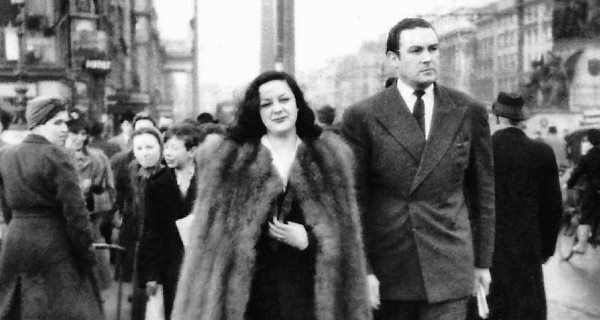
From the 1930s until he retired in 1988, Fields stood on O’Connell St Bridge, photographing passers-by. He was even there on Christmas Day. A conservative estimate puts the number of photos he took at 182,500.
No negatives exist. His wife, Doreen, developed the photos from a dark room under the stairs of their house in Raheny. They were dried on the clothesline in the garden, and later posted to the subjects.
The filmmakers Ciarán Deeney and David Clarke petitioned the Irish public — in a project launched on The Late Late Show in March — to send them their Fields photographs, which have now been published in a book.

The photos are an extraordinary social record of Dublin and Ireland. They include a seven-year-old George Harrison, the celebrity couple, Jack Doyle and Movita, match-day goers, night revellers and toddlers with their grandparents. A favourite one of Deeney’s is of a Co Kildare couple on the first day of their honeymoon, New Year’s Day, 1970. The groom’s parish priest advised him if he couldn’t find a bride in his hometown, Naas, he should go to the next town. He found his bride in Kildare town.
A documentary about Fields, which is narrated by actor Chris O’Dowd and includes evocative family video footage, will be screened on RTÉ One during Christmas.
“The documentary is a celebration, a search for why he stood there,” says Deeney. “He didn’t know much beyond the bridge. There is a myth created about him. In the documentary, it’s nice to peek behind the curtain to see what he was about. There was something deeper-down in Arthur that possessed him to stand out on the bridge taking photos. What was it that drove him to be there for so long?”
Fields was fascinating, impenetrable. His real name was Abraham Feldman and he was born in Dublin in 1901. His Jewish family had fled Kiev in the 1890s following pogroms in the Ukraine. He had a sister and five brothers, but was extremely close to one brother, David, who was also one of the legions of photographers who worked the O’Connell St beat in the 1930s.
When his brother died in 1955 Fields was bereft. He had a nervous breakdown. It took electroshock therapy to rouse him from his stupor. Remarkably, the treatment worked.
“Arthur Fields and his brother grew up in that Jewish tradition where families are very tight,” says Deeney. “They were really close and outsiders — back then, the Jews were a minority in Dublin, and treated as such. There was something that tied the two of them together. They lived together. They worked together. They commuted together. They ate together.
“When his brother died, he lost part of himself. Afterwards, he retook his spot on the bridge alone, without his brother. He started working more and more. He became more obsessed about being on the bridge.”
Fields loved routine, doing the same things again and again.He counted out loud while he pottered around his house, a trait shared, says one of Fields’s sons in the documentary, by Anton Bruckner, the Austrian composer.

“Maybe today,” says Deeney, “he would have been diagnosed with something — at the time he wasn’t diagnosed with anything — but as one of his sons says in the documentary, ‘It’s not about putting people in boxes’.”
Because of Fields’s obsession with taking photos on O’Connell St Bridge, he never attended any of his four children’s weddings, nor his children and grandchildren’s birthday parties. “He was quite possessive of his children,” says Deeney. “When they decided to marry and leave the family home, it was a reaction to that — his decision to work the bridge. When someone is leaving, and you want to own them, as he did, it was a big deal — leaving home. So he decided to work the days on the bridge, instead of going to the family weddings.”
Fields’s English wife, Doreen, whom he met in 1934, was devoted to him. Before he set off in the morning, during winter, she dressed him, pinning his hat to his coat so that it wouldn’t be stolen by rowdy youths or blown away in the wind.
She would bring him soup to eat down the dark alleyway beside Wynn’s hotel, off Abbey St. One of his grandchildren remembers that he would sup the soup, say little, and never a ‘Thank you’.
“She’s one of the main reasons Arthur’s photograph archive exists,” says Deeney. “She developed the photographs. She’s a real hidden hero of the story — how brilliant she was, not only in terms of the archive, but in raising the family.”
When she died — “worn out from looking after him,” speculates one of their grandchildren — Fields, who was found sobbing at the kitchen table a few days later, never attended her funeral, although he had gone to his brother’s. It is not known why. It’s one of several mysteries explored in one of the year’s great documentaries.

“We leave it open,” says Deeney. “There was obviously a reason. The family are not sure. It’s up to the audience to make a decision. Maybe it was him trying to protect himself. Maybe he didn’t do social occasions. Even though he met so many people in his job, he wasn’t a social person. He is a mysterious guy — this guy who photographed all these families, these social occasions, wasn’t your traditional family man.”
- The documentary, Man on Bridge, will screen, RTÉ One, 6.30pm, Sunday, 28 December. The Collins Press has published Man on the Bridge: Photos of Arthur Fields (€24.99). An exhibition of his photographs is on display at the Gallery of Photography, Meeting House Square, Temple Bar, Dublin, January 8















