Chronicler of life in China now has an audience in the West
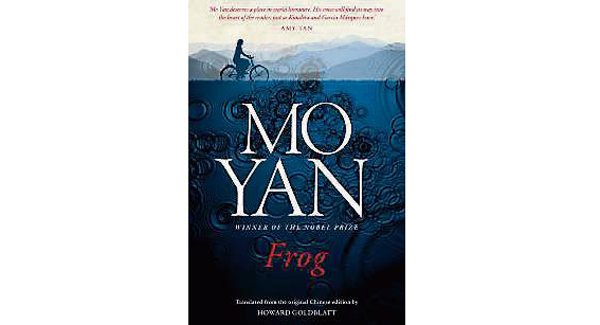
Frog

Chronicler of life in China now has an audience in the West

IN LATE 2012, the Swedish Academy surprised the literary world by announcing China’s Mo Yan as the recipient of the Nobel Prize for Literature.If he was known to western audiences it was for the 1987 Chinese-language film adaptation of his novel, Red Sorghum, which won the prestigious Golden Bear Award at the Berlin Film Festival. The Nobel Prize has catapulted him to international prominence.

Frog, his eleventh novel, is narrated by Wan Zu (also known as Xiaopao, or by the nickname, Tadpole), an aspiring writer. Across five sections, the last of which is a nine-act play, and with each section introduced by a letter to his mentor, a successful Japanese writer, Tadpole unfurls the story of his family and his country, during the second half of the 20th century, with a focus on his remarkable aunt, Gugu.

Gugu battled capture by the Japanese as a young child, and grew into a gifted medic who took over the birthing duties of her locality, her modern methods and near-perfect success rate with thousands of deliveries single-handedly breaking the brutal stranglehold of the old, witch-like midwives.

But after her sweetheart, a hot-shot air-force pilot, defects, along with his plane, to join Chiang Kai-shek’s Nationalists on the breakaway island of Taiwan, she is devastated. A communist, she throws herself into her work and embraces the new reforms, and the one-child system. Once revered for bringing so many children into the world, she turns state abortionist. Because of her staunch adherence to duty, even when it impinges on her own family, she is viewed as a monstrosity.

Sweeping historical novels like The Garlic Ballads and Big Breasts & Wide Hips have, over the past couple of years, verified Mo Yan’s standing as one of the world’s most compelling and imaginative writers. Critics challenge his comfort within the Chinese political system and his self-censorship, but he is a writer of innate skill, a gifted social observer and satirist who poetically uses metaphor, allusion and magical realism to present a picture of the world he knows intimately. Frog is not a perfect book. The sprawling cast of Chinese names is a challenge, the novel lags significantly in the final third, and the play is a misstep. But it is a work of considerable daring, and achievement, because it taps so directly into the author’s past. Understanding that the joy lies often in the minutiae, Mo Yan’s feel for the local is immaculate, his characterisations enchanting, and his narrative is sad, disturbing, funny, and often rich with morsels of detail that echo deeper meaning. The imagery can be surreal (an unforgettable early scene, for example, of children eating coal, while an unmentioned famine rages), but nothing is rendered simply for effect. Much is left unmentioned, but the implications are there. Post-war China, and the hardships of rural existence, require a broad canvas, and Mo Yan has the sure but subtle touch of a great artist. He is a talent too important to ignore.

x

More in this section

Cookie Policy Privacy Policy Brand Safety FAQ Help Contact Us Terms and Conditions

© Examiner Echo Group Limited













