Stunning pictures of truth and beauty at World Press Photo exhibition
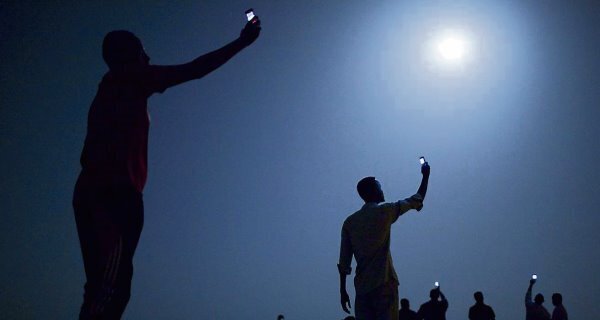
JOHN STANMEYER has enjoyed an interesting beat. He’s renowned for his documentation of social issues in the developing world. His photos have adorned the covers of 18 issues of Time Magazine. He’s covered wars in countries like Afghanistan and Sudan, and for the last decade he’s been working for National Geographic, who commissioned him a couple of years ago to work on its Out of Eden Walk project.
The Out of Eden Walk is a fascinating venture. It’s a seven-year trek across the world – an exercise in “slow journalism”, led by Pulitzer Prize-winning journalist Paul Salopek – to trace the earliest footprints of humankind. It began in January 2013. Salopek, who plods along at a walking pace of three miles an hour, will have clocked up 30 million footsteps (or 21,000 miles) by the time he finishes in 2020.
Salopek’s journey began at Herto Bouri in the Ethiopian Rift, humanity’s birthplace. From there, he’s hiked up Africa, across Bab-al-Mandeb, the ‘gate of grief’ strait that links Africa to Arabia, across the Middle East and ultimately he’l l journey across the plains of Asia, down to China, up to Siberia, over to Alaska and finally all the way down the western seaboard of the Americas to Tierra del Fuego, the farthest tip of South America. The people he meets along the way often ask him: “Are you crazy? Are you sick?” Stanmeyer parachutes in every now and again to put some pictures to Salopek’s travelogue. One of the pictures, Signal, bagged him this year’s World Press Photo award.
“We’re following the human bone trail of our collective humanity – how we populated our planet as we are today,” says Stanmeyer. “It’s an intriguing project because we’re travelling overland, and enlightening for me – and I hope for those who read and follow the project – in reminding one how connected we all are.
“We truly are all brothers and sisters. It’s just through the geography of where we were born that makes us look different and speak different. We maybe dress different, but we’re all exactly the same. This project is allowing me to answer and verbalise more clearly a lot of the issues I had in my mind. You may say you’re from Ireland, but where are you from? Where are you actually from when you go back 2,500 generations?”
Stanmeyer says that when you look at the human bone fragments of our ancestors across this planet, there’s an area in Ethiopia where we started from, although there are a few other locations in that part of Africa that some palaeontologists might argue about. “But by and large, the human Homo sapiens’ bones that are scattered all over the ground there, about a foot or so deep, date back 60,000-150,000 years ago.
“If you leave from that point in any direction – 365 degrees – the bones become younger. So when you get to North America, there used to be a land bridge that is present-day Siberia and Alaska, the oldest Homo sapiens’ bones ever to be discovered in North America are only about 13,000 years old. Well, we walked here, right? Our ancestors walked here.
“The youngest bones would be in the tip of Argentina where the oldest Homo sapiens’ bones are 7,000 years old. When you go into Ireland, Scotland, the UK, Scandinavian countries, you’re looking at probably 40,000 to 20,000 years old – although I’m not an expert on the dating.
“But how did you get there? As human beings, we didn’t just magically pop up in Siberia and Mexico. We walked there. We didn’t have aeroplanes or cars or trains. You moved in the act of falling and catching yourself with every footstep.”
At the moment, there are almost a billion people on the move across the world. Possibly the most harrowing of Stanmeyer’s pictures from the Out of Eden Walk project is one taken of the corpse of a man lying strewn on a lava field in Djibouti. Some of his bones can be seen where flesh has been chewed off. At night-time, wild dogs come out to feast on the hands and legs of the unfortunate African migrants who have died trying to make it by foot to the Middle East to find work. Stanmeyer and Salopek came across maybe half a dozen corpses, their clothes half ripped off in spasms of madness.
Stanmeyer makes light of the travails the journalists encountered on their journey. He says serendipity plays a large part in his work. Certainly it was the wind that blew him towards his award-winning photo.
“When I got to Djibouti City, I was ahead of time – I’m not always with Paul. I did what I normally do when I’m in a place that I’ve never been before – I go out and I get lost. I just want to wander around, and hopefully in the process find and discover something or discover something in myself. Myself and my translator had wandered on the beach and there was a group of 16 to 20-year-olds, men and women, playing football together. Although Djibouti is not a strict Islamic nation, I was intrigued, looking through the layers, going, ‘Oh, wow, women and men playing together, wearing shorts. How do I maybe make something out of this? Am I reading too far into it?’
“After taking some photographs and trying to make something out of nothing, my translator said, ‘Are you ready to go?’ I said, ‘No, the light’s great. It’s just getting dark. Let’s go and walk along the beach and get lost.’
They walked for about an hour, and came to a part of the beach where there were about 15 people had their phones in the air.
“Some talking on the phone, most of them waving their phones in the air. I said to my friend, ‘what are these people doing? Why are they standing here?’
“We hadn’t seen anybody for a few kilometres. ‘Oh,’ he said, ‘these are people from Somaliland who come to this spot with SIM cards that they pick up in the black market, put them in their phones, and they do what is called “catching” – trying to catch a signal in neighbouring Somalia’ because we were about 40 miles away.”
If they are lucky and they catch the signal, they can speak for hours almost for free to their loved ones who have emigrated further.
“One gentleman was talking to his mother and father who had already made it to Sweden. It hit me: oh, my God, this is our modern way in the act of migration – this holding of a tenuous link to the only thing that is stable in our lives and that is our family. Here was an act performed in front of me by countless people every night in this act of communicating back home to that element that is stable.
“When Paul finally got into Djibouti City, I said, ‘Paul, I gotta take you to this beach spot. You’re going to be gobsmacked by how connected this is to our story, especially to this modern element – these ubiquitous things we have in our pockets all the time.’”
The 2014 World Press Photo exhibition runs from today to Nov 15 at The chq Building at the IFSC in Dublin.
www.worldpressphoto.ie.

CONNECT WITH US TODAY



Be the first to know the latest news and updates

















