Book: The Impulse Society
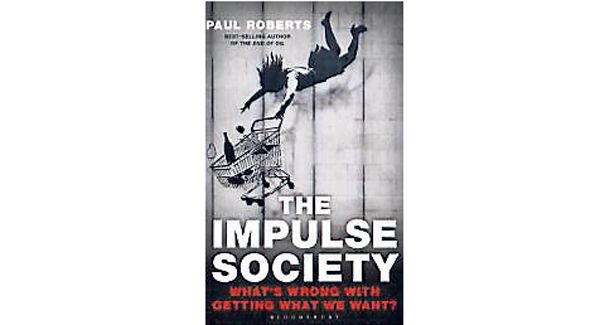
IF THE Impulse Society was a country, muses author Paul Roberts, the emblem on its flag would be a person looking down the wrong end of a telescope. The image would represent a people for whom the future is a very distant and tiny consideration compared with the irresistible lure of the immediate.
It would signify a consumer culture dedicated to having right now and paying — or perhaps defaulting — much, much later.
It would speak of a corporate mindset interested only in producing to feed whims of fad and fashion rather than innovating to meet real deficiencies in science, engineering and medicine.
It would symbolise a financial system that encourages the cynical manipulation of markets to create instant profit rather than creating something that becomes profitable because it’s actually worth buying.
Roberts has borrowed the image from the British economist, Arthur Pigou, who died in 1959, leaving us with the concept of the ‘defective telescopic faculty’. But whatever Pigou’s concerns about short-termism in economic — and by consequence social — planning, they were in the ha’penny place compared to the grief it’s causing Roberts.
Roberts is not an economist, although as a journalist in the United States for the last 30 years he has written extensively on economics and its complex interaction with politics, sociology, technology and natural resources.
His first book, The End Of Oil, published in 2004, examined the developed world’s over-reliance on oil with all the jeopardy that continues to entail, while the follow-up, The End Of Food, explored who and what really dictates what we eat and asked the ever-perplexing question of why close to a billion people suffer hunger or malnutrition. His third venture might have completed the trilogy by taking the title The End Of Civilisation because, according to one of the theories Roberts presents, the signs are that things are heading towards a nasty end.
Early man didn’t have the luxury of long-term thinking, he posits. Life was so full of immediate needs and hazards that he had to act and react now simply to survive long enough to have a future.
Gradually, however, he began to see the benefit of working collectively to a plan that extended beyond the next meal.
As Roberts puts it: “The story of civilisation is arguably the story of societies getting better and better at persuading, coercing or otherwise inducing individuals to repress their impulsiveness and myopia, or repress them sufficiently, to keep civilisation moving forward.
“And then what happened? Well, it appears we’ve gone back to the beginning, unable or unwilling to look beyond our next jam doughnut or quarterly accounts to see what damage we might be doing to ourselves and society at large.”
Roberts provides plenty of anecdotes to bring to life the inhabitants of his Impulse Society but, basically, if you’ve just given in to the urge to upgrade your smartphone because the new model has five per cent more functions than the one you bought six months ago, 95% of the functions of which you never used, then this book is about you.
Likewise, if you’re a low paid employee of the smartphone company who can’t afford to run the model you have never mind upgrade, you’ll feel in familiar territory among its pages. And if you happen to be the CEO of this hugely profitable company who’s just slashed the workforce and got rewarded with soaring share prices that inflate your personal stock options while bringing the local community to its knees then you’re going to see a lot of yourself by the time you get to the last page.
Roberts is writing amid the ruins of the global recession, in which his own country played a leading role, but he tracks the roots of the Impulse Society back long before the madness of the early noughties.
He believes Henry Ford got it largely right, delivering unprecedented personal freedom and convenience in the form of a mass-produced car in shiny black, built to last, that the workers in his own factories could afford to buy and who bought it with saved-up cash because Ford didn’t believe in consumer credit.
The problem was, his cars were too good. For copycat companies to get in on the action and get a cut of the profits in this new market, people needed to be convinced to keep buying, even if they didn’t need to.
So along came rival General Motors with a range of car colours and various gimmicks to excite the emotional side of a potential buyer, and easy credit to encourage him to purchase on impulse.
In unashamed advocacy of planned obsolescence, Alfred Sloan, GM’s top man from the 1920s to the 1950s, said: “Each year we build the best car we possibly can to satisfy the customer. And then the next year we build another to make him dissatisfied.”
Sloan was only one player in the new mass consumerism but still, Roberts argues, a grateful post-war society retained enough unity and civic mindedness to keep excesses in check. But the more liberal 1960s encouraged free-thinking which some used to pursue inner peace and others to pursue personal fortunes.
Fast forward to the 1980s and while Steve Jobs was unveiling the digital future in the form of the Apple Mac prototype, Ronald Reagan was implementing his laissez faire brand of economic policies that became known as Reaganomics.
With production automation on the rise thanks to Jobs and corporate autonomy increasing thanks to Reagan the scene was firmly being set for a drastic revision of the worker-capital relationship and the result was never going to be a good one for those on the factory floor. As Roberts writes: “Through the 1980s, hundreds of companies were taken over and reorganised or eliminated entirely. The business pages were filled with gory details of economic violence done to venerable firms and to the employees and communities who had depended on them.”
He acknowledges the shift did some good in “forcing complacent and stodgy companies to get competitive” but he argues the pursuit of efficiency, often presented as an entirely positive goal, went too far.
It’s not efficient to shop at the downtown butcher, baker and hardware store so all roads lead to the thriving hypermarket while a downtown — and all the varied jobs, skills and social interaction it fostered — dies.
It’s not efficient to spend time home-cooking — far better to take out or order in and forget about the heart disease and obesity that comes on the side.
Roberts writes specifically about the United States although Ireland does get dishonourable mention for our property bubble and crash and much of what he says applies here too.
He ponders potential solutions with some ideas on how to weaken the influence of the financial markets but mainly he’s grasping at intangibles such as bravery in politics with a focus on long term legacy, not the next election; the rebuilding of a sense of community at both local and national level, and meaningful discussion about where his country wants to go.
He is at least contributing to the latter, albeit in a meandering way as this is not the tidiest of books in terms of organising the various theories, thoughts, anecdotes and arguments.
Arguably Aesop did it much more succinctly in his fable of The Goose That Laid The Golden Eggs and certainly Roberts would not be read to the end if Impulse Society rules governed every reader who picks up his work but it’s worth taking time with, which seems to be his overall message to society at large.
The Impulse Society — What’s Wrong With Getting What We Want?
CONNECT WITH US TODAY



Be the first to know the latest news and updates

















