Staying close and comfortable with your baby in a sling
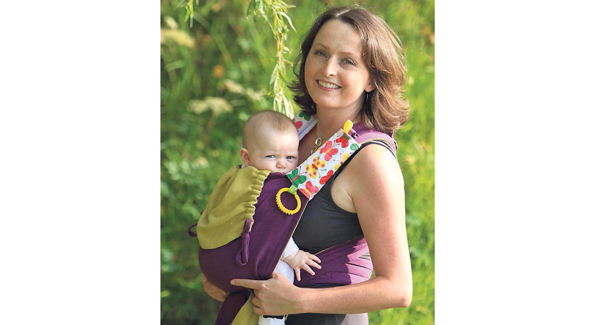
EVERY parent knows the feeling of dread when faced with trying to negotiate a stroller around the tables and chairs in a restaurant or up and down the stairs at a train station.
But while a pram is a necessary evil when it comes to transporting children, there are a few months in their young lives when they can relax, happily and snugly, next to your chest, leaving adult arms free to navigate even the tightest corner shop.
Mothers in particular have been strapping their babies to their bodies for centuries and in recent years, using a sling or papoose has become popular again with everyone from Angelina Jolie and Sarah Jessica Parker, to Jessica Alba and Gisele Bundchen choosing to keep their babies close.
On September 28, the Wear A Hug Fair in Kildare celebrates all that is positive about ‘babywearing’ and offers advice on keeping babies close while carrying out daily tasks.
Ina Doyle, a baby wearing consultant (trained with Die Trageschule babywearing school), says there are many benefits to parent and baby.
“Carrying baby in a sling meets his innate need for physical contact and allows him to observe and be part of life, in security and comfort,” she says. “It aids the development of a strong bond, supports normal physical and cognitive development and develops the baby’s sense of balance.
“A well-fitted sling also supports healthy hip development and relieves colic and constipation.”
And it allows the wearer to see to the baby’s needs quickly, helping to reduce stress levels all round.
One of the biggest advantages of babywearing is the close contact it allows between parent and infant, crucial to early development.
“By virtue of its biologic origin, the human off-spring isn’t left behind in the nest, nor does it flee the nest shortly after birth,” she says. “It is carried around by older caregivers and is hard-wired to expect this — babies are born with a multitude of reflexes, such as the spread-squad reflex and contact cry reflex, to facilitate the survival of the species.
“In fact, in the first three months an infant’s nervous system is immature and dependent on close physical contact with caregivers to regulate their heart rate, blood pressure, temperature, breathing and insulin levels.
“As humans, we take a long time learning about the world we were born into and we do this best from a secure base and with all our senses. Babywearing stimulates all of these – not just smell, sight and hearing, but also a baby’s sense of balance and touch,” says Doyle.
Although it may seem like it from the outside, babies in slings are not trapped. “They are active participants: their inner ear and muscles adjusting to the wearer’s movements, wriggling and pushing in the sling to get comfy, signalling to the wearer to move to help them release tension, making eye contact to assess situations and hiding their face when things get too much.”
However, while wearing a sling has many benefits, it can be dangerous if not used properly.
Earlier this year a 36-day-old baby boy in Britain suffocated while being carried by his mother who had taken him for a ten-minute walk. An inquest into this tragic death revealed that the infant’s position inside the sling led to asphyxiation.
Doyle says it is very important to choose the correct style and position for your child and ensure it is adjusted to fit.
“As with any piece of equipment, unsafe or improper use can be dangerous,” she says. “The main dangers are of baby slumping in the sling and their chin falling onto their chest, which could compromise baby’s airway and/or baby being covered by fabric and not visible to the wearer.
It’s important to follow certain guidelines:
n Baby should always be visible and kissable (high enough for wearer to bend forward and kiss baby’s head)
n There should be a two-finger width space between baby’s chin and chest
n Fabric should mould around baby and hug them tight to the wearer’s centre of gravity.
n Most carriers are suitable for babies up to nine months old and while some are suitable for new-borns, it is recommended that others are not used until the baby is four weeks old. If in doubt, parents should get advice from a babywearer or consultant.
Child psychologist David Carey says while wearing a baby in a sling is beneficial for parent and baby, it’s important to point out that it isn’t imperative for infants to be carried in this way to create a bond.
“Wearing a baby in a sling makes the baby feel secure, warm and comfortable and this releases the wonderful feel-good chemical in the brain called oxytocin for the baby and parent,” he says. “But we have to be careful not to create a fear that if parents don’t ‘wear’ their babies, it will interfere with bonding— because it won’t.
“Also, there is no evidence to show that it enhances bonding, as this usually happens in the first few weeks of life, at a time when babies are really too small to be carried in this way.”
* Slings and baby carriers can cost from €30 to €200.
* To find out more about the baby wearing event www.wearahugfair.eu and www.bumptobeyond.com
Clara Boland (38) lives in Kildare with her partner Brian and children Naomi (6), Nathan (22 months) and Jessica (4 months). She has used carriers for all of her three children but has just discovered one which is perfect for all her needs.
“I used a high-street carrier for my first two babies but as they got bigger my back began to ache, so I stopped,” she says.
“When I was pregnant with Jessica, I got into babywearing on a daily basis once I discovered ergonomic carriers. A friend was carrying her baby in a sling and told me about Babywearing Ireland — this is where I learned the correct position to carry the baby.
“I went to Sling Meets where I could try different slings before buying one that suited me. They were much more comfortable and I carried my son in one until I was eight months pregnant with my youngest daughter.”
Clara finds the sling so comfortable that she has been using one for her baby almost since birth. “I’ve been carrying Jessica since she was two-days-old; it’s a fantastic way to keep her close for cuddles and I have my hands free to look after the two other kids.
“It has also been invaluable for her as she has some reflux and the upright position means she’s not suffering as much as if she was lying down. So far I have only had positive experiences with babywearing.”
I’ve been carrying Jessica since she was two-days-old; it’s a fantastic way to keep her close for cuddles
CONNECT WITH US TODAY



Be the first to know the latest news and updates









