PHIL LYNOTT: The legend lives on
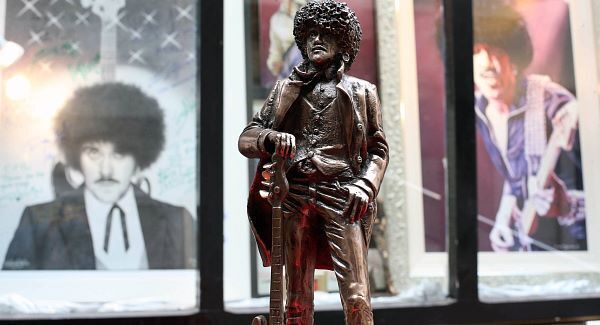
HAD he made it, Phil Lynott would be celebrating his 65th birthday today. You can imagine him marking the milestone by squeezing into his favourite leather trousers and strapping on a guitar: the Dubliner was an inveterate rocker, for whom loud raucous music was a way of life.
But, of course, he didn’t make it. Lynott passed away on January 4, 1986, after decades of drug and alcohol abuse, another music industry casualty for whom living free meant dying young. At the time, he was believed to be at a low ebb creatively: his band, Thin Lizzy, had broken up and, to put it kindly, their legacy was not aging well. People seemed in a hurry to forget — which was perhaps why Lynott’s attempts at a solo career and a new group were not going anywhere. In the heyday of the new romantic movement and hair-metal, 36-year-old Lynott was perceived as a dinosaur, especially in the super-faddy UK music scene.
But in the past 15 years, Thin Lizzy’s stock has soared. Bands as diverse as Metallica and The Cardigans have proclaimed themselves devotees, the former even had a hit with a respectful cover of ‘Whiskey In The Jar’. Lynott, meanwhile, has joined the ranks of Irish iconhood — the burnished statue of the singer off Grafton Street in Dublin confirms his membership of the club of secular Irish saints.
“He would love it — he’d be amazed,” says Lynott’s mother Philomena. “He would be delighted about the statue – and wonder ‘how the heck did I manage that?’”
At one level, Lizzy’s present popularity is merely part of rock’s incessant ebb and flow. Disparaged through the ’80s and ’90s as one-dimensional headbangers, it was to be expected their legacy would be eventually due for reassessment. However, it is also the case that, as closer attention is paid to Lynott’s writing, his gifts as lyricist and arranger have started to shine. He could growl and swivel his hips as per regulation but beneath the bravura, was a sensitive writer, with lots to say. Consider ‘Sarah’, a Valentine to his newborn daughter so delicate and raw it can be hard to listen to knowing he didn’t get the chance to watch her grow up.
“Phil Lynott was never afraid to write from the heart, even if it was a little corny,” Metallica’s James Hetfield said in 2009. “Thin Lizzy inspired a lot of Metallica’s guitar harmonies.”
For Irish people, especially, Lynott has become talismanic. Of mixed-race and proud of his heritage, he was a glimpse of a future version of the country: multicultural, confident in its Irishness.
“Phil was so proud of being Irish,” Thin Lizzy’s Scott Gorham told me last year. “No matter where he went in the world, if we were talking to a journalist and they got something wrong about Ireland, he’d give the guy a history lesson. He’d forget about the album or the show he was supposed to be promoting and just talk about Ireland. It meant a lot to him.”
The Irishness bled into the music, more soulful and melancholy than hard rock is normally permitted to be.
Though in so many ways a quintessential Dub, Lynott was actually born near Birmingham, in the UK on August 20, 1949. With his mother working in Manchester, Lynott was sent back to Crumlin, to his grandparents. As a black child in Dublin, Lynott felt different — even special, says his mother. In a way, it made him the perfect rock star.
“As a child he was used to attention. There was nothing shy about him…He loved his fame.”
Lizzy came together in 1969, as Irish music was starting to throw off the dead weight of the showband epoch. ‘Whiskey In The Jar’ was an early calling card. However, the band’s attempt to marry Celtic mythology and progressive rock proved not to have legs commercially; their high watermark of popularity came in the late ’70s, with comparatively straightforward hits such as ‘Jailbreak’ and ‘The Boys Are Back In Town’.
As their popularity grew it seemed for a spell Thin Lizzy might go where no Irish act had previously ventured by conquering the United States. Indeed Lynott was briefly heralded as Ireland’s Springsteen, a designation that confused and amused.
“There’s a guy here in LA who’s written how I’m Bruce Springsteen,” he told Creem magazine in 1976. “Now I have to spend half me interviews saying ‘I’m not… Bruce Springsteen’ and that I appreciate him but I don’t try to imitate him; I take it as a compliment when we’re compared, but I take it as an insult when it’s said I imitate him. This guy … in LA worded it in such a way that all of a sudden I’m on the defensive.”
While his excesses were well known in music circles, nonetheless Lynott’s passing came as a shock — especially to his former bandmates.
“When I heard Phil Lynott had died I could not believe it,” Gorham told me. “I mean, this was Phil Lynott. He could take more drugs, screw more chicks, stay up more days in a row than anyone else. He was the guy. He’d had hepatitis and come through with flying colours. I found out he had a heart attack and was in a really bad way. Then he died. And I was thinking… man, what the hell just happened?”
“We used to have our little chats and he would say that as he got older and the band finished he would go into producing and managing young groups,” says Philomena. “He would have continued writing as well. He wrote some great songs.”
-

CONNECT WITH US TODAY



Be the first to know the latest news and updates

















