It’s The Late Late glow with Gay Byrne
GAY BYRNE hasn’t got up on a motorcycle for two years. He sold his Honda because he didn’t have time to ride it. Space in his diary was at a premium. He doesn’t “go into” work, per say, so there was no daily spin to keep him sharp.
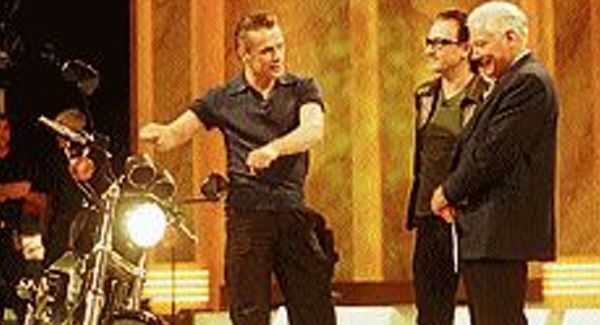
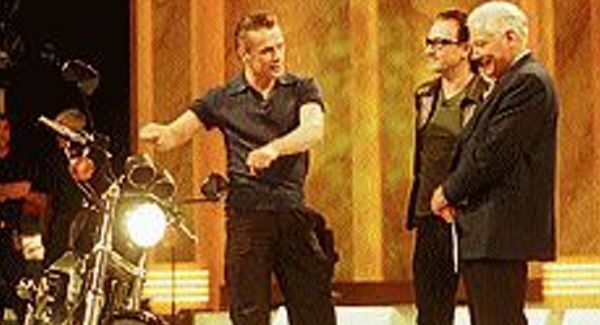
“I sold it and I intended to get another bike but I simply haven’t had the time,” he says. “I had a mind to go back to the bike the boys gave me, (that’s Bono and Larry Mullen, who presented him with a Harley Davison on his last Late Late Show in 1999), or maybe get something lower and easier but I haven’t had the time to attend to it.
“The other difficulty was that I didn’t ride it enough because I didn’t have the time and if you don’t ride regularly you don’t get good and if you don’t get good you’re a danger out there.”
There you have it. A man on the cusp of entering his ninth decade hasn’t been able to muster enough spare time to indulge a favourite hobby, which happens to be togging out in leathers and tearing around on a motorcycle.
For at least two generations of Irish people, Gay Byrne has never been young. He was “Uncle Gaybo” on the box, the man who was there when they arrived at the age of reason, and still there when they left home, retaining an instinctive pull on parents’ attentions. Others, in the foothills of adulthood, know him primarily as the face of road safety in the country, a pleasant and patient face, who was once somebody, way back in the mists of time.
Yet the most outstanding feature he currently possesses is his capacity to defy age. “How’re you for early mornings?” he inquires, when approached for an interview. “It’s getting into July and the diary is filling up.” The only slot he has is at 8am, before the day opens up into one long demand on his time.
He enters the hotel under a wide brimmed hat, swinging an umbrella, an inconspicuous figure to whom nobody would pay much attention, unless a second take sparked recognition of one of the best known faces in the country over the last 50 years.
Only now, in acknowledging a significant birthday, is he reeling in commitments. He is stepping down as chairman of the Road Safety Authority after an eight year stint, despite a request to keep going. He is also pulling back from a few other of his myriad interests. But he is most certainly not battening down the hatches as the winter years come blowing through his life. He will return in the autumn with his Time Warp music programme on Lyric FM, complete with nostalgic jazz and bracingly curmudgeon opinions. And there will be more interviews on the spiritual musings of the great and the good in The Meaning of Life. Apart from that, he’ll listen to offers, but is intent on retreating to a more discerning position when it comes to demands on his time.
In a world where most people look forward to leaving work behind, there has been much speculation that Byrne’s busy schedule might be ascribed to needs. He was very vocal at the outset of the economic crash on how he had invested in bank shares and lost big.
From a financial perspective, lightening has struck him twice. Thirty years ago, at the height of his fame, he lost most of his savings when it emerged, after the death of his financial adviser, that his money had been frittered away in fraud.
So, does he need the cash?
“No, there’s no pressure. I’m very lucky. I think I’m ok, touch wood. I’m doing various things at the moment because I want to do them. I came out of the RSA because I did my five years and they asked me to stay on another three and I did and then they asked me to stay on for two more and I said no. The way it is, you open your diary and the week is gone so I decided to make a clean break at 80.
“I just wanted a bit more time to myself. I’m very lucky that RTÉ are very indulgent with me and I’m half afraid that if I give up everything the brain will shut down and I’ll go ga-ga like everybody else and I’m trying to stave off ga-gas-ville as long as I can.”
One recent project that gave him particular satisfaction was the TV documentary on his father’s involvement in World War I. “It started with a random comment on the radio programme one Sunday afternoon that I regretted not taking more interest in the war,” he says. “We (he and his father) never spoke about it as adults. He died when I was doing my Leaving Cert. Anyway, the incredibly positive and warm reaction I got from the programme all over the country would be a recent highlight for me. So many of my generation said to me that they never knew anything about it. How could we when we were told about the GPO, a little about 1922, but that thing over there? Don’t mention that 250,000 Irishmen went off to fight the war. That’s the way things were told in this country.”
The reaction to My Father’s War closed one particular circle for Byrne. Back in 1988, following an appearance on his show by an Irish survivor of the War, Gaybo declared he was going to wear the poppy in honour of the man.
You’re wha, Gay? Those who defined their Irishness in direct proportion to a hatred of Britain, kicked up blue murder. For a public figure like Byrne to stray from the nationalist narrative was simply unacceptable. Unseen forces began whispering in powerful ears.
“What happened then would be unthinkable now,” he says. “Considerable pressure must have been brought to bear on Bob Collins, (the director general of RTÉ at the time) and the RTÉ Authority, and even the minister. The point they used was that when Gay Byrne was on the Late, Late he was representing RTÉ, and somebody representing RTÉ wearing the Poppy was blah, blah, blah. That’s the way it was. The queen coming here demolished all that, it’s gone, gone. The reaction to the documentary showed that.”
Byrne’s position in the evolution of modern Ireland is assured. Between the 1960s and 1990s, when television was still pretty much a pup, and the outside world surged in waves over the Irish coastline, Byrne was to the fore. His Late, Late Show was an institution, delivering a staple diet of entertainment and affairs that spanned both public life and personal lives. The daily Gay Byrne Show on radio allowed him scope to delve deeper and wider. Nobody in today’s world could exercise the kind of influence that he did in his time.
His elevated profile came to the fore again a few short years ago, as the country apparently thrashed around to find a suitable successor to Mary McAleese as president. After a broadcasting fashion, polls were conducted to see who might fare best in an election. In one particular radio poll, the names of ten candidates were proposed. The callers to the show came back with an eleventh.
“I was walking in Donegal when David Harvey (of 4FM) rang me. 92% of the listeners , he said, had ignored the list and came up with Gay Byrne. I considered it and dismissed it. The only momentary consideration was when Kathleen (Mrs Byrne), who grew up in a political household, raised the issue of public service. But as somebody said to me at the time, the only reason to go would be if you really, really wanted to be president and I never really did.”
He was reassured in his decision when the ensuing campaign pummelled the candidates physically and emotionally. Each one of them had to endure being confronted with every word and action that had informed their respective pasts.
“I was appalled at how it turned out,” he says. “I remember that even when my name was mentioned, there were guys on the phone saying, ‘we are going back through every Late, Late and you said that in 1968 and this in 1973’ and so on. I can’t remember what I said yesterday.”
Like most of the country, he believes that the current incumbent is doing a great job, “He (Michael D) is a perfect president, loveable and cuddly and he does it with great dignity. And Sabina is terrific.”
While public office doesn’t offer any attraction at this stage of the game, Byrne has certainly made an impact in his role as chairman of the Road Safety Authority. When he was first appointed in 2006, some who should have known better — including this writer — suggested he was the wrong choice for the job, a man out of time, a complete stranger to the young adults who are primary offenders. Not for the first time, the guy simply dismissed his critics. He took to the job with relish, and is proud that the death rate plummeted in the first five years of operation.
“The real credit must go to Noel Brett (former chief executive of the RSA) who came in and worked assiduously at the task,” Byrne says. (He likes words like ‘assiduously’, wrapping it around his tongue and presses deliberately down on the vowels for emphasis).
The success over the early years was tempered in 2013 when the graph of fatalities spiked again, rising to 190 lives lost, from 162 — each number accounting for wasted life, and ripples of bereavement. Byrne ascribed at least some of the reversal of trends to a depletion of resources in the traffic corps. He wrote to the minister for transport to complain, and his concerns were passed onto the minister for justice, Alan Shatter. That minister’s response dripped with condescension.
“Gay Byrne’s logic is completely wrong,” Shatter said at the time, going on to arrange the stats in a manner that suggested fewer cops on the beat was not the issue.
Byrne was taken aback. “I was surprised at his reaction. I was surprised he was dumb enough to believe what his civil servants were telling him.
“In fact, I’ve been proven right by (Bob) Olsen (Chief inspector of the Garda Inspectorate) and Noirin (O’Sullivan interim garda commissioner) and all that, but that’s Shatter’s style and I don’t know where it came from because many years ago he was a regular contributor to the Gay Byrne Show.
“He was an up and coming bright young solicitor at the time, we would have been well known to each other, he used to come in on a regular basis and answer queries on air about legal issues. We never got friendly, I mean solicitors tend to be pompous people anyway, but he was perfectly nice and perfectly amenable.”
Relations between the two men would deteriorate further a few months later after Byrne got a call from Brett on another issue.
“It was the October bank holiday weekend (of 2012). Noel said it was urgent and we met up in Buswell’s hotel and I was agog at the list,” he says. The list in question was a file compiled by two garda whistleblowers which showed widespread abuse of the penalty points system.
“We all knew what went on. If you knew a guard or somebody who did, and things got fixed, but what was amazing and astonishing was the extent of it, the number of people and particularly repeat offenders who were getting away with this.”
Byrne says that on the night he met Brett, the latter man predicted that Shatter would ultimately have to resign over this matter. If the account is accurately recalled, it was a prophetic statement that would have found practically zero purchase at the time.
Over the following 18 months, Byrne kept a close eye as the policing and political dramas unfolded. Along the way, he added his tuppence worth on his Lyric show, calling at one stage for Shatter to apologise to the two whistleblowers for misrepresenting them in the Dáil.
“I watched the bus approaching to the eventual crash,” he says.
The whole issue, and other related matters concerning road safety did little to reassure him about the effectiveness of the police force.
“I came to the conclusion quite some time ago that the garda force is in disarray. I had a chat with a one particular smart young cop, probably two years ago now. I said to him that the force wasn’t very well managed and he said to me it wasn’t managed at all.
“Martin Callinan was never anything to me but courteous and welcoming, but that is my impression of the gardaí. I am regularly accosted in the street by fellas in mufti saying, ‘I’m a member and everything you say is true’ and saying they didn’t want to give their name and all that.
“I think Noirin (O’Sullivan) is a good woman, a very nice woman and probably very efficient but what I see is a force in disarray and that is very dangerous.”
It’s not the cheeriest assessment, coming from somebody who had close contacts with the force during his time at the RSA, but in keeping with a rather pessimistic outlook he possesses; he sees little hope of the country emerging out from under the huge banking debt with which it was saddled.
“I’m against Europe,” he says. “I hate Europe. I hate the whole point of Europe. I believe we’re heading towards a totalitarian state of Europe. It will be long after I’m gone but there will be a totalitarian state run by bureaucrats in Brussels and we will be told what to do with our lives. Yes it is very bleak.” (Bleak is another word that gets the full heavy emphasis on, signalling once again the broadcaster’s love of language and how one should accord words their full blown worth).
His outlook might be greeted with horror in the corridors of power, but, as during an earlier phase of his life, when his opinions sailed across the airwaves on a daily basis, he is most likely striking a chord with a large slice of the population.
By the end of the interview, he is up out of the seat, grabs his hat and brolly and heads for the exit, another day, another appointment.
Annually, he and his wife and two daughters and their families head for Co Donegal at this time of year, to rest, recuperate and recharge the batteries. His birthday falls on August 5. Is he expecting a major celebration?
“My daughters have all that in hand. For the last 40 years we have almost always been in Dunloe and we’ll have some family and friends for a get-together. I’ve been given no information and I’ve asked for none and the less fuss the better.”
With that, he’s off into a damp summer’s morning. Still mad for action after all these years.
GAY Byrne was born 80 years ago, into an Ireland with a fledgling radio service and no television station. As presenter of the Late Late Show, and the Gay Byrne Radio Show, he would become the best known face and voice in Ireland. Dr Finola Doyle O’Neill, a broadcast historian at the school of history, UCC, teaches about Byrne’s role as the father confessor to a nation.
Bono, the U2 frontman, said “if you grow up in Ireland, you are never going to be as famous as Gay Byrne.”
When The Late Late Show, now the world’s longest-running talk show, was first broadcast on Friday, July 6, 1962, few could have predicted that Byrne, its first presenter and producer, would remain at its helm for 37 years.
Born on August 5, 1934, Gabriel Mary Byrne, the youngest of six children, was reared in Dublin’s South Circular Road.
Byrne was a pupil of the Christian Brothers School in Synge Street, where, according to his autobiography, pupils were beaten “for failure at lessons and simply, it seemed, on principle.” In spite of his religious education, Byrne could discuss sexual issues and taboo subjects and still be a good Catholic. Byrne also, simultaneously, presented a pioneering radio show for 26 years — The Gay Byrne Hour, later to become The Gay Byrne Show (GBS).
Unlike the television talk show, which generated huge debate on emerging issues, the radio show straddled a line between light-hearted entertainment and areas of Irish life that were raw, uncomfortable and unarticulated. The radio show, which had begun as a ‘disc and patter’ programme, evolved into a form of confessional for its almost exclusively female listeners, a ‘housewives choice’ programme for the many married women who were not allowed to work outside the home, due to legislation.
From 1962 to 1999, Byrne maintained an effortless grip on the live talk show, both on radio and on television.
He was not a missionary; he was simply a talented broadcaster who had no hesitation in pushing boundaries to make entertaining television. According to novelist, Colm Toibín, his talent ” was in knowing how fast the pulse of the country was beating and in knowing whose pulse he should be taking.”
When Byrne retired from the Gay Byrne Show, in 1998, and less than five months later departed as host of the Late Late Show, a flurry of media interest and a slew of newspaper eulogies followed. Former Dáil Deputy, Gemma Hussey, said it was ” hard to imagine any other broadcaster exercising the kind of influence that Gay Byrne did.”
The city fathers of Dublin conferred the Freedom of the City on Byrne, referring to him “as a true Dub”, someone who had a “liberating effect that was astonishing and refreshing.”
Yet, Byrne disregarded the popularity stakes, claiming, quite early in his career, that “anybody in this type of job who expected to be universally loved is little more than a fool.”
In spite of his ordinariness, Byrne became officially part of Ireland’s history in 2000, when he featured on the Leaving Certificate history syllabus.
More surprises were to come, in 2006, with his high-profile appointment as the chairman of the Road Safety Authority, followed, in 2009, by an Outstanding Achievement in Radio Award for his work on the classical music station, Lyric FM, where he continues to present a weekly jazz programme.
In 2011, Byrne’s name was touted, and later withdrawn, for candidature for the presidency of Ireland. Much critical media attention greeted this aspiration, including attacks on his much-publicised hostility to the European Union. Much of Byrne’s influence as a talkshow host was due to his willingness to probe and question the anomalies at the heart of Irish life.
Yet, he might never have become the much-needed conduit for open discussion and debate, had he been offered a job in the Guinness Brewery, in Dublin, where his father, and all of his family, had been employed.
When Byrne was turned down for a job there, he would later claim it was “a source of shame.” This rejection would become a factor in cementing his desire to succeed in broadcasting.
From an early age, he had also sensed that Catholic, nationalistic fervour was the norm in most Irish households and one particular incident reminded him of his ‘otherness’.
A school essay on his father’s experiences in the First World War incurred the wrath of a teacher, who ridiculed the young Byrne for its content.
Nevertheless, Byrne’s upbringing nurtured a sense of tolerance towards other cultures, in particular all things British, and this was to prove essential when dealing with the controversies provoked by both the radio and television shows.
Most of these controversies, in particular those on the Late Late Show, have been well-documented. Many viewers will recall the young Trinity student, Brian Trevaskis, causing outcry by referring to the Bishop of Galway as a moron; or the ‘Bishop and the Nightie’ incident, which involved a woman, a Mrs Fox, claiming she wore no nightie; and Byrne’s condescending interview with Annie Murphy, the lover of former Bishop Eamon Casey.
Who could forget an unctuous European Commissioner, Padraig Flynn, expounding on the difficulties of overseeing so many households, unaware that his host was callously, and masterfully, allowing him to self-destruct in public.
On his radio show, it was Byrne’s coverage of the death of 15-year-old Anne Lovett, who had given birth to a still-born child, next to the Grotto of Our Lady in a field in Granard, Co, Longford, which stands out most poignantly with radio listeners.
Yet, it was the discourse generated by the Gay Byrne Show, its sheer emphasis on the ordinary, which made it extraordinary. No secret was too strange to share, no request too silly to hear. The show gradually became the talking point of its day, reflecting or creating the pulse of the nation.
At 80, Byrne’s legacy is secure. Yet, it wasn’t just what Byrne talked about that made him a central figure in Irish culture for over 37 years.
It was the fact that he created a collective discourse that. He was the arbitrator, the facilitator, of all the talk that broke all those endless silences in Irish life.
Things have changed dramatically since Byrne’s golden era in broadcasting, and yet he, more than anyone else, has contributed to this change.
—
CONNECT WITH US TODAY



Be the first to know the latest news and updates

















