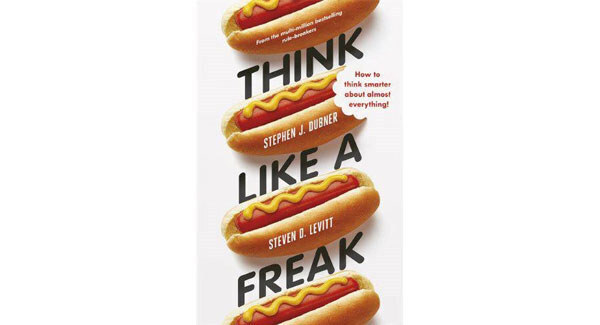
Think Like a Freak: How to Think Smarter About Almost Everything
“It’s also important, especially in the political realm, to put away temporarily your moral compass ... when you approach a real-world problem with your moral compass only, you’ll decide what’s the proper answer before you seek out possible solutions”
Steven D. Levitt and Stephen J. Dubner: “Thinking like a child is a huge, wonderful step toward productive thinking ... Thinking like a child, without fear of people ridiculing you or thinking too small is really important.
CAN you tell if a wine is transcendent or if it’s just quaffable? Don’t be worried if you can’t spot the difference. Good wines, bad wines — they’re pretty interchangeable, according to a study cited in Think Like a Freak: How to Think Smarter About Almost Everything.
Robin Goldstein, a food-and-wine critic, carried out 17 blind tastings across the USA. His investigation involved over 500 people drawn from uninitiated wine palettes to sommeliers or vintners. He got them to taste bottles of wine that ranged in price from $1.65 to $150. He found that on average his experimenters enjoyed “more expensive wines slightly less” than cheaper ones, which might make for interesting chatter when you uncork a bottle of wine at your next dinner party.
Steven D Levitt and Stephen J Dubner caused a stir when they published Freakonomics, their first economics tomb on contrarian thinking in 2005. A follow-up book, Superfreakonomics, a spin-off documentary and a podcast ensued, which established the basic ground rules of their thinking.
First, they argue, conventional wisdom is often wrong. Second, people respond to incentives.
Third, it’s important to know what to measure and how to measure it. Good numbers, they point out, help to “scrub away layers of confusion and contradiction”. Fourth, correlation doesn’t always equal to causality. Studies, for example, have told us for a long time that married people are happier than single people. Does marriage cause happiness, or is it that happy people are more likely to get married in the first place? As a researcher quoted in their book puts it, “If you’re grumpy, who the hell wants to marry you?”
The pair of thinkers have had such a deluge of queries from their fans on mysteries such as global warming, the merits of breast feeding and the pros and cons of using an iron off the tee that they’ve decided with Think Like a Freak to build on some of the ideas from previous works to create a manual for smarter problem solving. There are right and wrong ways to think about a problem, they argue.
“Don’t be afraid to say ‘I don’t know’,” says Dubner. “It sounds so ridiculous and obvious but many people — especially in public life, in media, in politics, in business — either pretend or think that they really know how to accomplish an outcome when they just don’t know.
“Thinking like a child is a huge, wonderful step toward productive thinking. There are a lot of things that children don’t do very well. We know that they’re not good drivers; you wouldn’t want a child running a nuclear power plant necessarily. But a lot of problem solving is creativity. The fact that a given problem still exists is because a lot of people have come along and failed to solve it. Inherently, you need a new solution. Thinking like a child, without fear of people ridiculing you or thinking too small is really important.
“My kids are 12 and 13 now. We tend to look at children as incomplete, imperfect versions of us adults, as if we are the perfected versions of the human species, but the way children ask questions, the way they follow their curiosity, the way they seek out fun, those are traits that I wish we could all smuggle across the border into adulthood; but even beyond those traits, what I’ve learned is that the brain, as a sort of machine, a computer, is never stronger or faster and more perceptive than between the ages of roughly 14 to 24, so it’s not a coincidence that most chess grandmasters, for instance, peak in their early 20s, why many theoretical physicists and scientists and mathematicians do their best work early.
“Now this is not to say that we adults don’t do some things much better. We have experience, wisdom. We learn how to bullshit our way around and sound very convincing when we’re not [sure], but rather than looking at adolescents and young people as adults in training, we should look at them, in some ways, as the optimal form of us. They have the brainpower, the energy and the reckless abandon to think and redefine problems and potentially produce solutions. We should look at them as allies.
“It’s also important, especially in the political realm, to put away temporarily your moral compass. We all have a moral compass — and thank God for that; no one wants to live in a world where we don’t appreciate the difference between right and wrong — but when you approach a real-world problem with your moral compass only, you’ll decide what’s the proper answer before you seek out possible solutions.”
On this vein, the book is very entertaining on the idiocy of predictions, and the battalions who make a living on our airwaves — from stock analysts and sports pundits to meteorologists — from this quackery. As Niels Bohr once said: “Prediction is very hard, especially if it’s about the future.” Dogmatism tends to be the worst trait in the punditry species. It isn’t a good mix when somebody who is poor at predictions is presumptuous.
Dubner and Levitt advocate tackling small problems if possible, which can lead to more tangible results. Education reform offers a useful example. Every year, trillions are spent by governments in tinkering with their schools, often according to fads. Class sizes might be reduced, new methods of testing or curriculum introduced, resulting in little discernible improvements. It might be more useful to look at the students themselves. Take their eyesight for instance.
One in four children have subpar eyesight and 60% of “problem learners” have trouble seeing. In Gansu, a poor, remote province in China, it was found that out of 2,500 children aged nine to 10 who needed glasses, only 59 actually wore them. With the help of a World Bank research grant, $15 pairs of glasses were given to half of these kids; the others went without.
A year later, those with the free specs had learned 25-50% more in school than the kids without.
Dubner also adds that if you want to think like a freak you have to know when to fold. “With decision making, it’s important to appreciate the upside of quitting. We are conditioned and encouraged — and some of this is a moral argument; we’re considered moral failures if we give up — and I just think that’s ludicrous. There are all kinds of reasons to fail fast, fail well and move onto the next project or job or relationship or philosophy.”
Or religion. It pays to be a Protestant. One of the interesting passages in Think Like a Freak examines research by a young German economist called Jörg Spenkuch who compared the demographics of 16th century Germany with the country today. Its religious pockets are largely the same — predominately Catholic areas remain so today, as do their Protestant counterparts. There are differences in their income levels, though.
Spenkuch found that people in Protestant areas make more coin — about 1% — than people in Catholic areas. And it has nothing to do with cronyism. Protestants don’t get better paid. They do, however, work more hours in the week and they’re more likely to be self-employed. Protestant women also are more likely to work full-time than Catholic women. It seems there is something to the contention made by the German sociologist Max Weber over a hundred years ago — that Protestants have a better work ethic than Catholics.
In defence of the workshy German Catholics, it must be noted a new study by Spenkuch reveals that German Protestants were roughly twice as likely to vote for the Nazi Party than their Catholic neighbours. Now that’s freaky.
CONNECT WITH US TODAY



Be the first to know the latest news and updates









