Family’s missing link
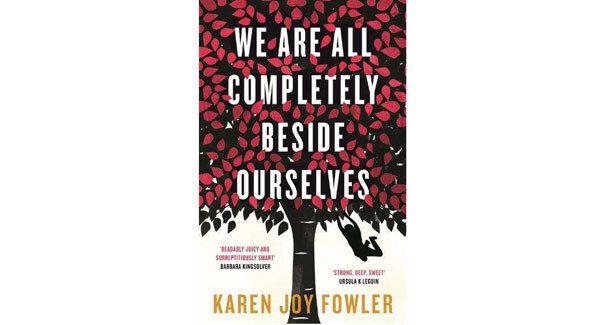
We Are All Completely Beside Ourselves

Family’s missing link

“In essence, the book’s success hangs on basic definitions of family, what it means to be human, the rights and wrongs of blame, and where memories go when they can’t quite be faced”

Karen Joy Fowler has established herself as one of the most notable talents in the field of science fiction and her best-selling breakthrough novel, The Jane Austen Book Club, was successfully adapted for the big screen in 2007.

KAREN JOY FOWLER’S sixth novel is an astonishing achievement. Giant-stepping back and forth through the life of its put-upon narrator, Rosemary Cooke, the youngest of three siblings, the reader is treated to a wild ride of tragic hilarity, but one which only ever serves to heighten its beautiful, heartbreaking core. In essence, this is a straightforward family drama, except that the Cooke clan are about as far from straightforward as it is possible to be, and their drama is light-year multiples ahead of what might at any stretch be considered normality.

The raw facts are laid out within a few sentences: “In 1996, ten years had passed since I’d last seen my brother, seventeen since my sister disappeared.” These words have the impact of a hand grenade, and it braces the reader for a certain kind of story, but all is not what it might seem. The words are essentially honest, yet are also merely a variation of the truth. That 75 more pages are allowed to pass before the situation is further (though still not wholly) clarified only hints at the skill involved on the author’s part. It’s a magic trick, of sorts, a high-wire balancing act, but the sleight-of-hand deception can be tolerated and even embraced because the narrative voice is so compelling. Rosie, an immaculately-hewn leading character, freely confesses that she has always been a talker. In adulthood she has quietened, in an attempt at self-preservation or, more specifically, self-concealment, but on paper, in telling her story, the old ebullience, the true her, is given free rein.

“When you think of three things to say,” she is told often, especially in her young life, fatherly advice that attempts to stem the flow, “pick one and only say that”. It is, for her, a futile suggestion. Talking is her way of being, and of striving to understand not only the world but also the things that defy easy or logical explanation. “Please assume,” she writes, “that I am talking continuously in all the scenes that follow until I tell you that I’m not.” And it is this, more than anything else, this vibrant, free-ranging voice ringing with the note-perfect authenticity of a psychologically brutalised but still intently hopeful soul, that explains away the occasional lapses in focus, the tangential gallops and most of all the plot deceptions, and which ensures the reader’s unwavering commitment.

We Are All Completely Beside Ourselves begins somewhere in the centre of its tangled, scattershot story, a decision again based on fatherly wisdom: “Skip the beginning. Start in the middle.” So, in nicely non-linear fashion, it’s the winter of 1996, in a University of California campus cafeteria, and Rosemary, then 22 years old, is about to be arrested in a case of mistaken identity. The couple at a nearby table explode into a row that quickly escalates into the violence of thrown food, dishes and even chairs. But when a campus policeman turns up, it is Rosie, an innocent bystander, that he targets. The woman behind the counter attempts to put him right, but then our narrator, fired by some rebellious impulse, exacerbates matters: “I threw the glass onto the floor. It broke and splashed milk over one of my shoes and up into my sock. I didn’t just let it go. I threw that glass down as hard as I could.”

It is a slapstick opening to a mess not easily cleared up. On the way to jail she makes a new friend: Harlow, the drama-queen instigator of the cafeteria row, who tends to fill voids as if it they have been cleared with her in mind and whose wild-child demeanour hooks admirers at every turn. And it is soon after this that Lowell turns up, claiming to have a lead on their long-lost sister.

From here the story begins to fall into focus and becomes something else entirely. Rosemary’s father is a psychology professor with a deep interest in studying animal behavioural patterns, and as an experiment has decided to raise his daughter virtually side-by-side with a ‘twin sister’, a chimpanzee named Fern. Living in a big farm house in Bloomington, Indiana, with her parent, Lowell and a number of graduate students, Rosemary’s first five years of life were intimately acquainted with the simian side of nature. It was a tit-for-tat childhood, each endlessly measured against the other. If Fern climbed a locker and jumped off, Rosemary could not be scolded or dissuaded from following suit, even at the cost of a broken elbow. But while Fern began to master a basic sign language, Rosemary, an intellectually advanced and naturally slightly jealous child, developed her voice and learned the art of manipulation. In child-speak, everything was simplified down to a clear black and white divide, Same and NotSame.

Then, at five, something happened to irrevocably change her life forever. Shipped off to her grandparents, abandonment seemed a natural assumption. But when her father turned up, a week or two later, it soon became apparent that it was Fern, not she, who’d been culled. They’d moved house, too, downsizing, an act that would be repeated again and again in her life, their way, perhaps, of placing less emphasis on newly empty spaces. Worse, her mother, in the midst of a breakdown, had taken to locking herself away, and Lowell, still shy of his teens, began spending as much time as possible out of the house. Fern’s absence was a black hole, a quiet horror that impacted on every thought and action, then and for all the time to come, but it was one left unspoken and unexplained.

In essence, the book’s success hangs on basic definitions of family, what it means to be human, the rights and wrongs of blame, and where memories go when they can’t quite be faced. And one overriding question dominates: What exactly happened in Rosie’s life when she was five years old? The answers, which unfold slowly, are disturbing in their revelation of facts and truth and terribly painful at times, but they are also what help elevate this from a merely funny and poignant read to something devastating and, in its way, sublime.

Next Friday Karen Joy Fowler will present a reading of her work in the Maritime Hotel in Bantry as part of this year’s West Cork Literary Festival. The event promises to be one of the unmissable highlights in a week-long programme (starting tomorrow) that also boasts such talents as 1991 Booker Prize-winning Nigerian author, Ben Okri; Irish literary legend, Jennifer Johnston; and latest publishing sensation and winner of the Bailey’s Women’s Prize, Eimear McBride.

Over the past quarter of a century, Miss Fowler has established herself as one of the most notable talents in the field of science fiction, Her best-selling breakthrough novel, The Jane Austen Book Club, was successfully adapted for the big screen in 2007. Now, with We Are All Completely Beside Ourselves, she is set at last for widespread recognition. The critical praise has been effusive, and the book has already begun to accrue such major prizes as the California Book Award for Fiction and the prestigious PEN/Faulkner Award.

For a remarkable writer, and for a genuinely stunning novel — certainly one of the year’s finest — it is success hard-earned and thoroughly deserved.

An Evening with Karen Joy Fowler at the West Cork Literary Festival on Friday, July 11 at 8.30 in the Maritime Hotel. The West Cork Literary Festival takes place in and around the town of Bantry from July 6 to 12 – www.westcorkliteraryfestival.ie or 1850 788 789

x

More in this section

Cookie Policy Privacy Policy Brand Safety FAQ Help Contact Us Terms and Conditions

© Examiner Echo Group Limited













