Vintage view: Art Deco
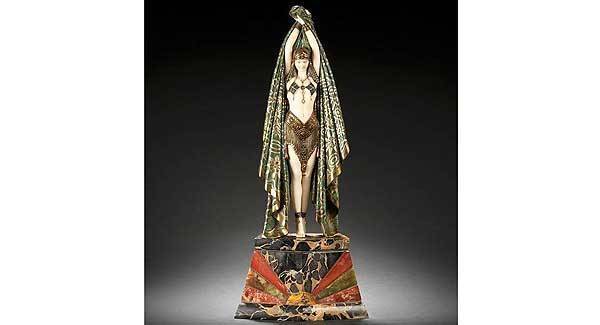
Kya deLongchamps takes a look at early 20th century statuary, particularly, daring Art Deco figures in ivory.

Vintage view: Art Deco

IMAGINE a fabulously beautiful young woman with sharply bobbed hair, spanking the Charleston out in the air with wildly outstretched arms and legs.

The horn of the gramophone rhythmically bounces from her light steps across the floor. You have to love Art Deco figures for their peek-a- boo daring. Their scandalous physical antics celebrated in spelter, fine bronze and ivory still raise a smile. The flapper girl didn’t take off the corset of her mother’s generation, she joyously flung it away.

As early as the 1870s a new figurative tradition began, and formerly respectable statues began to throw off their clothes. This might have been received as much more of a shock if the public had not been accustomed to the magnificent classical women in scantily clad Greek and Roman statues in many public spaces.

A new machine called the pantograph allowed the bronze foundries to trace and reduce in scale famous statuary for the masses. Many of these commercial ladies didn’t have a stitch. Cloaked in what was deemed as her cultural respectability, with her blank haughty stare and clamped meaty thighs, she didn’t generally offend the morals of the era.

Art Nouveau females from the late 1800s might have brought new, original characters, but they were still relatively polite, passive creatures. A pretty tableau of a girl sleeping in flowery bowers, drifts of material falling across any unmentionable areas, was typical.

By the 1920s, a new siren form gyrated across the mantles and side-tables of high society across the world. She might be striding out with a borzoi dog, a dress clinging naughtily to the breasts and hips, or dancing with hypnotic grace to the latest jazz, completely nude. The hair is short, her limbs long and athletic, the costume fit for the theatre or smoky nightclub.

Even fully dressed in stunning couture of the day, these girls have attitude and a sense of personal freedom, a toe stepping neatly across the line of acceptable behaviour. This girl doesn’t have time to stiffly support a Grecian urn or play out a chapter of Homer, she’s completely alive and very often simply lost in the moment.

Art Deco figures perfectly embodied the spirit and seismic changes of the age. The roar and frenzy of jazz music and dance, a new celebration of youth a defiance in the face of what had been suffered in WWI and a new liberty for women in their dress, politics, sexual behaviour and prospects. Even pieces produced to applaud war heroines and celebrities, such as flyer Amy Johnson, are sexually charged, delivered up as warriors — not wall flowers. The pantograph allowed for multiple productions in small and large editions of salon favourites and the public soon fell in love with the gay abandon of these self-assured lovelies.

The great names in Art Deco bronzes include Joseph Lorenzl of Vienna, whose long limbed athletes and dancers are generally presented naked. Like many figures inspired by Hollywood and the stage, the length of the arms and legs are exaggerated to reach a more seductive line.

Demetre H. Chiparus of Paris, was fascinated by the talent and glamour of the corps of dancers of the Ballet Russes in the city, and delivered costume to match the intricate detail of the theatrical characters with applied semi-precious stones and cold painted decoration.

These are widely faked in the Far East, including bone instead of the ivory limbs of the original chryselephantine, (gold and ivory), sculptures. Chiparus went on to create a wide range of pieces imagined up after the opening of Tutankhamen’s tomb by Howard Carter in 1921.

Ferdinand Preiss of Berlin, loved a bit of drama and the spread and fly of the outfits and props on his girls, adds geometry and fascination to his archers, dancers and mythic vamps. The detail in these masterpieces is jaw dropping with tiny ivory finger nails, carved belly-buttons and exquisite detailing to the face.

The work of Marcel-Andre Bouraine and Pierre Le Faguays is less well known but highly influential. Large bronze art deco figures, by the magic names of the early 20th century, while not achieving the stratospheric prices of the 1980’s, are still high ticket items. Often cast in pieces, the detail ‘chased’ with engraving, they were expensive to produce. Many were given applications of other colours, gilding and enamelling and small bronzes by lesser makers and spelter figures (a combination of lead and zinc) turn up regularly and fall into the low to high hundreds depending on subject and condition. If you’re lucky enough to find an ivory statue that you are sure is authentic, examine it closely for damage to the extremities — toes and fingers are often the first to go. Signs of age to the base are acceptable, but buy as perfect as you can manage. Fakes and reproductions abound.

More in this section

Cookie Policy Privacy Policy Brand Safety FAQ Help Contact Us Terms and Conditions

© Examiner Echo Group Limited













