Shakespeare's 450th birthday marked by Abbey production of Twelfth Night
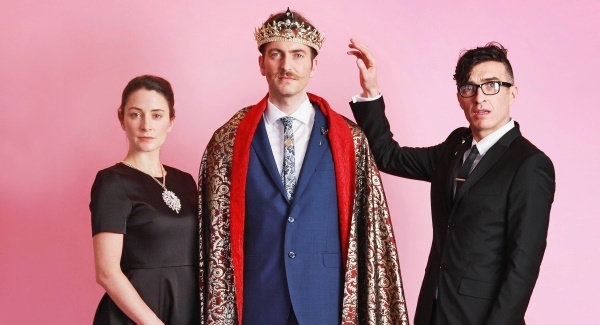
HAD he not died, at the age of 52, William Shakespeare would be an improbable 450 years old today. But he has lived on in his plays. His work remains vital, his poetic understanding of human nature as relevant today as it was in the Elizabethan era. This is true of the Abbey Theatre’s new production of Twelfth Night, Shakespeare’s most provocative comedy. Named after the festive ‘twelfth night’ of Christmas, when a brief disposition was granted for excess, disorder, and devilment, the play is a screwball wonder of mistaken identities, gender-crossing, and boozy conspiring. It has a seemingly peripheral character who is actually one of the greatest in Shakespeare’s eclectic bestiary. Though the play centres on the muddled romances of two couples, Lady Olivia and Sebastian, and Viola and Duke Orsino, it is the outcast Malvolio, Olivia’s prudish and fastidious steward, who fascinates audiences.
Malvolio is played by one of Ireland’s most admired actors, Mark O’Halloran. Malvolio is the victim of a practical joke, engineered by his arch-nemesis, Sir Toby Belch (played by Nick Dunning). Sickened by Malvolio’s censure, Sir Toby and his debauched friends cook up a scheme to make the steward believe that Olivia (Natalie Radmall-Quirke) is in love with him. It all reduces Malvolio to a silly, sordid, and sorry state.
“The part is extraordinary, in that it’s both tragic and funny at the same time,” says O’Halloran. “There’s something of the Puritan in Malvolio, and we see those Puritans alive and well today. He’s trying to put rules upon society, while shutting down an element of chaos that is going on around it. And, within himself, he has ambition. He feels that he should be rewarded for his work, but rewarded out of his class, and, at the time, that was regarded as against nature. And that’s what destroys him actually. It’s not his Puritanism that destroys him, but his ambition. And he does get rightly plucked asunder. But the method that they use — and its consequences — is far too cruel. That’s why it has such an impact with an audience.”
Director Wayne Jordan has not set the play in a specific period, but has immersed it in a vivid theatricality. “It creates its own world,” says O’Halloran. “It’s almost a Day-Glo, ‘pop’ world. It’s like the world of Pedro Almodovar’s films. And this is Almodovar territory. The crossing of genders, and all of that, still seems incredibly fresh. Orsino falls in love with a boy, who then becomes a girl. And everybody ends up with somebody either out of their class or out of their gender, or with someone they didn’t originally fall in love with.”
O’Halloran says Twelfth Night is about the need for social balance and, as such, it speaks to 21st century Ireland.
“At the start of the play, Malvolio and the Puritans are in control of the court, while Sir Toby Belch is getting drunk and he’s railing against them. Then, Toby breaks out and madness breaks out and the whole middle of the play is absolutely insane. So, balance has got to be restored. When you look at our own society, if you look at all the stuff that happened around Panti-gate, and all of that, there’s a right-wing element that wants to impose its will. Now, I have a liberal perspective on things. But I think both of those voices have to be heard, and be acknowledged within a society, for a society to have a balance. Both have to be respected. It’s never going to be about the triumph of one thing over the other, because that skews things. This play is dealing with all of that.”
O’Halloran’s first encounters with Shakespeare were in secondary school, in his home town of Ennis. “Doing The Merchant of Venice was hilarious, because we all changed it to The Merchant of Ennis,” he says. “And then, for the Leaving Cert, we did Hamlet. For the brooding teenager, there’s no better play.”
O’Halloran is also a distinguished writer in both film (Adam & Paul and Garage) and theatre (Trade, Lippy). He is developing a film adaptation of Trade, which was a hit, and expects to shoot his own script for Perdido Amor, with director Paddy Breathnach, in Cuba this autumn.
“The script is in Spanish and it’s set around the world of transgender prostitution in Havana,” he says. “There’s a very strong musical element, too. So it’s been difficult to sell — two Irish guys making a film in Spanish about that sort of world. But I think we’re nearly ready to go and I’m very proud of the script.”
O’Halloran’s writing has centred on complex and humane treatments of character.
“Having an actor’s imagination involves having empathy,” he says. “You go out onto the streets and you look at people who are in trouble, or even just having a quiet moment, and you’re able to invent a story for them. And that’s where writing came from, for me. I didn’t come at it thinking, ‘I have something to say about society’. Personally, I don’t have anything to say about anything. I know that sounds ridiculous. But I sometimes think that the writer should get out of the way more. It’s because Shakespeare writes in such an open, and generous, fashion that you can come back to the plays constantly and look at them differently.”
*

CONNECT WITH US TODAY



Be the first to know the latest news and updates

















