The Corkman who invented the Roman-Irish baths
IN the spa towns of Germany and Switzerland, patrons can indulge in the Roman-Irish nude bath. At the 19th century bathing palace in Baden-Baden for example, clients are put through a 17-stage ritual of two hours and 45 minutes. Their body is gently warmed-up, soaped, massaged and gently cooled-down, before being dried and deposited in the resting area; a blissful halfway house between Roman-Irish heaven and life. Mark Twain, who visited the baths, said: “Here at the Friedrichsbad you lose track of time within 10 minutes and track of the world within 20 ...”.
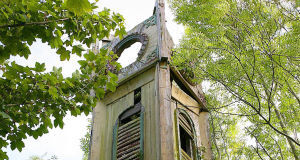
Why does our damp little island share billing with the bathing superpower that was Imperial Rome? The inventor of the Roman-Irish bath was our own Dr Richard Barter (1802-1870), of Cooldaniel, Co. Cork. The crumbling remains of his hydropathic baths at St Ann’s, near Blarney, are gradually going back to nature. On that site, in 1856, Dr Barter built the first Turkish bath in Britain or Ireland.
Dr Barter was a popular and talented physician, who observed that drinking water enabled cholera patients to sweat and eased their symptoms. He examined a trend in European alternative medicine, the water cure. Its Czech pioneer, Vincenz Priessnitz, administered cold water to confront a range of conditions. One of his techniques was the blanket wrap: a patient was tightly wrapped in blankets and given cold water to drink. The patient was unwrapped and sponged down with tepid water.

In 1842, having attended a lecture by Captain Richard Claridge, a follower of Vincent Priessnitz, one of the founders of hydopathy, Dr Barter helped blanket wrap a delicate woman. She later introduced herself to him on the street, and he was impressed by her healthy complexion. Dr Barter became a convert to the water cure and visited England to see it in action. On his return to Cork, he turned his practice at St. Ann’s over to the new medicine.
He started with vapour baths, into which the patient sat, leaving the head exposed. Barter built a vapour-filled room, where patients could be exposed to 15 degrees more heat than the box bath generated.
St Ann’s continued to treat patients in this way, until, in 1856, having read a description of Turkish baths in a book, The Pillars of Hercules, Dr Barter invited its author, David Urquhart, to come to St Ann’s and build one for him.
Turkish baths envelope the bather in steam-laden air. Forcing a muck-sweat out of his patients was central to Dr Barter’s treatment, but the air in his first Turkish bath was so moist that it restricted perspiration. It, and a second bath, were judged failures and the doctor turned his attention away from the moisture-laden Turkish bath to the dry air of the baths of ancient Rome.
As a result, nearly 1,500 years after the fall of Rome, Ireland got its first Roman bathhouse.

As in Roman times, heated air was pumped under the floor through a network of channels. The absence of water in the room meant that there was no sweat restricting steam. To offset the dangers of a piping-hot floor, another new bath was built, with the heating flues incorporated into the walls.
Dr Barter took out a patent on this novel twist to 2,000-year-old technology and the Roman-Irish bath was born.
The hydropathic baths at St Ann’s flourished, becoming the large complex of buildings still traceable on the ground today. Dr Barter embarked on lecture tours and was involved in building bath houses, for medical and recreational use, in Cork, Dublin and elsewhere.
The Dublin bath, founded in 1869, was situated in Reynold’s Hotel in Sackville Street, (now O’Connell Street). Re-launched as the Hammam Hotel, with a new bath house out the back, it continued to operate after Dr Barter’s death in 1870. In 1922, having been occupied by anti-Treaty forces, the hotel was destroyed, becoming, like our precious public records, another piece of cultural heritage pointlessly lost forever at the start of the Civil War.
If you are seeking a nude (or even nearly nude) bathing experience worthy of the last days of ancient Rome, you will have to go to Central Europe. The Roman-Irish bath is not available in its homeland. Perhaps there is space amongst the reiki and the hot stones for some entrepreneur to bring this antidote to a damp climate back to its real home.
The Friedrichsbad´s seventeen stage, 2 hour and 45 minute bathing ritual has been de-stressing people since 1877, a mere seven years after Dr Barter´s death. The architecture is described as´Renaissance style´ and the building houses the conserved remains of a genuine Roman bath house. Those of us worried by the nudity might be consoled by the notion that everyone will most likely be distracted by the architecture.
www.carasana.de/en/friedrichsbad/home/
More than thirty years ago, Leukerbad provided a welcome distraction from the storyline of a film called Bobby Deerfield, starring Al Pacino. The Roman-Irish bath has something of the stage set about it, having been designed to look like the courtyard of a Roman villa. On special nights, clients dine in Roman garb, before embarking on the eleven stage bathing process.
www.alpentherme.ch/en/roman-irish-bath.html
Situated in the foothills of the Black Forest, Badenweiler was a farming village until a health resort developed around its warm springs in the mid-nineteenth century.
The Roman-Irish bath in the Cassiopeia Therme is located near its ancestor, a genuine Roman bath house, the remains of which have been conserved and are open to the public.
www.badenweiler.de/en
Set in a converted nineteenth century brewery, the bare stone, barrel-vaulted cellars housing this bath give it an air of antiquity. The ten-stage bathing ritual might be the shy person’s choice. In Zurich, you can keep your togs on.
www.thermalbad-zuerich.ch/index.asp
Bern has no pedigree as a spa town. Westside itself, is a 1.5 million square foot Urban Entertainment Centre designed by Daniel Liebeskind and completed in 2008.
This is a different experience to the rest, with its angular windows and straight lines, but amidst the modernity, Dr Barter’s tried and trusted technique of warming you up, relaxing you and cooling you back down, lives on.
www.westside.ch/en-GB/roman_irish.aspx















